Sprint Start Reaction Test: What It Measures and How to Train With It

You see "On your marks... Set... GO!" and need to explode forward instantly. That's what sprint start reaction tests measure—your ability to respond to sequential starting signals under pressure. Unlike basic reaction time tests that measure simple stimulus-response speed, sprint start tests add anticipation, timing, and the challenge of explosive movement initiation.
These tests matter beyond competitive sprinting. Any situation requiring controlled anticipation followed by rapid action—from driving when a light turns green to responding to emergency signals—involves similar cognitive and motor demands. Understanding what these tests actually measure helps you train the right components.
What Makes Sprint Starts Different
A basic reaction time test presents a single stimulus and measures how quickly you respond. Sprint start tests introduce a preparatory sequence that fundamentally changes what's being measured.
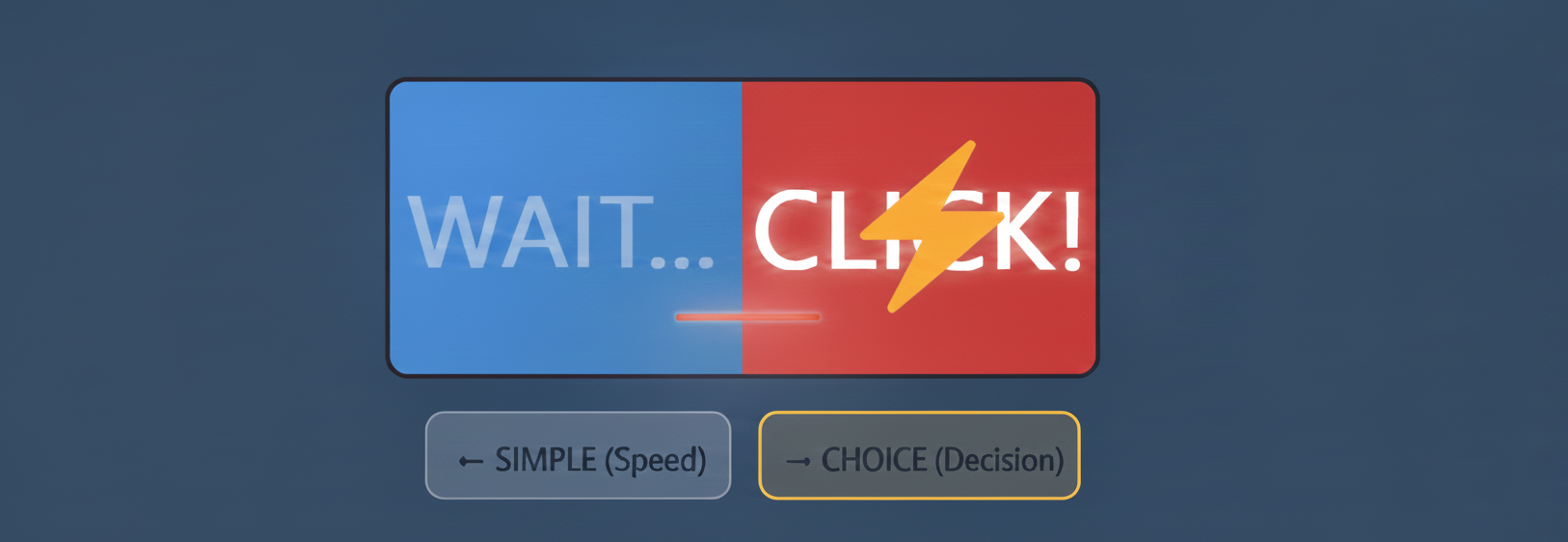
The "On your marks" signal tells you to prepare. The "Set" signal creates a state of heightened readiness where you're anticipating the final signal. The "GO" signal triggers your response. This sequence adds layers of cognitive demand that don't exist in simple reaction tests.
During the "Set" phase, you're holding a prepared motor program ready to execute while simultaneously monitoring for the go signal. This requires sustained attention and motor readiness that can't be maintained indefinitely—your muscles are tensed, your attention is focused, and you're fighting the urge to launch early.
The Anticipation Problem
Sprint starts introduce a unique challenge: the temptation to anticipate rather than react. If you can predict when the "GO" signal will come, you can launch before actually hearing or seeing it—which produces a faster time but represents anticipation, not reaction.
In competitive sprinting, false starts (leaving before the gun fires) result in disqualification. Research on elite sprinters has found that responses faster than approximately 100ms are generally considered false starts in track and field, as they likely represent anticipation rather than genuine reaction to the stimulus. However, the same research confirmed that some sprinters can achieve genuine auditory reactions as fast as 80ms, leading to ongoing debate about the validity of the 100ms threshold.
This creates a strategic tension. Launch too early and you false start. Wait to be absolutely certain the signal has occurred and you lose time. Athletes who compete at high levels develop the ability to maintain maximum readiness while staying just on the legal side of anticipation.
The Sprint Start Reaction Test simulates this sequence with randomized delays between "Set" and "GO" to prevent timing prediction. If you click before the GO signal appears (visual mode) or before the gun sound plays (audio mode), it counts as a false start and doesn't contribute to your average—just like in real competition.
The Go/No-Go False Start Test takes this further by occasionally presenting "hold" signals that require you to suppress your prepared response, mimicking the mental challenge of avoiding false starts while maintaining readiness.
What the Test Actually Trains
Motor Preparation and Explosive Response
Sprint start reaction tests train the neural pathways responsible for rapid motor initiation. When you anticipate a start signal, your premotor cortex prepares movement patterns before the stimulus arrives. The premotor cortex is involved in motor planning and the selection of appropriate movements, particularly for externally cued actions like responding to a starting signal.
The random delay between the set position and the go signal prevents anticipatory timing, forcing genuine reactive responses.
Inhibitory Control and False Start Prevention
Waiting through the set phase without reacting prematurely exercises your prefrontal cortex's inhibitory functions. This go/no-go aspect of sprint starting requires suppressing the urge to move while maintaining peak readiness.
Research on inhibitory control suggests that the prefrontal cortex plays a key role in response inhibition, with the inferior frontal gyrus modulating connectivity between the premotor areas and subcortical structures to facilitate motor suppression. Regular practice with tasks requiring this balance between excitation and inhibition in motor circuits tends to reduce impulsive responses while preserving reaction speed.
Auditory Processing Speed
The Sprint Start Reaction Test offers both visual and audio modes. The audio mode specifically targets the auditory cortex and its connections to motor areas. Studies comparing sensory modalities have found that auditory reaction times are typically faster than visual ones, possibly because the auditory pathway to motor regions may be more direct.
The test simulates a realistic gun sound using synthesized noise with an exponential decay envelope, similar to actual starting pistols used in track and field.
Who Can Benefit from Sprint Start Training
Track and Field Athletes
Sprinters, hurdlers, and relay runners can use this test to practice start reactions without physical fatigue. In competitive sprinting, the difference between winning and losing often comes down to hundredths of a second at the start. This tool allows athletes to accumulate hundreds of mental repetitions, potentially building the neural efficiency that could translate to faster block clearance on race day.
Team Sport Players
Football linemen, basketball players, soccer goalkeepers, and tennis players all require explosive first-step reactions. These athletes must respond to whistles, visual cues, or opponent movements with immediate acceleration. The combination of inhibitory control and rapid response trained here could apply to game situations where premature movement results in penalties or positional disadvantage.
Esports Competitors and Gamers
Competitive gamers may benefit from faster auditory and visual reaction time when responding to in-game events. The inhibitory control aspect could help prevent misclicks and premature ability usage. This approach complements mechanical practice by targeting the underlying neural speed that may determine reaction ceiling. For more on gaming-specific training, see our articles on aim training basics and click speed versus accuracy.
Older Adults Maintaining Cognitive Sharpness
Reaction time naturally slows with age, but targeted practice appears to preserve and potentially improve response speed. The combination of anticipation, inhibition, and rapid response in this test engages multiple cognitive systems simultaneously, providing what some consider efficient cognitive training for maintaining mental agility. Research on aging and reaction time suggests that consistent practice can help slow age-related decline.
Anyone Working on Impulse Control
The false start penalty mechanism makes this test potentially valuable for individuals working on impulsivity. Learning to stay poised under pressure while maintaining readiness could build transferable self-regulation skills applicable to various situations.
Real-World Applications
Driving and Traffic Response
Reacting to sudden brake lights, traffic signals, or pedestrians stepping into the road requires similar explosive response patterns. The ability to maintain alertness without overreacting to false alarms mirrors the inhibitory control practiced in this test. Faster genuine reactions combined with fewer false responses could contribute to safer driving. For more on reaction time and driving safety, see why reaction time matters for defensive driving.
Workplace Responsiveness
Many jobs require rapid response to alarms, signals, or sudden requests. Emergency responders, factory workers monitoring equipment, and security personnel all benefit from trained reaction speed. The audio mode particularly applies to environments where auditory alerts demand immediate action.
Physical Activities and Injury Prevention
Quick reactions help prevent falls and injuries during daily activities. Catching yourself when you trip, avoiding dropped objects, or responding to unexpected obstacles all rely on rapid motor initiation similar to what this test develops. Consistent training may help maintain the neural readiness that keeps you safe during physical activities.
How to Train Effectively
Start with Visual Mode
If you're new to reaction training, begin with visual signals to establish baseline performance. The test displays "On Your Marks" in orange, "Set" in yellow, and "GO" in bright green. Once you achieve consistent times with low variability, switch to audio mode for more sport-authentic training that simulates actual starting guns.
Focus on Consistency Over Speed
Athletes who compete at high levels often prioritize low variability in their start times. A consistent 180ms average is generally more valuable than occasional 140ms reactions mixed with 250ms outliers. The test tracks your standard deviation (labeled as "Variability")—monitor this metric and aim to reduce it over sessions.
Lower variability indicates more reliable performance under pressure, which matters more in competition than a single fast time that you can't reproduce consistently.
Practice in Short, Focused Sessions
Reaction time tends to degrade with mental fatigue. Ten focused trials often produce better training adaptation than fifty unfocused ones. The test offers options for 5, 10, 15, or 20 trials per session—many trainers suggest starting with 10 trials and taking breaks between sessions.
Train when mentally fresh for what appears to be optimal improvement.
Adjust Delay Settings
The test offers four delay settings between "Set" and "GO": short (1-2 seconds), medium (1.5-3 seconds), long (2-4 seconds), and variable (1-4 seconds). Start with medium delays to get comfortable with the sequence, then switch to variable delays to prevent timing prediction and force genuine reactive responses.
Use Audio Mode for Sport-Specific Training
If you're training for actual sprint competitions or sports with whistle signals, use the audio mode. Make sure to test your audio first using the "Test Sound" button—the test won't let you start in audio mode until you've confirmed your sound is working. Adjust the volume slider to a comfortable level where you can clearly hear the gun sound without it being too loud.
Track Your Progress
The test saves your last 10 sessions in browser storage, showing your average time, best time, number of trials, and false starts for each session. Review this history to identify trends. Are your times improving? Is your variability decreasing? Are you getting fewer false starts as you develop better inhibitory control?
If you're not seeing improvement after 2-3 weeks of daily practice, you may have reached your current ceiling. At that point, consider whether factors like sleep quality or caffeine timing might be limiting your performance.
Understanding Your Results
After completing a session, the test displays four key metrics: Best Time (your fastest valid reaction), Average (mean of all valid reactions), Variability (standard deviation—lower is more consistent), and False Starts (times you jumped the gun).
The rating scale provides context: Elite is under 150ms, Excellent is 150-200ms, Good is 200-250ms, and Average is above 250ms. These benchmarks are based on observed performance across different populations, with elite sprinters typically reacting in the 120-160ms range.
If you're getting many false starts, you're likely anticipating too aggressively. If your variability is high (above 40-50ms), you're probably not maintaining consistent readiness across trials. If your average is above 300ms, you may benefit from starting with the simpler reaction time test to build your baseline speed before adding the complexity of the sprint start sequence.
Common Questions
What's a realistic improvement timeline?
Improvement timelines vary by individual and starting baseline. Some people report noticeable gains within the first few weeks of daily practice, while others may take longer to see changes.
How does this compare to other reaction time tests?
Sprint start tests typically produce slower times than simple reaction tests because the sequential "On Your Marks → Set → GO" format adds cognitive load. The need to maintain readiness during the "Set" phase while avoiding false starts makes this more complex than a basic stimulus-response test. For understanding these differences, see our guide on reaction time tests explained.
Should I use visual or audio mode?
Audio mode is more sport-authentic if you're training for competitions with starting guns or whistle signals. Visual mode is easier to start with and doesn't require audio setup. Some athletes train with both modes to develop responses to different sensory modalities.
Why do my times vary so much between trials?
Reaction time naturally varies based on attention fluctuations, anticipation level, and random neural noise. Variability of 30-50ms between trials is normal. If your variability is consistently above 60-70ms, you may not be maintaining consistent focus across trials. See what's a good reaction time by age for more context on normal variation.
Final Thoughts
Sprint start reaction tests measure something different from basic reaction time—they measure your ability to balance anticipation with control, maintain explosive readiness, and respond instantly when the signal finally arrives. This combination of skills applies beyond track and field to any situation requiring controlled anticipation followed by rapid action.
Whether you're training for competition, working on impulse control, or simply want to maintain sharp reactions, the Sprint Start Reaction Test provides a focused way to practice these skills. Start with short sessions, track your progress, and aim for consistency over speed.