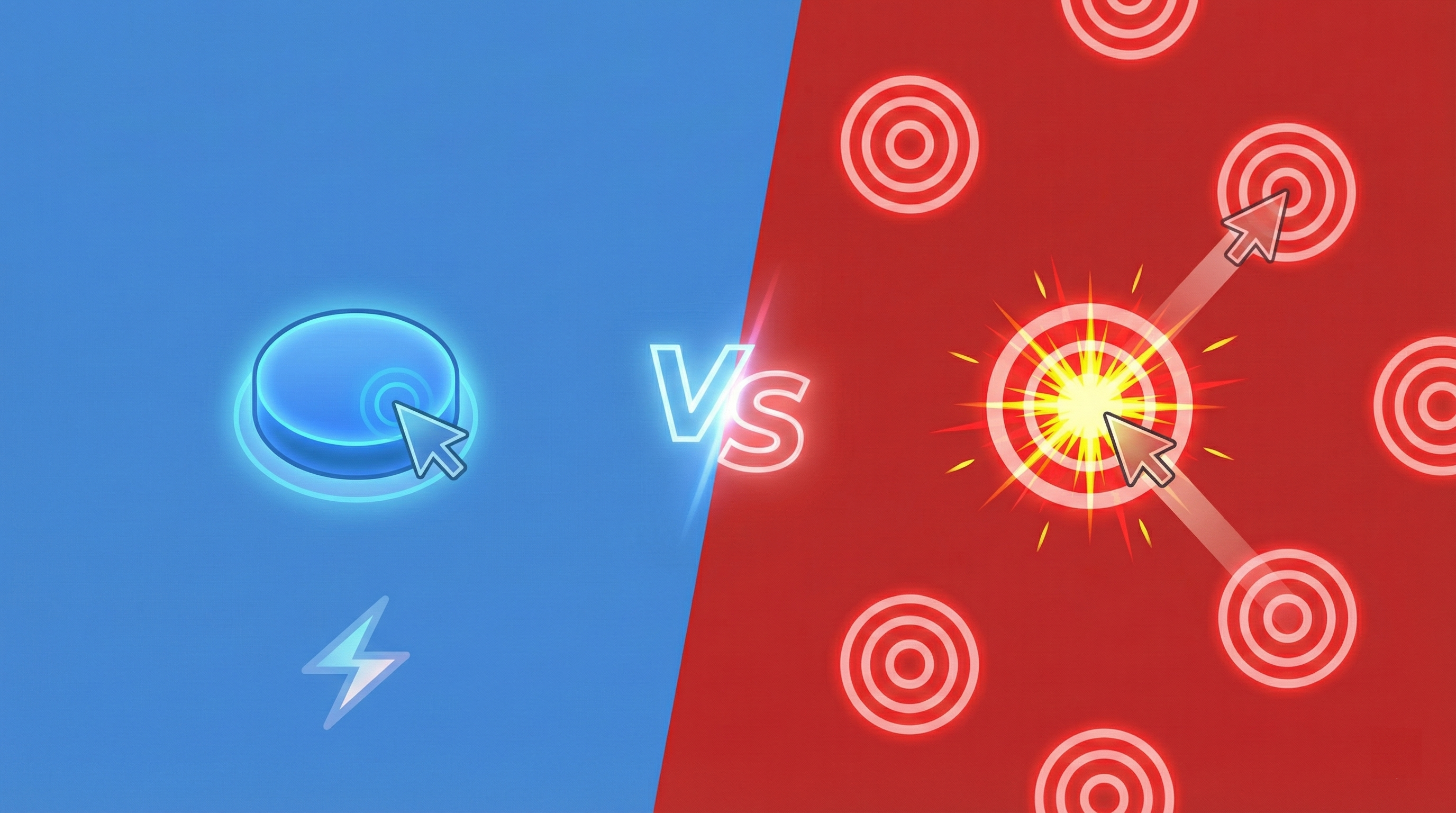
Click Speed vs Accuracy: Which Should You Prioritize in Aim Training?
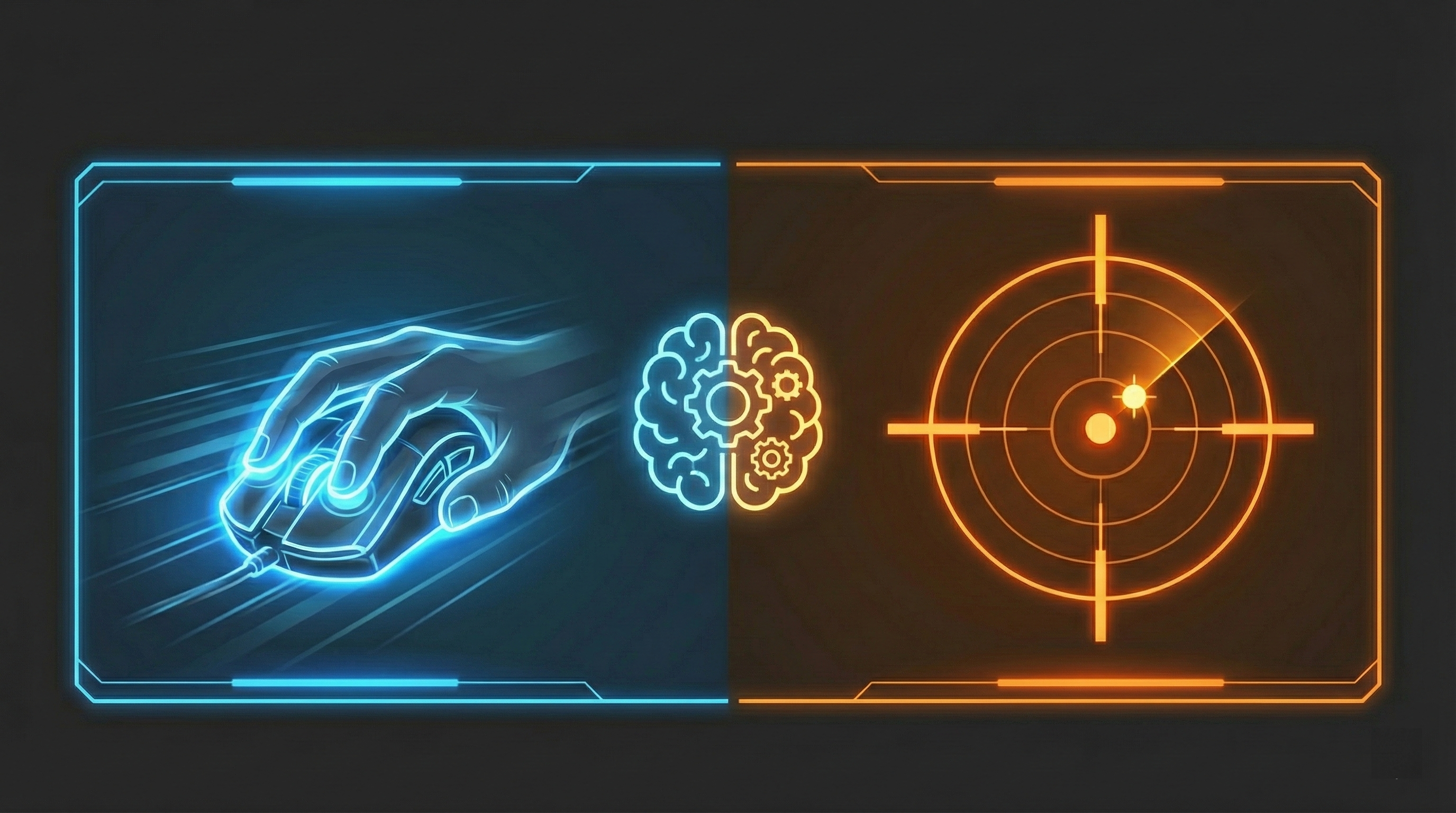
You're working on your aim. Should you focus on clicking faster, or hitting your targets more precisely? Most players instinctively chase speed, pushing their clicks per second higher and higher. But speed without accuracy often means missing more shots—and in most games, a fast miss loses to a slow hit.
The answer isn't "always prioritize one over the other." The right priority depends on your game, your current skill level, and what's actually limiting your performance. Understanding when to train speed and when to train accuracy helps you improve the skills that matter most for your specific situation.
What Speed and Accuracy Actually Measure
Click speed is straightforward: how many times you can click your mouse in a given timeframe, usually measured in clicks per second (CPS). A click speed test isolates pure clicking ability—no aiming required, just repeated button presses as fast as possible.
Accuracy in aim training refers to how often you successfully hit targets. An aim test measures this by tracking what percentage of your clicks land on targets versus empty space or incorrect targets. High accuracy means most of your shots connect; low accuracy means you're clicking frequently but missing often.
The tradeoff between these two exists because of how your brain processes motor control. When you prioritize maximum speed, you reduce the time available for your visual system to confirm target position and your motor system to make fine adjustments. When you prioritize accuracy, you slow down to allow more time for precise positioning—but this reduces your effective fire rate.
Neither speed nor accuracy alone determines performance. What matters is the combination: hits per unit time. As a simple example, a player with 8 CPS and 60% accuracy lands 4.8 hits per second, while a player with 6 CPS and 90% accuracy lands 5.4 hits per second. In this scenario, the slower but more accurate player wins.
When Speed Matters More
Speed becomes the priority when your accuracy is already high enough that faster clicking directly translates to more successful hits.
In Minecraft PvP, click speed plays a particularly important role in combat. Faster clicking can generate more hits and knockback, potentially overwhelming opponents before they respond effectively. Players who maintain high click speeds with reasonable accuracy often perform well because the game mechanics tend to reward rapid hits.
For tracking-heavy games where you're following a moving target continuously, click speed matters less than tracking accuracy, but having adequate speed ensures you're capitalizing on every moment your crosshair is on target. If you can track accurately but click too slowly, you're wasting opportunities.
Speed training makes sense when you can already hit static or slow-moving targets consistently. If you're landing most of your shots on an aim test with medium-sized targets, your accuracy foundation is solid enough that increasing your click speed will directly improve your performance.
Notice what's actually limiting you: if you find yourself thinking "I knew where to shoot, but I couldn't click fast enough," the problem is execution speed rather than target acquisition or tracking. That's when speed training helps.
When Accuracy Matters More
Accuracy becomes the priority when you're missing shots frequently enough that increased speed just means more misses.
In tactical shooters like Valorant, CS:GO, or Rainbow Six Siege, accuracy heavily outweighs speed. These games emphasize headshots, positioning, and making your limited shots count. A player who takes an extra moment to line up a headshot typically outperforms someone who clicks faster but aims at center mass or misses entirely.
For flick-heavy gameplay where you're rapidly acquiring new targets, accuracy determines whether your fast movements result in hits or wasted actions. Players who flick quickly but inaccurately end up with poor performance despite impressive-looking mouse movements.
If you're missing targets frequently on basic aim training tests, speed training will likely make your performance worse, not better. You'll click faster, but you'll also miss more, and the net result is fewer successful hits despite higher CPS.
Training tools like the Multi-Target Aim Trainer help develop accuracy under pressure by forcing you to distinguish correct targets from distractors. This selective accuracy—hitting the right targets while avoiding the wrong ones—matters more than pure speed in most competitive scenarios.
Watch how you perform when the pressure is on: if you're clicking plenty fast but consistently missing shots you feel you "should have" hit, your issue is likely target acquisition or precise positioning rather than execution speed. That's when accuracy training helps most.
The Speed-Accuracy Tradeoff in Practice
Most players operate somewhere in the middle of the speed-accuracy spectrum, and the optimal balance shifts based on the situation.
In practice, players tend to adjust their speed-accuracy tradeoff based on task demands. When consequences for errors are high (headshots in tactical shooters), they slow down to improve precision. When consequences are low but frequency matters (body shots in fast-paced games), they speed up and accept more errors.
Your training should reflect this. If your game punishes misses heavily—limited ammo, long time-to-kill, headshot-focused gameplay—train at the accuracy level your game demands, even if it means accepting slower click speeds. If your game rewards high fire rates and forgives misses—generous ammo, fast respawns, forgiving hitboxes—train to maintain acceptable accuracy at higher speeds.
One practical approach: establish your accuracy baseline at a comfortable speed, then gradually increase speed while monitoring how much accuracy drops. If you can increase speed noticeably while accuracy only drops slightly, that's usually a net win. If increasing speed costs you substantially more accuracy, you're trading poorly.
How to Train Each Component
Speed training isolates the clicking motion itself. Pure click speed tests where you're trying to maximize CPS without worrying about cursor position build the raw motor speed. Practice this in short bursts—30 seconds to 1 minute—and focus on relaxed, consistent clicking rather than tensing up.
Accuracy training should happen at a speed where you can be deliberate. Start with larger targets and prioritize very high accuracy before increasing difficulty. Once you can maintain high accuracy consistently, you can either make targets smaller, add movement, or introduce distractors to increase challenge.
For combined speed-accuracy training, set a minimum accuracy threshold that matches your game's demands and try to click as fast as possible while staying above that threshold. This teaches you to operate at your actual speed-accuracy frontier rather than training the extremes in isolation.
The Multi-Target Aim Trainer works well for this because it forces both speed (targets disappear after a time limit) and accuracy (you must hit correct targets while avoiding distractors). This more closely mirrors real gaming scenarios than pure speed or pure accuracy tests.
Common Mistakes to Avoid
Training speed before you have adequate accuracy is the most common error. Players see professional gamers with high CPS and assume that's what they need to develop first. But most high-level players appear to have built strong accuracy foundations before increasing speed while maintaining it. Trying to build speed on a weak accuracy foundation just ingrains bad habits.
The opposite mistake—over-prioritizing accuracy to the point of being too slow—happens less often but still hurts performance. If you're so focused on perfect accuracy that you're taking twice as long as necessary to line up shots, you're probably giving up more value in missed opportunities than you're gaining in precision.
Training only in favorable conditions creates a false sense of progress. If you only practice on large, stationary targets with no time pressure, you'll develop a speed-accuracy balance that doesn't transfer to actual games where targets are smaller, moving, and shooting back.
Inconsistent training makes it hard to identify what's actually holding you back. If you alternate randomly between pure speed tests and pure accuracy tests without any systematic approach, you won't build the integrated speed-accuracy skill that matters in real gameplay.
Matching Your Training to Your Game
Different games demand different balances, and your training should reflect what actually matters in your main game.
For Minecraft PvP: Speed matters more than in most games, but you still need baseline accuracy. Aim to maintain reasonable hit rates at high clicking speeds. Pure click speed practice helps, but make sure to also practice clicking while moving and tracking.
For tactical shooters (Valorant, CS:GO): Accuracy is paramount. Train to maintain very high accuracy on headshot-height targets, even if it means accepting slower click speeds. The difference between hitting and missing in these games is usually more valuable than clicking faster.
For battle royale games (Fortnite, Apex): You need both, with emphasis shifting based on the weapon and range. Shotgun flicks reward accuracy heavily; SMG tracking rewards maintaining decent accuracy at higher speeds. Train both scenarios separately.
For MOBAs (League of Legends, Dota 2): Pure click speed matters less than clicking the correct target quickly. The Multi-Target Aim Trainer's filtering mechanics (clicking specific colors or shapes while ignoring distractors) more closely matches the skill of selecting the right champion in a teamfight than raw clicking speed does.
Measuring Your Progress
Track both metrics separately and together. Record your raw click speed, your pure accuracy on aim tests, and your effective hit rate (accuracy × speed) over time. Improvement in any one metric might not matter if the others decline enough to offset it.
Pay attention to which improves faster. If you're naturally gaining speed but accuracy is stagnant, shift training focus to accuracy. If accuracy is already high but speed isn't improving, dedicate more time to pure clicking practice.
Test under different conditions. Your performance on a relaxed, untimed accuracy test might be very different from your performance under time pressure with multiple targets. The latter more closely reflects actual gaming scenarios, so weight those results more heavily when deciding training priorities.
Compare your training performance to your in-game performance. If your aim test accuracy is significantly higher than your in-game hit rate, something isn't transferring. This often means you need to train under conditions that better simulate real gameplay—moving targets, time pressure, or decision-making components.
The Bottom Line
Neither speed nor accuracy alone determines aim performance—what matters is the product of both. A slow but accurate player and a fast but inaccurate player can both lose to someone with balanced development.
For most players at most skill levels, accuracy is the better starting point. Build a foundation of consistently hitting targets at a comfortable speed, then gradually increase speed while monitoring accuracy. This approach builds good habits and creates sustainable improvement.
Speed becomes the priority only after you've established solid accuracy—generally high consistency on training tests that match your game's difficulty. Before that point, speed training often creates more problems than it solves.
Your training should match your game's demands. Tactical shooters reward accuracy over speed; fast-paced combat games often reward speed over accuracy. Know which your game values, and train accordingly.