Reaction Time Tests Explained: What They Measure and How They Work
Reaction time means different things to different people. So how do "reaction time tests" actually work? If you've tried one before, you know the format: you click a button when a screen changes color, a number appears, and you get a score in milliseconds. But what exactly is a reaction time test measuring? And what do those numbers actually tell you about your brain and body?
Understanding what reaction time tests measure — and what they don't — helps you use them more effectively, whether you're tracking your baseline, training for improvement, or just curious about how your nervous system performs.
What Reaction Time Actually Is
Reaction time is the interval between a stimulus appearing and your response to it. When you take a reaction time test, you're measuring how long it takes for a signal to travel from your eyes to your brain, get processed, trigger a decision, travel down to your motor cortex, and finally activate the muscles in your finger to click.
This entire chain happens remarkably fast. A large-scale study of 1,469 participants found that mean simple reaction time to visual stimuli was around 231 milliseconds — roughly a quarter of a second. That's the time for light to hit your retina, get converted to neural signals, travel through multiple brain regions, and produce a physical response.
Reaction time isn't a single thing you can point to in the brain. It's the combined output of multiple systems working together: visual processing, attention, decision-making, and motor execution. A reaction time test gives you a single number that represents all of these working in sequence.
The Three Main Types of Reaction Time Tests
Not all reaction time tests measure the same thing. Research distinguishes three main types, each adding cognitive complexity:
Simple Reaction Time — One stimulus, one response. The screen changes color, you click. This is what a basic simple reaction time test measures. You know exactly what's coming and exactly what to do; the only variable is when. This gives you the purest measure of your stimulus-response speed without any decision-making overhead.
Recognition Reaction Time (Go/No-Go) — Multiple stimuli, but you only respond to one. For example, click when you see green, but don't click when you see red. This adds a discrimination step: you must identify whether the current stimulus requires a response. The Go/No-Go Test measures this, and it's useful for assessing impulse control alongside speed.
Choice Reaction Time — Multiple stimuli, each requiring a different response. See a left arrow, press the left key. See a right arrow, press the right key. The Choice Reaction Test measures this. It adds decision-making: you must identify the stimulus and select the correct response from multiple options.
Each type takes progressively longer because each adds processing steps. Your simple reaction time might be 220ms, your go/no-go time 300ms, and your choice reaction time 400ms — the differences reveal how long those additional cognitive operations take.
What Your Score Actually Tells You
A single reaction time measurement tells you very little. Reaction times vary from trial to trial based on attention, fatigue, and random neural noise. That's why proper tests run multiple trials and report statistics like mean, median, and standard deviation.
Mean (average) gives you a general picture but can be skewed by outliers — one distracted trial where you took 500ms pulls the average up significantly.
Median (middle value) is more robust to outliers and often gives a better sense of your typical performance.
Standard deviation tells you how consistent you are. Two people might both average 230ms, but one might range from 210-250ms while the other ranges from 180-350ms. The second person is much less consistent, which matters in real-world situations.
Your test results are also affected by the testing conditions themselves. Research shows that computer hardware and software can add timing delays of up to 100ms, which is why comparing scores across different devices or websites isn't always meaningful.
Factors That Affect Your Score
Your reaction time isn't fixed. Multiple factors influence it, some you can control and some you can't:
Age. Research shows reaction time increases with age at roughly 0.5ms per year after early adulthood. This decline is real but gradual — a 60-year-old might be 20-30ms slower than their 20-year-old self, not dramatically impaired.
Alertness and fatigue. Sleep deprivation significantly slows reaction time. One study found reaction time increased by over 80ms after acute sleep deprivation. This is why reaction tests are used to assess fatigue in high-stakes contexts like aviation and medicine.
Substances. Caffeine can modestly improve reaction time, while alcohol impairs it. Many medications also affect reaction speed, which is why drowsiness warnings matter.
Attention and expectation. If you know roughly when the stimulus will appear, you'll react faster than if it's completely unpredictable. Good reaction time tests randomize the delay to prevent anticipation.
Practice. Reaction time is trainable. Regular practice on reaction tasks produces measurable improvements, though gains require consistent effort to maintain.
Testing vs Training: How to Use Reaction Time Tests
A common misconception is that reaction time tests are only for one-time measurement. In reality, they serve two distinct purposes:
Testing means establishing a baseline or tracking changes over time. If you want to know your current reaction speed, or see how factors like sleep or caffeine affect you, you're using the test as a measurement tool. For this, you want controlled conditions: same time of day, same device, same level of alertness.
Training means using repeated practice to improve. Research confirms that reaction time improves with practice. The test becomes a training tool — each session is an opportunity to challenge your nervous system and gradually get faster. For training, consistency matters more than perfect conditions.
The test works for both purposes. Test yourself once to get a baseline, then practice regularly if improvement is your goal.
When Simple Tests Aren't Enough
A simple reaction time test measures pure stimulus-response speed. But many real-world situations involve more than just reacting quickly — they require reacting quickly to the right thing, in the right way.
If your goal involves decision-making under pressure, the Choice Reaction Test adds that complexity. You're not just fast; you're fast and accurate when choices are involved.
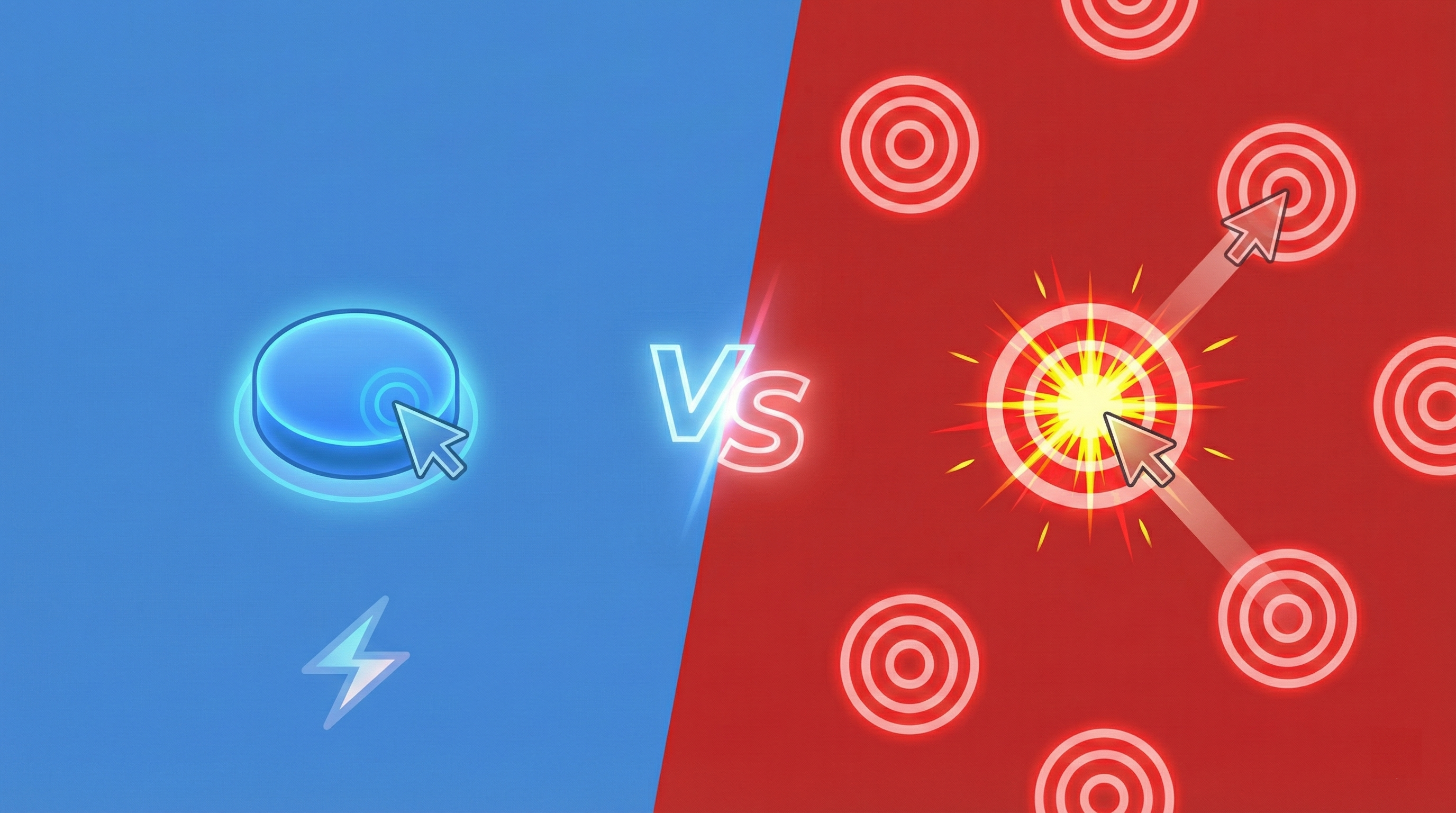
If your goal involves precision and motor control — gaming, sports, music — an Aim Test measures reaction speed plus the accuracy of your hand-eye coordination. The distinction matters: someone with a 200ms simple reaction time might take 400ms on an aim test because aiming adds motor precision demands.
If your goal involves filtering distractions, the Multi-Target Aim Trainer presents multiple objects where you must click only the correct ones. This trains selective attention alongside speed.
The simple reaction time test remains valuable as a baseline and for isolating pure reaction speed. But matching your training tool to your actual goal produces better transfer to real-world performance.
How to Get Accurate Results
If you want meaningful data from your test, follow these guidelines:
Run enough trials. A single measurement is almost meaningless due to trial-to-trial variability. At minimum, do 5-10 trials. More is better for establishing a reliable baseline.
Eliminate distractions. Reaction time tests are highly sensitive to attention. Close other tabs, silence notifications, and focus fully on the test.
Use consistent conditions. If you're tracking changes over time, test at the same time of day, on the same device, under similar conditions. Otherwise you're measuring environmental differences, not actual changes in your reaction speed.
Don't anticipate. Good reaction time tests randomize the delay before the stimulus appears. If you find yourself trying to predict when it will happen, you're testing anticipation, not reaction. Some tests penalize early clicks (false starts) for this reason.
Understand the limitations. Browser-based tests aren't as precise as laboratory equipment, but they're accurate enough to track your general performance and improvement over time. Don't obsess over single-millisecond differences.
What "Good" Reaction Time Looks Like
There's no universal standard for "good" reaction time because it depends heavily on the test type, equipment, and population. Research on large community samples found mean simple reaction times around 230ms, with younger adults faster than older adults.
Based on that research and general testing experience, here's a rough rule of thumb for interpreting your scores. These aren't clinical thresholds — just informal benchmarks that depend heavily on your device, browser, and testing conditions:
Under 200ms — Faster than most people. Suggests you were focused and your setup has minimal input lag.
200-250ms — Typical range. This is where the majority of healthy adults land on browser-based tests.
250-300ms — Slower than typical, but still normal. Could be your device, could be fatigue or distraction, could just be normal variation.
Over 300ms — Slower than expected for most adults. Often this reflects testing conditions (old monitor, wireless mouse, background distractions) rather than anything about you personally.
Remember: these numbers apply to simple reaction time tests with visual stimuli. Auditory reaction time is typically faster than visual. Choice reaction time is slower than simple because of the added decision-making step. And individual variation is enormous — comparing yourself to yesterday's results is more useful than comparing to strangers on the internet.
The Bottom Line
A simple reaction time test measures how quickly your entire nervous system can detect a stimulus and produce a response. It's a simple concept, but the number you get reflects the combined efficiency of your visual processing, attention, decision-making, and motor execution.
Different test types measure different things: simple tests measure pure speed, go/no-go tests add impulse control, choice tests add decision-making, and aim tests add motor precision. Matching the test to your goal gives you more useful data.
Whether you're establishing a baseline, tracking how lifestyle factors affect your performance, or training for improvement, understanding what these tests measure helps you interpret your results and use them effectively.