Aim Training Basics: What It Actually Improves (And What It Doesn't)
You've probably seen the claims: use an aim trainer for 20 minutes a day and watch your kill-death ratio climb. But does aim training actually work? And if it does, what exactly does it improve?
The answer matters because time spent in an aim trainer is time not spent playing your actual game. If you're going to invest in dedicated practice, you should know what you're getting—and what you're not.
What Aim Training Actually Is
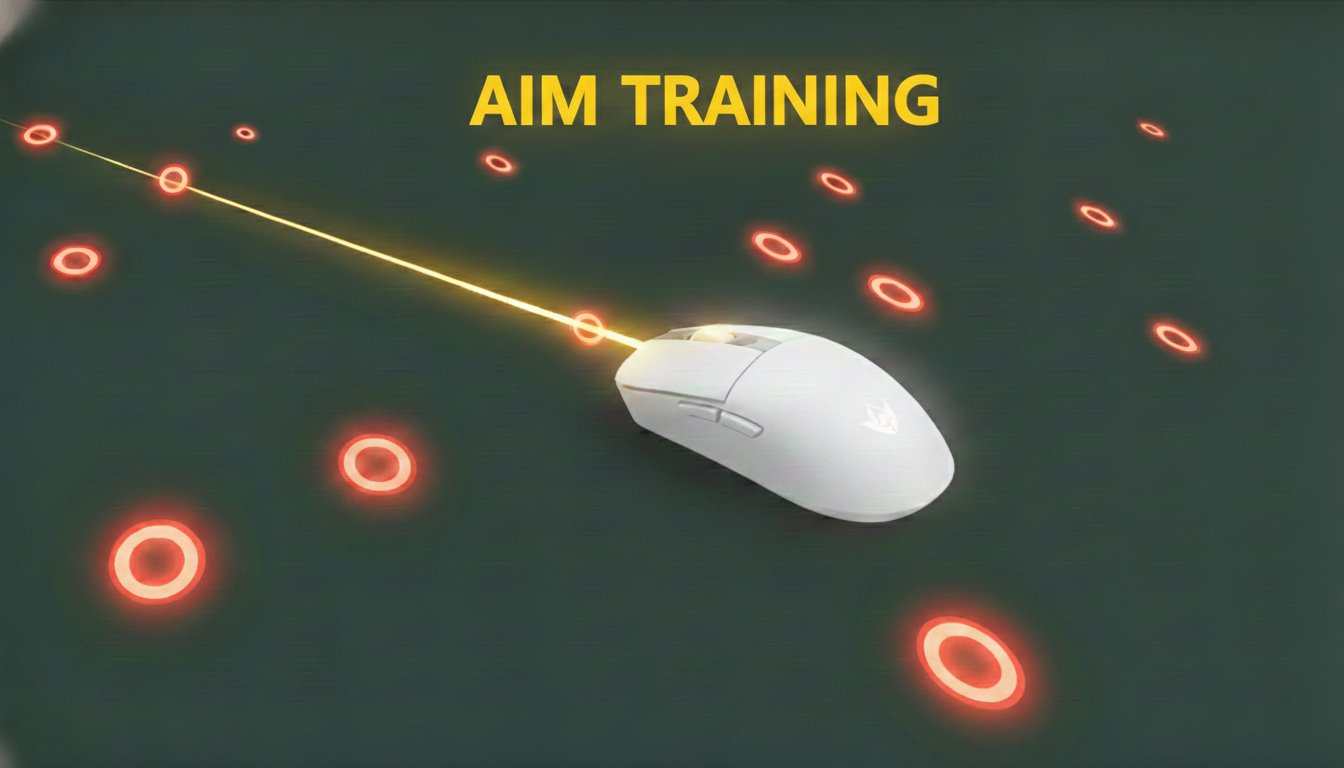
Aim training isolates the mechanical skill of moving your mouse to a target. That's it. An aim trainer strips away everything else—the map, the opponents, the strategy—and gives you one job: put your crosshair on the thing.
This isolation is both the strength and the limitation of aim training. It lets you practice pure mouse control without the cognitive load of actual gameplay. But it also means you're training a component skill, not the complete skill of playing well.
Think of it like a basketball player doing shooting drills. Standing alone at the free-throw line improves your shot mechanics. But it doesn't teach you how to create space, read the defense, or make decisions under pressure. The shooting drill is valuable, but it's not basketball.
What Aim Training Improves
Aim trainers target specific mechanical skills that do transfer to games, provided you practice correctly.
The most fundamental benefit is mouse control—learning to move your crosshair exactly where you intend. Repetitive practice builds neural pathways that make movements more accurate and consistent over time. If you currently overshoot or undershoot targets, structured practice helps calibrate your hand-eye coordination.
Flicking and tracking are the two main aiming styles, and both improve with dedicated practice. Flicking means snapping your crosshair from one position to a target quickly—useful when enemies appear suddenly or you're switching between multiple threats. The Multi-Target Aim Trainer specifically develops this. Tracking is the opposite: smoothly following a moving target with your crosshair, which matters more in games with longer time-to-kill where you need to stay locked on someone for several seconds.
Target switching—moving efficiently between multiple enemies—is really a combination of both styles. You flick to acquire the new target, then potentially track it. This improves naturally as the underlying skills develop.
Aim training also sharpens your reaction time to visual stimuli, though not as dramatically as you might hope. You won't fundamentally change how fast your nervous system works, but you do get faster at the specific pattern of seeing a target and moving to it.
What Aim Training Doesn't Improve
This is where expectations meet reality. No amount of aim training will help with these critical skills:
Game sense—understanding map flow, predicting enemy rotations, knowing when to push or hold—develops only through playing the actual game. You can't learn the rhythms and patterns of a specific game by clicking targets in a sterile environment.
Positioning is similar. Where you stand determines whether you even get to use your aim. Good positioning means taking fights you're likely to win and avoiding ones you're not. Map geometry, sightlines, cover usage, angle advantage—none of this exists in an aim trainer.
Decision-making under pressure is another gap. In a real match, you're constantly choosing: reload now or push, peek this angle or rotate, use utility or save it. These decisions happen while aiming, and they directly affect whether your aim even matters. Isolated mechanics practice doesn't build this muscle.
Movement and evasion matter too. In most games, you're not standing still while shooting—you're strafing, jumping, crouch-spamming, using movement abilities. Aim trainers typically don't incorporate realistic movement because that would make them too similar to just playing the game.
Then there's the game-specific stuff: ability usage in Valorant or Overwatch, weapon recoil patterns, spray control, bullet drop. Unless your aim trainer perfectly replicates a specific weapon's behavior, you're not practicing the actual gun you'll use in matches.
The Transfer Problem
Here's an uncomfortable truth: getting better at one task doesn't automatically make you better at a different task, even when they seem similar. This is why some players grind aim trainers for hundreds of hours and still struggle in actual games. They've become very good at clicking targets in the aim trainer—which is a real skill—but that skill doesn't fully carry over to the chaos of a real match.
The closer your training matches the actual task, the better the carryover. Same sensitivity, same field of view, similar target sizes and speeds—these details matter. If the training environment feels very different from your game, you're essentially learning two separate skills.
Most successful players combine aim training for mechanical foundations with substantial in-game practice for integration. You build the base skill in isolation, then wire it into actual gameplay through repetition in real matches.
Who Benefits Most from Aim Training
Aim training isn't equally valuable for everyone. Your current skill level and what's actually limiting your performance matter a lot.
Beginners see the biggest gains. If you're new to mouse-and-keyboard gaming, basic mouse control is probably your weakest link—and it's genuinely trainable. Aim trainers accelerate this process compared to just playing games because you get so many more repetitions per minute.
Players switching sensitivity or hardware also benefit. New mouse, new sensitivity, new setup? The controlled environment helps recalibrate faster than relying on game time alone.
If you already have good game sense but weak mechanics, isolated aim practice addresses the actual bottleneck. You know where to position and when to peek—you just need to hit the shot when you get there.
But for advanced players, diminishing returns set in quickly. If you're already highly ranked, your aim probably isn't your main limiting factor anymore. Game sense, teamwork, utility usage, and decision-making separate good players from great ones at that level. More aim training hours may yield less improvement than focusing on those other skills.
The trap is prioritizing aim training over game time. Spending two hours clicking targets and 30 minutes in your actual game optimizes for aim trainer performance, not game performance. The skills you're neglecting—positioning, decision-making, game-specific knowledge—will hold you back more than slightly better flicking will help.
How to Use Aim Training Effectively
If you decide aim training is worth your time, here's how to get the most from it.
Keep sessions short—15 to 30 minutes of focused practice beats multi-hour grinds. Shorter, more frequent sessions with rest between them produce better skill acquisition than marathon sessions. Quality of focus matters more than raw time.
Match your settings to your game. Same sensitivity, same DPI, same field of view. If your aim trainer supports it, match resolution and aspect ratio too. The closer the training environment, the better the transfer.
Train your weaknesses, not your strengths. It feels good to practice what you're already good at, but improvement comes from targeting deficiencies. If your tracking is weak, do more tracking scenarios even though flicking feels more satisfying.
Use aim training as a warm-up rather than a replacement for playing. Ten to fifteen minutes before your main game gets your hand-eye coordination active without eating into actual game time. This is the most common pattern among players who actually improve.
And don't neglect in-game practice. The skills aim trainers can't develop—game sense, positioning, situational awareness—are exactly the skills that matter most at higher levels. No amount of target clicking substitutes for that experience.
The Realistic Expectation
Aim training works for what it's designed to do: improving isolated mechanical skills. If your mouse control is genuinely your bottleneck, dedicated practice will help.
But aim is just one component of performance in any shooter. For most players, especially those already past the beginner stage, time is better spent in the actual game developing the skills that aim trainers can't touch.
The players who get the most from aim training are realistic about what it offers. They use it strategically—as a warm-up, as targeted practice for specific mechanical weaknesses, or as a tool for adjusting to new hardware. They don't expect it to magically make them better at games without also putting in the game time.
If you're going to aim train, do it with clear goals and reasonable expectations. Know what you're developing, know what you're not, and make sure you're also investing in the other skills that actually win games.