Simple vs Choice Reaction Time: Pick the Right Test for Your Goal
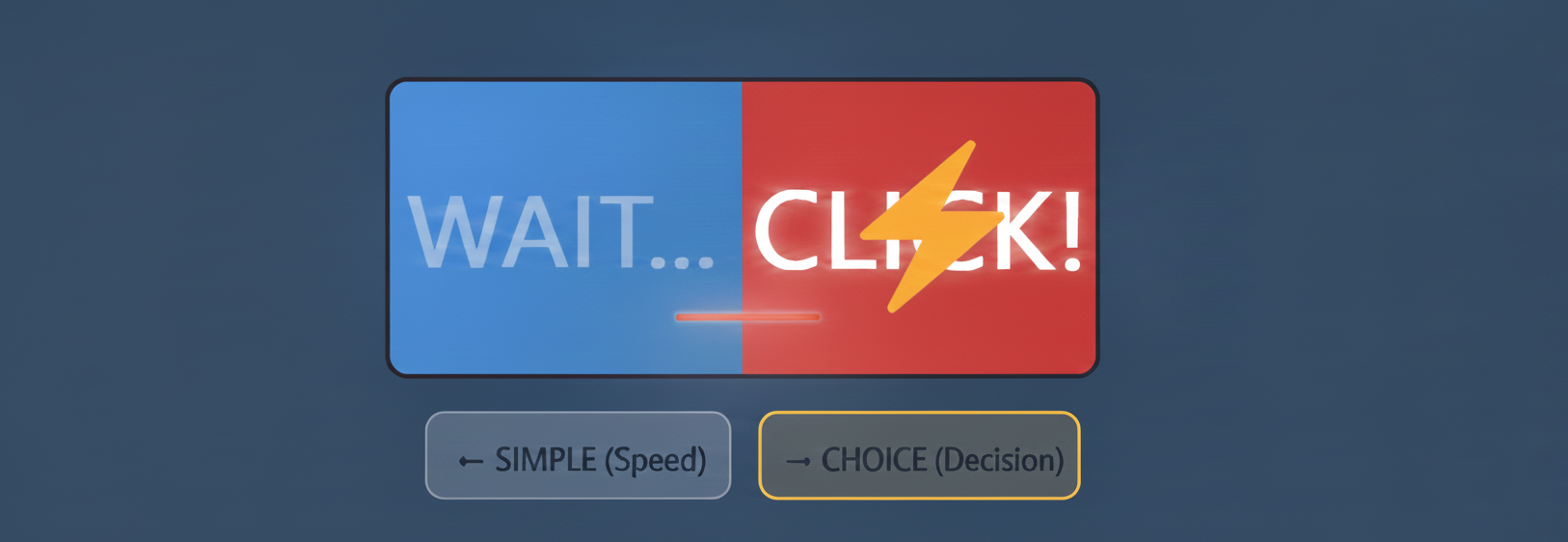
You want to test or train your reaction time. You find two options: a simple reaction time test where you click when the screen changes, and a choice reaction test where you press different keys depending on what appears. Which one should you use?
The answer depends on what you're actually trying to measure or improve. These tests challenge different cognitive abilities, and picking the wrong one means training a skill that doesn't transfer to your real goal.
What Each Test Measures
A simple reaction time test gives you one stimulus and one response. The screen changes color, you click. You know exactly what to do — the only variable is when. This isolates your pure stimulus-response speed: how fast can your nervous system detect a signal and execute a pre-planned action?
A choice reaction test adds decision-making. Multiple stimuli appear, each requiring a different response. See a left arrow, press the left key. See blue, press one key; see red, press another. You must identify what appeared and select the correct response before you can act.
Research on reaction time paradigms shows this distinction isn't just semantic. Choice reaction time is consistently slower than simple reaction time because it includes additional cognitive processing stages. The difference between your simple and choice times reveals how long your brain takes to make decisions under time pressure.
When to Use Simple Reaction Time
Simple reaction tests are the right choice when:
You need a baseline measurement. Simple reaction time is the purest measure of your stimulus-response speed. It's less affected by cognitive factors like working memory or decision-making ability, so it gives you a cleaner picture of your basic neural efficiency.
Your real-world task involves expected signals. A sprinter waiting for the starting gun knows exactly what's coming — they just don't know when. Same with a goalkeeper watching a penalty kick, or a drag racer waiting for the green light. In these situations, the stimulus is predictable; only the timing is uncertain. Simple reaction training matches this pattern.
You want to isolate speed from accuracy. In simple tests, there's only one possible response, so errors are rare. This lets you focus purely on speed without worrying about the speed-accuracy tradeoff that complicates choice tasks.
You're tracking factors like fatigue or caffeine. Because simple reaction time has fewer cognitive components, it's more sensitive to physiological factors. Sleep deprivation and stimulants show clearer effects on simple tests than on complex ones where strategy can compensate.
When to Use Choice Reaction Time
Choice reaction tests are the right choice when:
Your real-world task involves decisions. Most situations outside the lab require you to identify what's happening before you respond. A driver doesn't just react to "something" — they must recognize whether it's a pedestrian, a braking car, or a traffic light, then select the appropriate action. Gaming, team sports, and emergency response all involve this stimulus-identification-response chain.
You want to train decision speed under pressure. Research on expert performance suggests that what separates elite athletes from average ones often isn't raw reaction speed, but how quickly they can read a situation and select the right response. Choice reaction training specifically targets this ability.
You're assessing cognitive function more broadly. Choice reaction time involves attention, working memory (holding the stimulus-response rules), and executive function (selecting among alternatives). Research shows choice reaction time is more sensitive to cognitive decline than simple reaction time, which is why it's often used in clinical and research settings.
Accuracy matters as much as speed. Choice tests inherently include accuracy as a metric — you can be fast but wrong. This forces you to manage the speed-accuracy tradeoff, which is exactly what real decisions require.
Matching the Test to Your Goal
Here's a practical breakdown by common goals:
Gaming (FPS, fighting games, MOBAs) — Choice reaction. You're constantly identifying threats and selecting responses. Raw reaction speed matters, but pattern recognition and decision-making matter more. The Choice Reaction Test trains this, and adding aim training covers the motor precision component.
Sprint starts, drag racing, reflex sports — Simple reaction. The stimulus is known; you're training the fastest possible execution of a pre-planned response. A simple reaction test directly matches this pattern.
Driving — Both, but choice is more relevant for skill. Emergency braking to a sudden obstacle resembles simple reaction, but most driving decisions involve identification (what is that object? what's that car doing?) followed by response selection. Choice reaction better captures this.
Team sports (basketball, soccer, hockey) — Choice reaction. Reading the play and selecting the right action under pressure is the core skill. Simple speed helps, but decision speed separates good players from great ones.
Establishing a personal baseline — Simple reaction. It's more stable and less affected by practice effects on the specific task, making it better for tracking your raw capabilities over time.
Cognitive health monitoring — Choice reaction is more sensitive to changes, but simple reaction is easier to administer consistently. Many research protocols use both.
How Training Relates to Real Performance
A common question: does getting faster on a reaction time test actually help with real-world performance?
Think of it like strength training. Building baseline strength doesn't automatically make you better at a specific sport, but it gives you more capacity to work with. Similarly, improving your baseline reaction speed may give you more raw speed to apply to domain-specific skills — though how much that helps depends on whether reaction speed was actually your bottleneck.
Reaction time training tends to be most useful when your real task has a clear "go signal" component (race starts, musical cues, defensive commits), or when consistency and alertness are the limiting factors. For tasks where anticipation, pattern recognition, or motor precision matter more than raw speed, the baseline gains may be smaller.
For most people, reaction time tests work well as both measurement tools and as general conditioning. Pairing them with practice in your actual domain — gaming, sports, music — helps connect any speed gains to the skills you're trying to improve.
Why Not Both?
You don't have to choose exclusively. Many people benefit from using both tests for different purposes:
Use simple reaction time to establish your baseline speed and track how factors like sleep, time of day, or supplements affect your raw reaction capability.
Use choice reaction time to train your decision speed and pattern recognition under pressure — the skills that matter more in most real-world situations.
Comparing your simple and choice times also tells you something useful. If your choice time is dramatically slower than your simple time, that suggests your bottleneck is decision-making, not raw speed. If they're relatively close, your limiting factor might be elsewhere — motor precision, pattern recognition, or domain-specific knowledge.
The Bottom Line
Simple reaction tests measure how fast you can respond when you know exactly what to do. Choice reaction tests measure how fast you can respond when you must identify the situation and select the appropriate action.
For most real-world goals — gaming, sports, driving, professional performance — choice reaction is more relevant because real situations involve decisions. Simple reaction is valuable for baseline measurement and for tasks with predictable signals.
The best approach is often both: simple tests for tracking your raw speed, choice tests for training the decision-making that actually matters in performance.