What's a Good Reaction Time for Your Age? Benchmarks and Examples
You take a reaction time test and score 280ms. Is that good? Bad? Average? The answer depends on your age, your activity level, and what you're comparing yourself to.
Reaction time isn't fixed. It improves through childhood and adolescence, peaks in your early-to-mid twenties, then gradually slows as you age. Understanding the research on age-related changes helps you set realistic expectations and recognize whether your performance is where it should be.
The Basic Age Curve: When Performance Peaks and How It Declines
Research tracking 3,305 people ages 16 to 44 found that cognitive processing speed begins declining around age 24. The decline happens gradually, not suddenly.
How gradual? Studies show reaction time slows by roughly 1-2 milliseconds per year for simple tasks. That doesn't sound like much, but it compounds over decades. The cumulative effect means noticeable differences between young adults and middle-aged or older adults.
For choice reaction time—tasks where you must identify a stimulus and choose the appropriate response—the decline is steeper. Large-scale studies show increases of 2.0-3.4ms per year, meaning decision-making speed deteriorates faster than pure stimulus-response speed.
This isn't uniform across everyone. Some people maintain faster reactions well into their sixties, while others decline more rapidly. Genetics, health, activity level, and whether you practice reaction-dependent tasks all play a role. But the general pattern holds: peak in your twenties, gradual decline thereafter.
What's "Good" for Your Age Group
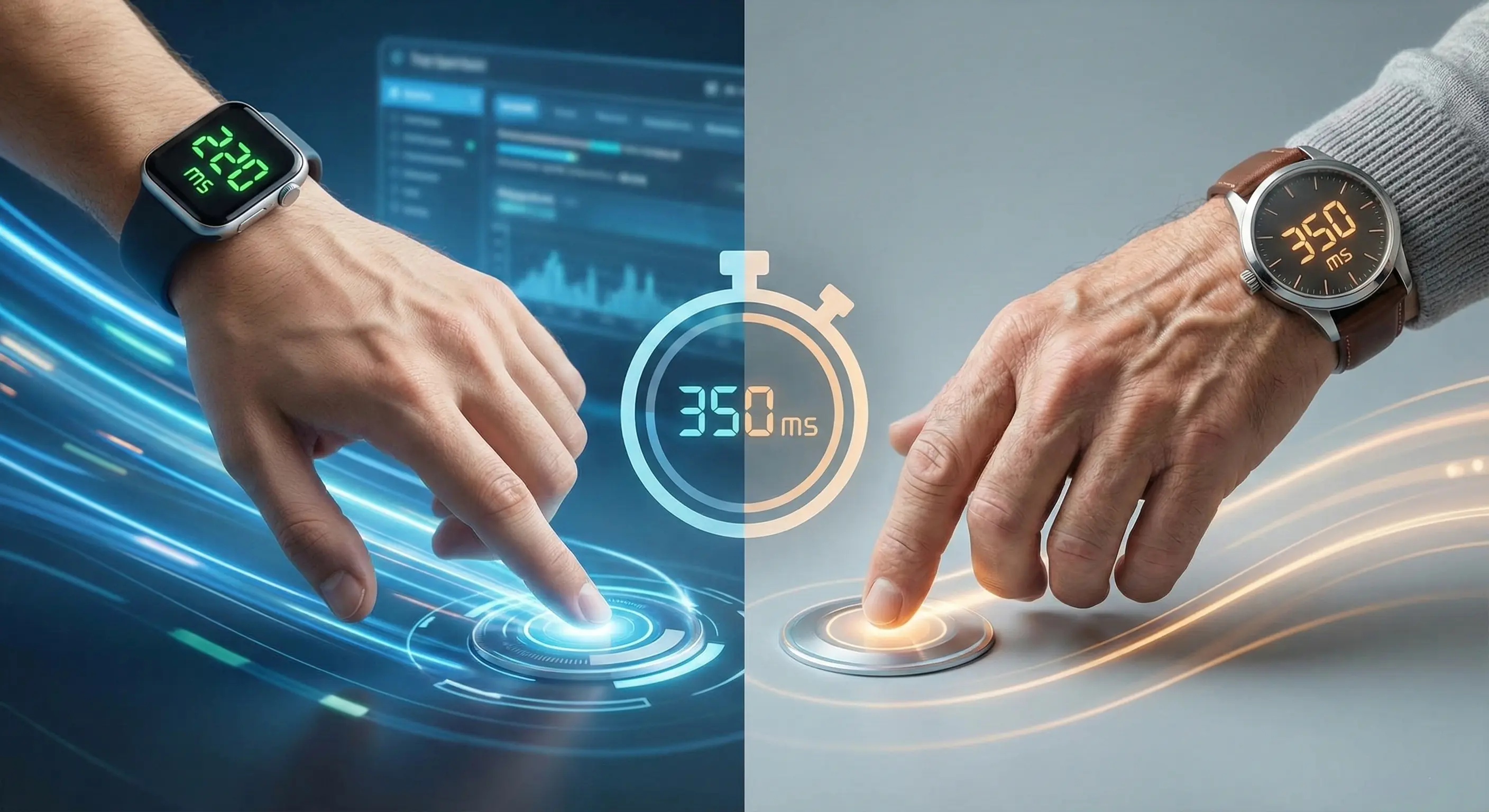
The average young adult performs simple visual reaction tasks in the 250ms range when tested with laboratory equipment. Research shows this is the baseline against which age-related changes are measured.
From that baseline, reaction time increases gradually. Studies tracking people across decades show decline rates around 1-2ms per year for simple tasks. This means someone in their fifties might be 30-50ms slower than they were at 25, while someone in their sixties could show 60-80ms of slowing or more.
For choice reaction time—tasks requiring decision-making—the decline is steeper. Large-scale studies document increases of 2.0-3.4ms per year, meaning the gap between younger and older adults widens more dramatically when tasks involve cognitive processing beyond simple stimulus-response.
Individual variation within any age group is substantial. A fit, cognitively active 60-year-old might outperform a sedentary 30-year-old. Lifestyle, training, health, and genetics all influence where you fall relative to age-matched peers.
If you're performing faster than average for your age group, you're likely benefiting from regular practice with reaction-dependent activities, good physical fitness, or favorable genetics. If you're slower than expected, factors like sleep quality, overall health, or simply lack of practice with timed tasks might be contributing.
How Athletes and Gamers Compare
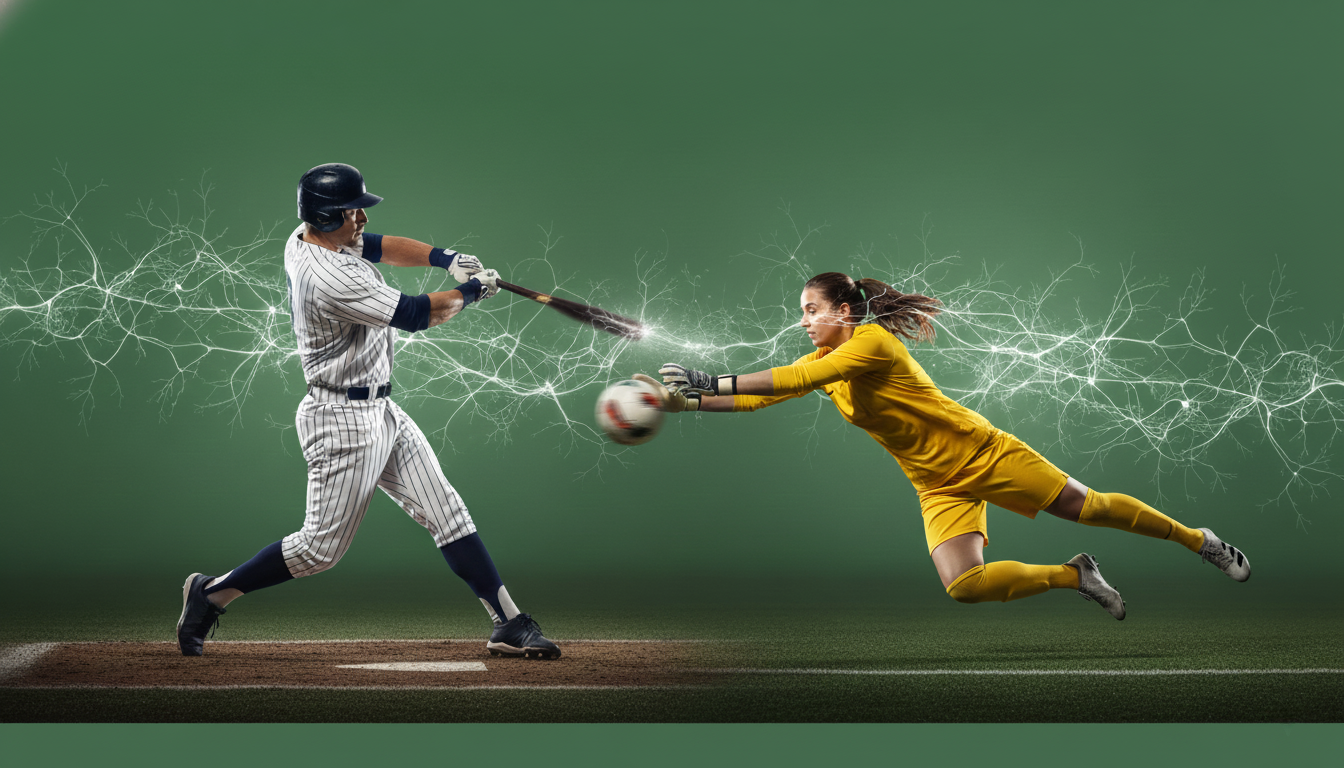
Professional athletes and competitive gamers represent the upper end of human reaction speed. But the advantage isn't as dramatic as you might expect.
A 2021 study comparing professional esports players to traditional athletes found minimal difference between the groups. Professional gamers averaged 249ms on simple reaction tests, while athletes averaged 256ms—only 7ms apart. Both groups were substantially faster than non-competitors, who averaged around 305ms.
Elite performers in both categories often achieve reaction times faster than the averages, with some reaching well below 200ms through dedicated training. But these represent the extreme tail of the distribution, not typical performance even among professionals.
What separates elite performers from average people isn't just raw speed. It's consistency. Professionals maintain their fast times across hundreds of trials with minimal variance, while casual test-takers show much wider fluctuation. An athlete might consistently hit 210-230ms, while an untrained person bounces between 240ms and 320ms depending on focus and fatigue.
The genre of gaming matters too. The same study found that FPS (first-person shooter) players tended to have the fastest reaction times in visual tests, while MOBA (multiplayer online battle arena) players showed better performance on acoustic reaction tasks. Different activities train different aspects of reaction speed.
Why Age Affects Reaction Time
The slowing isn't just about your reflexes getting slower. Multiple factors contribute to age-related decline in reaction speed.
Processing speed decreases with age as neural efficiency declines. Older adults show reduced gray matter volume, decreased white matter integrity, and need to recruit additional neural resources to complete the same tasks that younger brains handle more efficiently.
Research examining movement preparation time found that older adults need more time to prepare accurate movements, not because they're more cautious, but because their brains require additional processing time to plan and execute responses. The hesitation many people associate with aging appears to be a consequence of slower processing, not a deliberate strategy.
Sensory processing slows as well. Your eyes and ears take slightly longer to register stimuli, and the signal transmission from sensory organs to the brain becomes less efficient. These delays are small individually but accumulate across the entire reaction pathway.
Task complexity amplifies age differences. Studies show age-related slowing increases with cognitive demand. Simple reaction tasks show modest age effects, but choice reaction tasks—where you must categorize stimuli and select different responses—show much larger age gaps. This suggests that decision-making components of reaction time are more vulnerable to aging than pure motor speed.
When Your Reaction Time Matters
Should you care about these benchmarks? It depends on what you're using reaction time for.
For driving safety, reaction time becomes increasingly relevant with age. Younger drivers can often compensate for delayed recognition with faster responses, while older drivers face compounding delays in both perception and reaction. At highway speeds around 55 mph, even a 100ms difference in reaction time translates to roughly 8 additional feet of travel before braking begins—potentially meaningful in emergency situations.
For sports and gaming, reaction time matters primarily relative to your competition. If you're competing in age-group categories, being at the faster end of your age bracket gives you an edge. If you're competing in open categories against people in their early twenties, age-related slowing becomes a real disadvantage that requires compensation through better strategy and positioning.
For cognitive health monitoring, reaction time can serve as an early indicator of decline. If your reaction time is slowing faster than expected for your age, or if you notice sudden deterioration rather than gradual change, it might warrant investigation. However, remember that many factors affect day-to-day performance—sleep, stress, medication, and general health all influence reaction speed.
For personal development, knowing your baseline helps you track whether training is working. If you're 45 and score 320ms, training might bring you down to 280ms—still slower than a 25-year-old, but a meaningful improvement that could benefit your daily activities.
Can You Offset Age-Related Decline?
Practice helps, but it doesn't reverse aging. You can maintain better reaction times than the average person your age through regular training, but you're unlikely to match your own performance from twenty years earlier.
Studies on aging and reaction time training show that older adults can improve their scores through consistent practice. Research on training interventions demonstrates improvements ranging from 10-27% over 2-9 weeks of targeted practice. This improvement comes from better efficiency in executing the task—learning to anticipate timing, reducing unnecessary movement, and maintaining better focus—not from reversing the underlying neurological changes.
Physical fitness correlates with better reaction times at all ages. Cardiovascular health, in particular, supports faster neural processing. Active older adults tend to maintain reaction times closer to younger norms than their sedentary peers, though they still show age-related decline compared to their own younger selves.
The most realistic goal isn't to eliminate age-related slowing but to minimize it. Staying mentally and physically active, practicing reaction-dependent tasks, maintaining good sleep and nutrition—these can help you age along a more favorable trajectory, keeping you closer to the faster end of your age group's range.
What Your Score Actually Tells You
If you test yourself and get a number, what does it mean?
First, consider context. Online tests include technical delays from your device—the combination of display lag, input lag, and browser processing. Your displayed score likely includes some amount of this overhead on top of your actual biological reaction time.
Second, compare yourself to your age group, not to absolutes. Older adults performing at the average for their age are doing well, even though that same performance would be slow for someone in their twenties.
Third, look at trends, not single measurements. Research shows reaction time can vary by 9-34% throughout the day based on circadian rhythm, with performance typically worst in early morning and best in afternoon/evening. One test doesn't define your ability—patterns over multiple sessions give you better information.
Fourth, remember that reaction time is just one component of real-world performance. Anticipation, pattern recognition, decision-making quality, and strategic positioning often matter more than raw speed. A slower but smarter response frequently beats a fast but poorly aimed one.
The Bottom Line
A "good" reaction time depends on your age and what you're comparing yourself to. Performance generally peaks in the early-to-mid twenties, with research showing average young adults performing simple visual tasks around 250ms in laboratory settings. After that, expect gradual slowing of roughly 1-2ms per year for simple tasks, with greater decline in tasks requiring decision-making.
Professional athletes and gamers cluster around 250ms or faster, with the most elite performers achieving even faster times through dedicated training. Both groups show substantially faster performance than non-competitors, though individual variation within any age group is substantial.
These benchmarks give you reference points, but your lifestyle, training, health, and genetics all influence where you fall. The number matters most as a personal baseline to track changes over time, not as an absolute measure of capability.