How the Go/No-Go Test Trains Impulse Control (And Why That Matters)
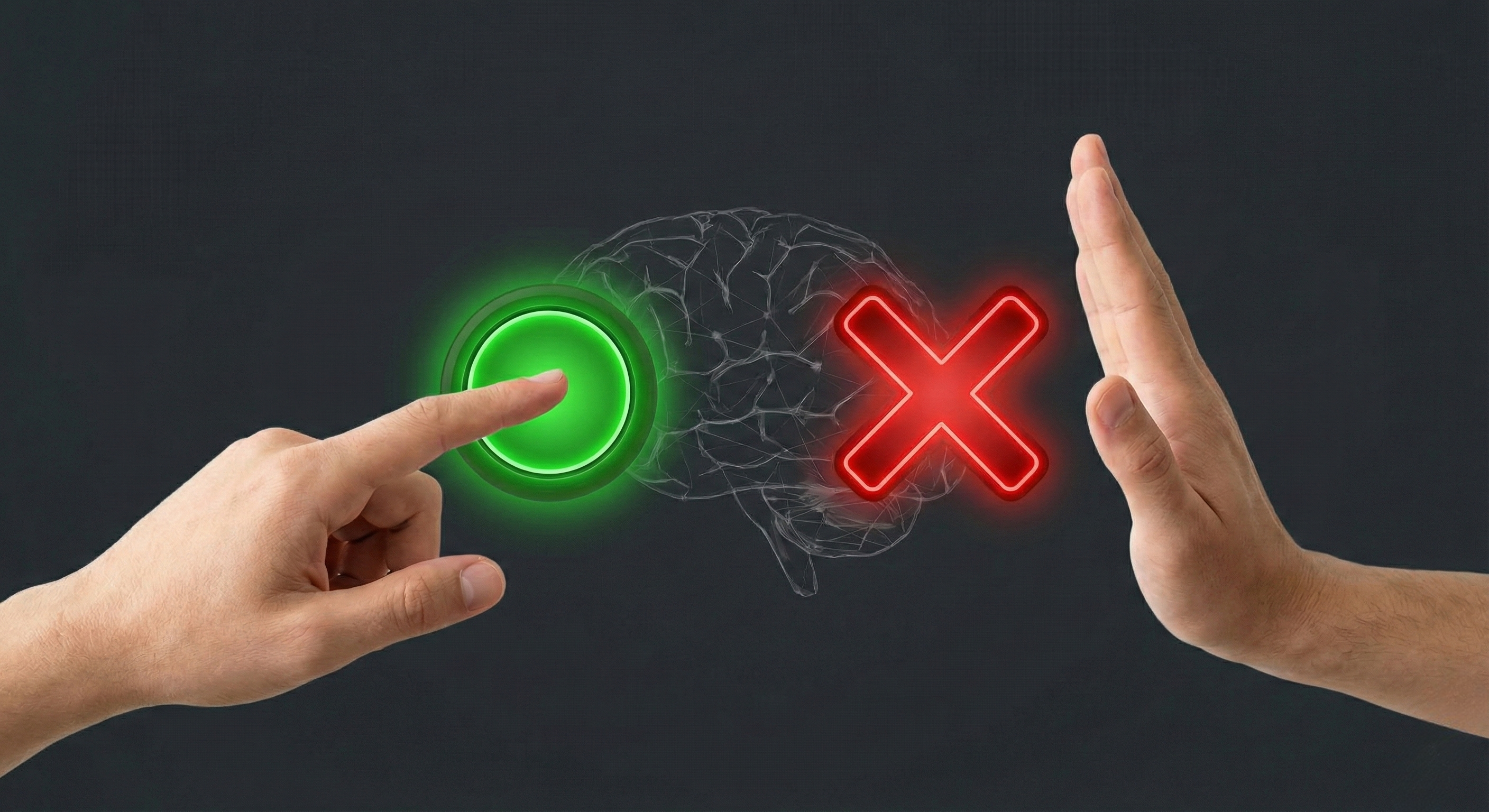
You see a green circle and click immediately. You see a red X and... resist. That split-second battle between action and restraint is what the Go/No-Go test measures—your ability to suppress a prepared motor response when the situation demands it.
Unlike simple reaction time tests that measure how fast you respond, the Go/No-Go Test measures how well you can stop yourself from responding. This distinction matters because many real-world situations require not just quick reactions but selective ones—knowing when to act and when to hold back.
What Makes Go/No-Go Different
A basic reaction time test trains speed. The Go/No-Go test trains control. The task is deceptively simple: respond quickly to "Go" signals (typically a green circle) while withholding responses to "No-Go" signals (typically a red X).
The challenge emerges from the response prepotency created by the test structure. When 70-80% of trials are Go signals, your brain develops a strong tendency to click on every stimulus. This creates the motor preparation that you then must override when a No-Go signal appears.
The Go/No-Go Test allows you to adjust this prepotency by changing the Go signal ratio. At 90% Go signals, the urge to respond becomes very strong, making inhibition more difficult. At 50% Go signals, both responses become equally prepared, reducing the inhibitory challenge.
The Neural Basis of Response Inhibition
Research on inhibitory control suggests that the prefrontal cortex plays a key role in response inhibition, with the inferior frontal gyrus and pre-supplementary motor area working together to suppress unwanted motor responses. When you successfully withhold a response to a No-Go signal, these prefrontal regions appear to modulate activity in motor areas to cancel the prepared action.
This process requires both detection (recognizing that this is a No-Go signal) and suppression (canceling the motor program before it executes). The test trains both components by forcing you to make rapid stimulus classifications while maintaining readiness to inhibit.
What the Test Actually Measures
Commission Errors (False Alarms)
When you respond to a No-Go signal, that's a commission error or false alarm. This represents a failure of inhibitory control—you couldn't stop the prepotent response in time. High false alarm rates suggest difficulty suppressing automatic responses, which can manifest in real life as impulsivity or difficulty resisting urges.
The test tracks these separately from your Go trial performance because they measure a fundamentally different ability. Someone can have fast reaction times on Go trials but still struggle with inhibition on No-Go trials.
Omission Errors (Misses)
When you fail to respond to a Go signal, that's an omission error or miss. This could indicate slow processing, distraction, or overly cautious responding where you're hesitating to avoid false alarms. While Go/No-Go tests primarily measure inhibition, the miss rate provides context about whether someone is trading speed for accuracy.
Reaction Time on Correct Go Trials
The test measures how fast you respond to Go signals when you correctly identify them. This baseline speed is important for understanding your inhibition performance—faster baseline responses generally make inhibition more challenging because there's less time to process the No-Go signal before the motor program executes.
Someone with 300ms average reaction time has more processing time to detect and inhibit No-Go signals compared to someone responding in 200ms. This is why the test reports both Go accuracy and No-Go accuracy separately rather than combining them into a single score.
Training Parameters That Matter
Go Signal Ratio
The proportion of Go signals directly affects inhibitory difficulty. Common training approaches start with 70% Go signals to establish a moderate response bias, then increase to 80-90% to strengthen the prepotent response and make inhibition more challenging.
Starting with 50/50 ratios tends to be less effective for training inhibition because there's no strong prepotent response to overcome. The test allows ratios from 30% to 90% Go signals so you can adjust the challenge level.
Stimulus Duration
The time the stimulus remains visible (default 800ms in the test) creates a response window. Shorter durations (300-500ms) increase time pressure and require faster stimulus processing. Longer durations (1000-1500ms) allow more processing time but can reduce engagement if the task feels too easy.
Responses after the stimulus disappears are counted as invalid—late responses for Go trials or late false alarms for No-Go trials. This ensures the test measures rapid response inhibition rather than slow, deliberate decision-making.
Inter-Stimulus Interval
The waiting time between trials (adjustable from 500ms to 3000ms in the test) affects sustained attention and anticipation. Shorter intervals create a faster-paced test that requires maintained focus, while longer intervals reduce time pressure but may allow attention to wander between stimuli.
Setting minimum and maximum intervals to the same value creates consistent timing, while variable intervals prevent rhythm-based anticipation where you learn to expect the next stimulus at a predictable time.
Who Benefits from Go/No-Go Training
People Working on Impulsivity
If you tend to act before thinking—interrupting others, making hasty decisions, or clicking "send" before rereading—Go/No-Go training targets the specific cognitive mechanism underlying these behaviors. The task builds the ability to detect when restraint is needed and execute that restraint quickly enough to prevent the unwanted action.
Studies on response inhibition training suggest that practice with tasks requiring frequent inhibition may improve inhibitory control in related contexts, though transfer effects can vary.
Athletes Avoiding False Starts
Sprint false starts, jumping offsides in football, or reacting to feints in tennis all involve failures of response inhibition. The Go/No-Go test trains the same neural mechanism used to suppress a prepared response when the situation changes. For sports-specific start training, see the Sprint Start Reaction Test or Go/No-Go False Start Test.
Gamers Managing Ability Timing
In competitive gaming, using an ability too early (before the enemy commits) or clicking the wrong target can decide fights. Go/No-Go training builds the impulse control needed to wait for the right moment and avoid premature actions under pressure. For aim-specific training, see our guides on click speed versus accuracy and target filtering.
Anyone Managing Automatic Habits
Breaking unwanted habits—checking your phone compulsively, stress eating, interrupting conversations—requires the same inhibitory control trained by Go/No-Go tasks. You need to detect the urge and suppress the automatic response before it executes.
Real-World Applications
Driving Safety
Defensive driving requires constant response inhibition: not accelerating when the light turns yellow, not changing lanes when you see an opening but haven't checked blind spots, not honking immediately when frustrated. These situations all demand suppressing a prepared response when additional information indicates restraint is safer. For more on reaction time and driving, see why reaction time matters for defensive driving.
Emotional Regulation
Stopping yourself from saying something you'll regret, not sending that angry email, resisting the urge to check your ex's social media—these are all response inhibition challenges. The cognitive mechanism is similar to what Go/No-Go tests train, though emotional arousal adds complexity not present in the neutral test environment.
Academic and Work Performance
Staying focused despite distractions, not immediately responding to every notification, waiting your turn in discussions—these professional behaviors rely on inhibitory control. People who score well on Go/No-Go tests often report better ability to maintain focus on priority tasks.
How to Train Effectively
Start with Moderate Difficulty
Begin with 70% Go signals, 800ms stimulus duration, and 20-30 trials per session. This creates enough response prepotency to require real inhibition without being frustratingly difficult. Aim for 85-90% No-Go accuracy before increasing difficulty.
Progress Systematically
Once you're consistently accurate at 70% Go signals, increase to 80%, then 90%. This strengthens the prepotent response and makes inhibition progressively more challenging. You can also decrease stimulus duration to add time pressure or increase trial counts to add sustained attention demands.
Track Both Accuracy Types
Monitor Go accuracy and No-Go accuracy separately. If Go accuracy is low (many misses), you may be over-cautious or distracted. If No-Go accuracy is low (many false alarms), you need more inhibitory control training. The test saves your last 20 sessions so you can identify trends.
Practice Consistently
Short, regular practice appears more effective than occasional long sessions. Daily 5-10 minute sessions build the skill more reliably than weekly 30-minute sessions. The test's customizable parameters let you adjust difficulty as you improve.
Apply to Real Situations
The ultimate goal is transfer to daily life. After practicing, try applying the same "detect and inhibit" strategy to one real-world impulsive behavior. Notice the urge, recognize it as a "No-Go" signal, and practice suppressing the automatic response.
Understanding Your Results
After completing a session, the test displays several metrics: Go trial accuracy (hits vs misses), No-Go trial accuracy (correct rejections vs false alarms), overall accuracy, and average reaction time for correct Go responses.
Strong performance shows high accuracy on both trial types. If your Go accuracy is high (95%+) but No-Go accuracy is moderate (75-85%), this pattern suggests you're responding quickly but struggling with inhibition—a common profile for impulsive individuals.
If both accuracies are moderate or low, consider whether you're trying to respond too quickly. Slowing down slightly often improves both Go and No-Go accuracy by allowing more processing time for stimulus classification.
Late responses (clicking after the stimulus disappears) are counted separately because they don't reflect the rapid inhibition the test trains. If you have many late responses, the task may be too fast for your current processing speed—try increasing stimulus duration or decreasing Go signal ratio.
Common Questions
How does this differ from other reaction time tests?
Most reaction time tests measure how fast you respond. Go/No-Go tests measure how well you can stop yourself from responding. The simple versus choice reaction time distinction is about decision complexity, while Go/No-Go is about response suppression—a different cognitive function entirely. For an overview of different test types, see reaction time tests explained.
Why do I sometimes click on No-Go signals even when I see them?
This is the core challenge the test addresses. Seeing the No-Go signal isn't enough—you must detect it, recognize it requires inhibition, and cancel the motor program before it executes. All of this must happen within hundreds of milliseconds. False alarms typically occur when one of these stages is too slow or when the motor program is already too far along to cancel.
Should I try to respond as fast as possible?
Not necessarily. While fast Go responses demonstrate good processing speed, extremely fast responses (under 200ms) leave very little time to detect and inhibit No-Go signals. A more moderate response speed often produces better overall performance by allowing enough processing time for accurate stimulus classification.
How long does improvement take?
This varies by individual and starting baseline. Some people notice improved No-Go accuracy within a week of daily practice, while others may take several weeks. The key is consistent practice and systematic difficulty progression rather than expecting rapid transformation.
Limitations and Considerations
Go/No-Go tests train a specific type of inhibitory control—canceling a simple motor response based on a clear visual signal. Real-world impulse control often involves more complex situations: ambiguous cues, emotional arousal, delayed consequences, and social pressure.
Training on the test may improve your ability to suppress simple motor responses, but this doesn't automatically transfer to complex behavioral situations like resisting dessert or managing anger. Think of it as building one component of a broader self-control skillset.
Additionally, the test uses neutral stimuli (shapes) rather than emotionally charged or personally relevant content. Your ability to inhibit a response to a red X may not directly predict your ability to resist checking your phone, though the underlying neural mechanism is related.
Final Thoughts
The Go/No-Go Test provides a focused way to practice response inhibition—the ability to suppress unwanted actions quickly and reliably. Whether you're working on impulsivity, training for sports that penalize false starts, or simply want better impulse control, the test offers measurable practice for a specific cognitive skill.
Start with manageable difficulty, track your progress across both trial types, and gradually increase the challenge as your inhibitory control improves. The goal isn't perfect performance but systematic development of the ability to detect when restraint is needed and execute that restraint effectively.