Peripheral Drift Illusion
Every row is completely stationary, yet the lanes may seem to slide in opposite directions when you blink or shift your gaze.
Look at the small gold marker near the middle of the image. Keep your eyes there while noticing the rows above and below it.
Now blink once or move your gaze briefly to another part of the page and back. Some rows may appear to drift sideways for a moment.
Because alternate lanes reverse their brightness sequence, neighboring rows can seem to move in opposite directions.
The image is not animated. Every block remains fixed in exactly the same position.

This is the Peripheral Drift illusion, a static-motion effect created by repeating an asymmetric sequence of luminance values.
The pattern interacts with brief retinal changes produced by blinks, eye movements, and peripheral viewing. The visual system can interpret the resulting timing differences as genuine motion.
What Is Actually Drawn?
Each lane contains a repeating four-block sequence:
Black → dark gray → white → light gray.
The next lane reverses that order. The blocks have fixed widths and do not change color, position, or shape.
The illusion does not require blue, yellow, or another special hue. It can occur entirely in grayscale because the critical information is the asymmetric order of light and dark regions.
When the order is reversed, the expected drift direction also reverses. That is why the rows can appear to slide against one another rather than moving as one sheet.
The same four-level principle is arranged around circles in the more elaborate Rotating Snakes Illusion.
The Proof: Every Boundary Stays Fixed
The proof image places gold vertical guides over selected block boundaries and white reference lines through the centers of the rows.
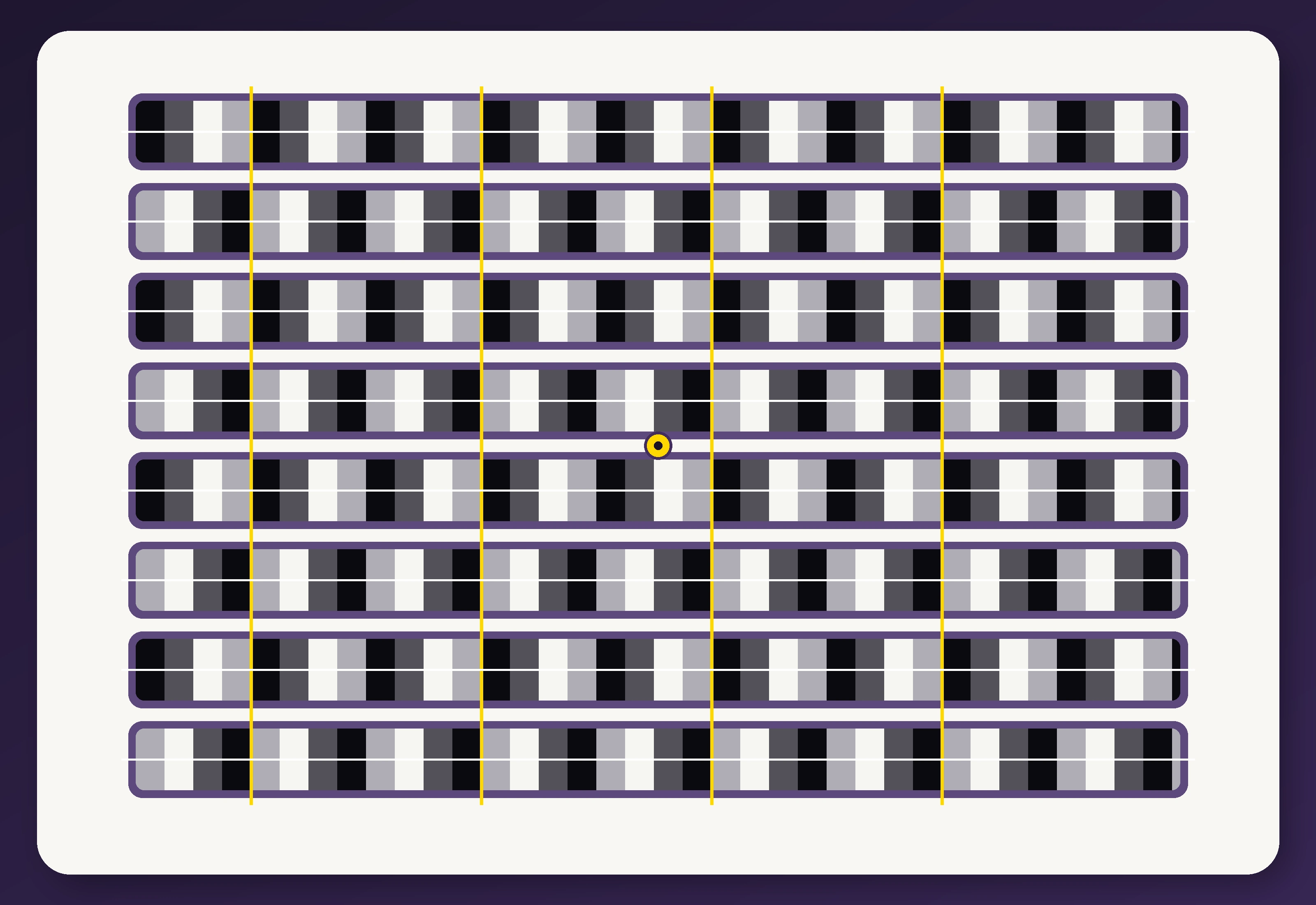
If the rows genuinely shifted, their block edges would move away from the guides. They never do.
A screenshot taken at any moment records the same arrangement. The apparent drift is created during viewing, not stored in the image.
Why Asymmetric Brightness Produces Direction
Visual responses to different luminance transitions do not all develop at exactly the same speed.
A very bright region, a very dark region, and intermediate grays can produce responses with different latencies. When they are arranged in an asymmetric repeating order, a sudden retinal change does not affect the sequence evenly.
The staggered response can resemble the activation produced by a real edge moving from one block toward the next.
Jocelyn Faubert and Andrew Herbert introduced the term peripheral drift illusion in their 1999 experimental report.
They proposed that the illusion combines visual transients from blinks or eye movements, differences in luminance-processing latency, and integration of those signals in peripheral vision.
Responding quickly to a real visual change is a different task. Cognitive Train’s Reaction Time Test measures how quickly you react when the screen physically changes.
Why Peripheral Vision Helps
The lanes often appear more active when you look at the fixation marker rather than directly at the row you are judging.
Peripheral vision combines information over larger areas and represents fine spatial detail less precisely than central vision. The separate blocks can therefore be integrated into a broader directional signal.
Direct fixation makes their stationary edges easier to resolve. The apparent movement may stop until the row returns to peripheral vision or another eye movement refreshes the pattern.
In a 2003 study by Akiyoshi Kitaoka and Hiroshi Ashida, the order of four luminance regions proved critical.
Their optimized arrangement used the transitions from black to dark gray and from white to light gray, producing a stronger and more predictable drift direction.
Small Eye Movements Help Stabilize Vision
Your eyes never become perfectly motionless, even when you try to stare at one point.
Microsaccades and slower fixational drift continually shift the retinal image by tiny amounts. These movements normally help refresh visual information and prevent stationary scenes from fading.
The Peripheral Drift pattern turns that useful activity into a false motion signal.
A 2008 study by Anna Beer and colleagues linked the illusion to mechanisms that compensate for small involuntary eye movements and help stabilize perception.
The illusion is not caused simply by shaky eyes. It emerges because a directionally biased pattern is processed while the visual system is trying to maintain a stable world.
Try Related CT Tests
The effect combines fixation, peripheral monitoring, visual processing, and responses to brief changes.
Cognitive Train’s comprehensive Attention Test measures sustained attention, selective focus, impulse control, and visual scanning:
The Brain Speed Test combines rapid visual matching, decisions, and reactions into one broader speed score. More targeted exercises are available in the Processing Speed hub and Focus & Attention hub.
Could Pupil Changes Also Contribute?
Recent research has added another possible source of retinal change.
The pupil expands and contracts after changes in light, blinks, and gaze shifts. That alters how much light reaches the retina across the asymmetric pattern.
In a 2025 study by George Mather and Patrick Cavanagh, the duration and size of pupil dilation were associated with the duration of perceived peripheral drift.
The authors proposed that pupil movements following pattern onset, blinks, or saccades can help generate episodes of illusory movement.
This does not necessarily replace eye-movement and response-latency accounts. Pupil changes, retinal shifts, and motion-sensitive processing may contribute together.
How It Differs From Other Motion Illusions
The Motion Aftereffect requires adaptation to genuine movement before a stationary image appears to drift in the opposite direction.
Peripheral drift needs no moving adapter. The illusion appears while you view the static pattern itself.
The Scintillating Grid Illusion is also triggered by gaze shifts, but it creates brief dark flashes at white intersections rather than sideways motion across complete rows.
The Lilac Chaser Illusion depends more heavily on sustained fixation, fading, and a complementary-colored afterimage.
How It Relates to Brightness Illusions
The White’s Illusion also uses repeated dark and light elements to alter perception.
White’s illusion changes the apparent lightness of stationary targets through grouping and surface context. Peripheral drift instead turns ordered luminance transitions into a directional motion signal.
The physical pattern is stable in both cases, but different visual systems interpret its relationships differently.
What It All Comes Down To
The Peripheral Drift illusion creates apparent motion from a fixed sequence of light and dark blocks.
Asymmetric luminance order gives the pattern a preferred direction. Blinks, gaze shifts, small eye movements, and possibly pupil changes create brief retinal events that motion-processing systems can misread as displacement.
The blocks never move, but alternate lanes can appear to slide in opposite directions.
For more examples of static motion, changing brightness, false color, and distorted geometry, browse the full Optical Illusions guide. Cognitive Train’s brain tests explore attention, perception, speed, and reasoning, while its free brain training tools offer more ways to challenge visual processing.