Scintillating Grid Illusion
Every intersection contains the same white disk, yet dark spots may flash across the grid whenever your eyes move.
Look generally across the image rather than staring at one disk. As your gaze moves, brief black or charcoal points may appear inside some of the white circles.
Try looking directly at one of those dark spots. It disappears immediately, while another seems to flash somewhere else.
Nothing in the image is animated. Every disk remains uniformly white, and no dark dots have been placed inside them.
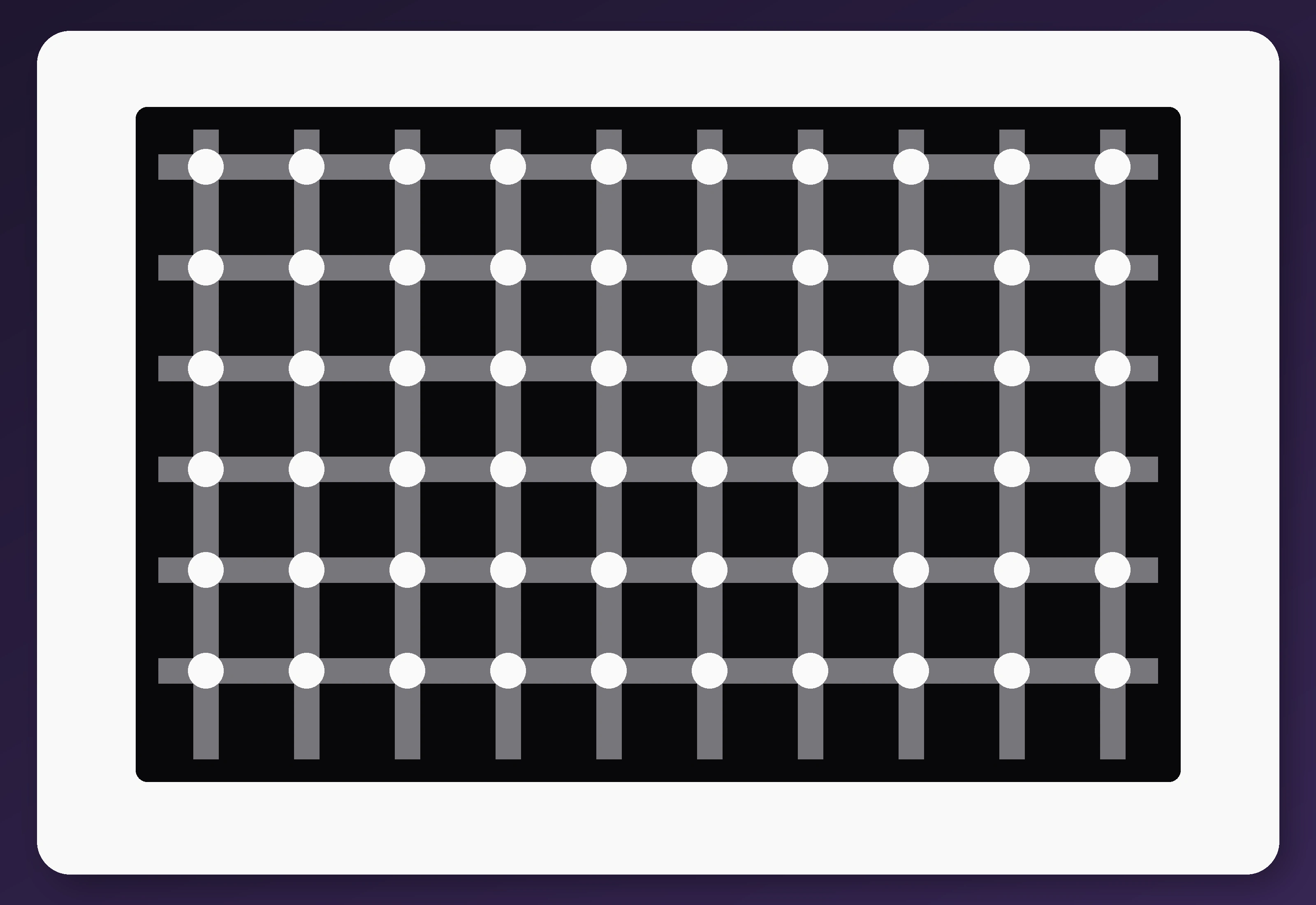
This is the Scintillating Grid illusion, created by placing bright disks over the intersections of a gray grid on a black background.
The word “scintillating” refers to the apparent flickering or sparkling. The image remains static, but the dark points seem to appear, disappear, and jump between intersections.
What Is Actually Drawn?
The physical pattern contains a black background, medium-gray horizontal and vertical bars, and solid white circles centered at every crossing.
All circles have the same diameter and the same white pixel value. None contains a gray center, shadow, gradient, or transparent overlay.
The dark spots exist only in perception. They are strongest at intersections outside the exact point of fixation and usually vanish when inspected directly.
Unlike genuine animation, the apparent events do not occur at fixed times or locations. Their positions change with your gaze.
The Proof: Every Disk Is Identical
The proof image outlines three intersections and connects them to isolated white samples underneath the grid.
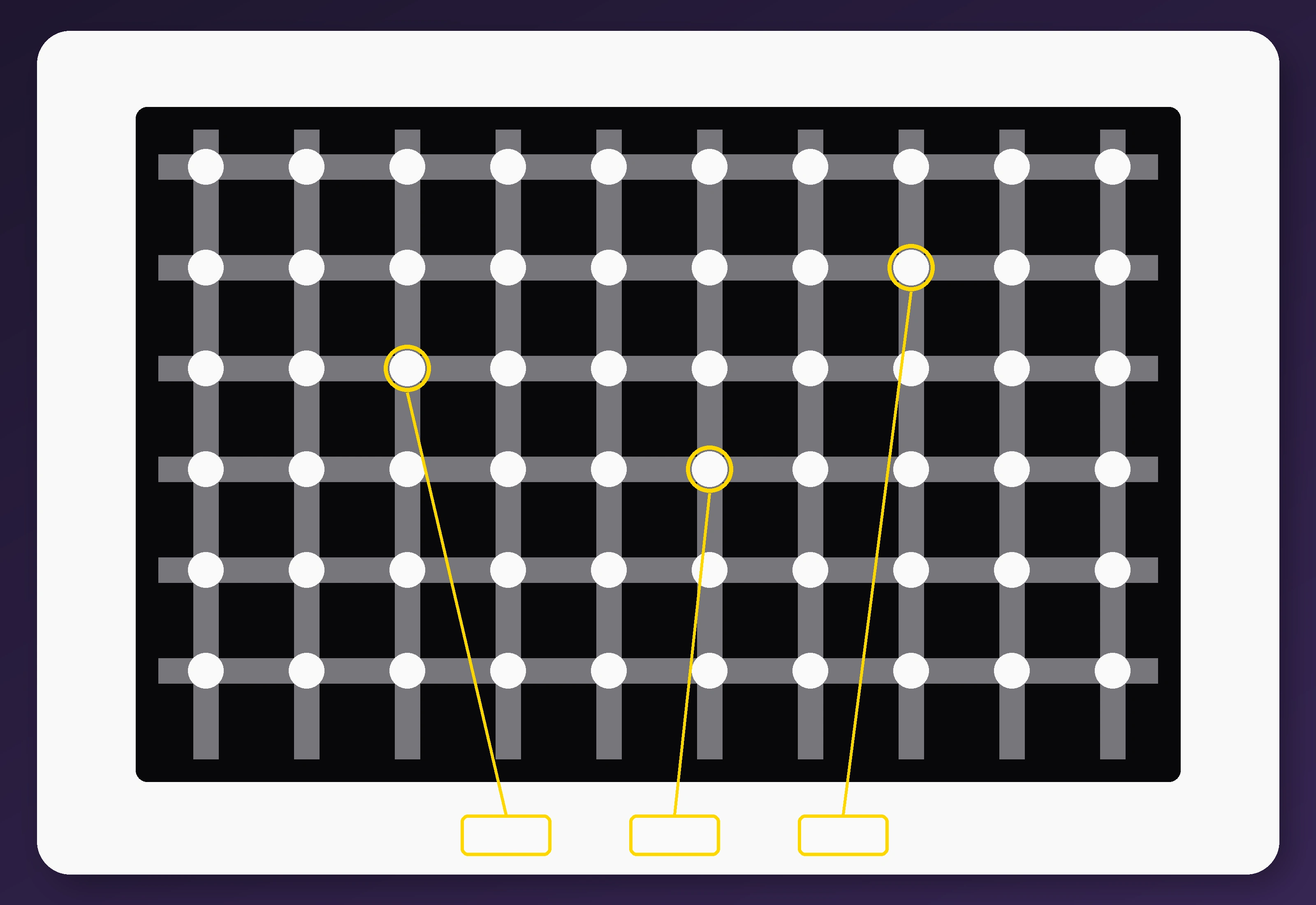
The dark appearance cannot be captured by sampling a supposedly flashing spot because the pixels never change.
A screenshot also records only clean white disks. The scintillation is generated while your visual system processes the pattern.
Why Eye Movements Matter
The effect becomes strongest when the eyes scan from one part of the grid to another.
Each quick eye movement shifts the intersections across different areas of the retina. The white disks repeatedly move between central and peripheral vision, where spatial detail and contextual information are processed differently.
In the original 1997 study by Michael Schrauf, Bernd Lingelbach, and Eugene Wist, dark spots appeared to flash inside the disks with each flick of the eyes.
The researchers found that scanning eye movements were necessary for the characteristic scintillation. That requirement helps distinguish the effect from the older Hermann Grid illusion.
When you stare steadily at one disk, the conditions producing a dark flash at that location weaken. Other intersections remain in less detailed peripheral vision, where new spots may appear.
Scintillating Grid vs. Hermann Grid
The Scintillating Grid developed from the Hermann Grid Illusion, but the displays are not identical.
The Hermann Grid normally consists of black squares separated by white streets. Soft gray smudges appear at empty white intersections, especially in peripheral vision.
The Scintillating Grid uses gray bars on black and adds real white disks at every crossing. The illusory marks appear as sharper, darker points inside those disks.
The Scintillating Grid also feels more active. Its dark spots flash and jump as the eyes move rather than remaining as relatively soft peripheral shadows.
Mach Bands are another brightness effect, but the Mach Bands Illusion occurs near changes in a smooth luminance gradient rather than at repeated grid intersections.
Why Disk Shape and Orientation Matter
The intersections do not produce equal scintillation with every possible patch shape.
In a 2009 study by Kun Qian and colleagues, researchers varied the size, shape, and orientation of the bright patches.
Large square patches produced a weaker illusion than circles or diamond-shaped patches. Rotating the display also changed the effect.
The visual system was therefore sensitive not only to the amount of white at each crossing, but also to the orientation of the patch edges relative to the surrounding grid.
This helps explain why the classic display uses circles. Their edges do not align with horizontal and vertical bars in the same way square edges do.
Local Cross-Shaped Structure Is Important
The long grid may look like the obvious cause, but the structure immediately surrounding each disk is particularly important.
In a 2012 study of orientation processing, the illusion weakened when disks appeared at intersections formed from shorter bars.
A small gap between a disk and the bars did not eliminate the effect, but a larger gap weakened it. Offsetting the bars so they no longer continued cleanly across the intersection reduced the illusion substantially.
The researchers concluded that the local cross-shaped arrangement and the continuity of oriented edges influence the flashes.
Contrast processing probably contributes, but orientation-sensitive processing and contour organization also matter.
Try a Related Attention Test
The dark spots are easiest to notice away from direct fixation and while attention shifts across the display.
Cognitive Train’s Attention Test measures selective attention, sustained focus, impulse control, and visual scanning across four short tasks:
More exercises involving peripheral monitoring, distraction control, and visual scanning are available in the Focus & Attention hub.
Can the Illusion Occur Without a Complete Grid?
Surprisingly, the full lattice is not absolutely required.
In a 2020 study by Toyomi Matsuno, observers perceived similar dark spots in patterns that did not contain continuous grid bars.
Arrangements of repeated bright patches and nearby local elements could still generate scintillation-like effects.
This reinforces the idea that the visual system responds to local spatial relationships, repetition, and peripheral organization rather than recognizing only one specific complete grid.
Why Two Eyes Can Strengthen It
The illusion is often stronger when viewed with both eyes.
In a binocular-viewing study, participants reported stronger scintillation when the pattern was seen binocularly than when it was presented to only one eye.
The increase was not explained simply by adding two independent monocular impressions. Processing that combines information from both eyes also contributed.
This places at least part of the effect beyond the earliest monocular stages of vision.
How It Relates to Other Unstable Illusions
The Lilac Chaser Illusion also changes as you hold fixation. Colored disks fade, an afterimage forms, and an apparently moving green spot can emerge.
The Peripheral Drift Illusion and Rotating Snakes Illusion create apparent movement from static luminance sequences, often becoming stronger after blinks or gaze shifts.
The Scintillating Grid does not make the whole pattern move. Instead, eye movements and peripheral processing create brief dark events inside fixed white disks.
Why the Effect Varies
Try viewing the image at full size, sitting slightly farther from the screen, and moving your gaze between several intersections rather than staring at the center.
Display brightness, contrast, image scale, room lighting, and disk size can all affect the result.
Some viewers see sharp black flashes. Others notice softer gray dots, brief dimming, or only a few unstable intersections.
Not seeing a dramatic effect does not indicate poor vision. Perceived strength varies between observers and viewing setups.
What It All Comes Down To
The Scintillating Grid contains identical white disks placed at the intersections of gray bars on black.
As the eyes scan the pattern, dark points seem to flash inside disks outside direct fixation. Looking directly at one removes it while another appears elsewhere.
Eye movements and peripheral viewing are important, but patch shape, orientation, local cross structure, contour continuity, and binocular processing also influence the effect.
For more examples of false brightness, color spreading, apparent motion, and distorted geometry, browse the full Optical Illusions guide. Cognitive Train’s brain tests explore attention, perception, speed, and reasoning, while its free brain training tools offer more ways to challenge visual processing.