Lilac Chaser Illusion
Keep looking at the center. The lilac disks may fade away while a green dot appears to race around the circle.
Fix your eyes on the small cross in the middle of the animation below. Try not to follow the disappearing gap.
At first, you should see a ring of lilac disks with one empty position moving clockwise. After several seconds, a green disk may appear in the empty position. With longer fixation, some or all of the lilac disks may fade, leaving what looks like one green dot circling a gray field.
No green disk is present in the animation. The only physical change is that one lilac disk disappears at a time.
Viewing note: look away and stop if the animation feels uncomfortable or causes eye strain.

This is the Lilac Chaser illusion, sometimes called the Pac-Man illusion.
It combines three effects: apparent motion from the advancing gap, a complementary-colored afterimage, and the fading of stationary peripheral objects during sustained fixation.
What Is Actually in the Animation?
The display contains twelve fixed positions arranged around a circle. Eleven positions show lilac disks while one is blank.
Every 150 milliseconds, the blank position moves to the next location. The disks themselves do not travel around the ring. One disk disappears and the previous one returns.
The green “chaser” is not drawn in any frame. It is a negative color afterimage that appears where a lilac disk has just vanished.
As fixation continues, the lilac disks that remain physically present may become less visible. This can make the afterimage seem brighter and more isolated than it did at the beginning.
The Proof: Only the Gap Changes Position
The proof image shows three separate frames from the animation. Gold circles mark the missing disk in each frame.
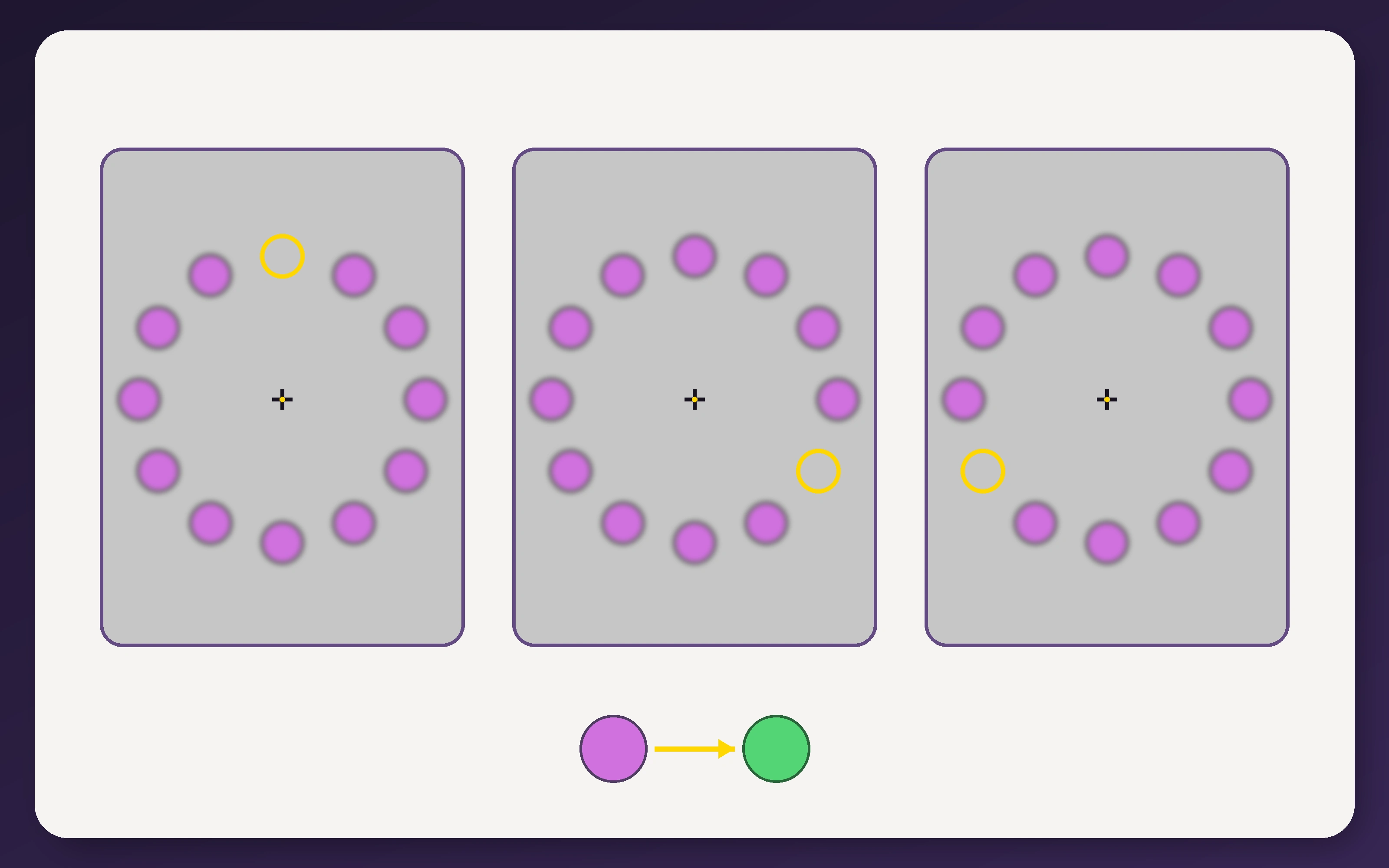
The three rings have the same geometry. The only physical difference is which position is empty.
The swatches underneath show the relationship between the lilac inducer and the greenish afterimage many viewers perceive. The exact afterimage color varies with the screen, background, and observer.
Why the Missing Position Appears Green
Staring at a color for several seconds changes the sensitivity of visual mechanisms responding to that color.
When a lilac disk disappears, the adapted location suddenly shows neutral gray. The temporarily unbalanced color response can make that neutral area appear greenish, roughly opposite lilac in color space.
This is a negative color afterimage. It is related to the colored shapes that may briefly remain after you look away from a bright image.
Research on the neural location of color afterimages found that afterimage signals arise in the retina and can then be modified by later cortical processing.
The afterimage is short-lived because the physical lilac disk returns quickly. The next disk then disappears, creating a new greenish afterimage at the neighboring position.
Cognitive Train’s Color Hue Test measures discrimination between real hue differences rather than colors generated by adaptation.
Why the Green Dot Appears to Move
The animation never moves one object smoothly around the ring. It presents a sequence of events at neighboring locations.
Visual motion systems connect those successive events, so the blank gap initially appears to circle the display. Once the green afterimages become visible, the same timing makes the green position appear to travel around the ring.
This is a form of apparent motion: separate changes presented in sequence are experienced as one continuously moving object.
The illusion was created by Jeremy Hinton in 2005. Michael Bach’s Lilac Chaser reference page records receiving Hinton’s original animation and publishing it online that year.
Why the Lilac Disks Fade
The disks remain visible in every frame except when each takes its brief turn disappearing. Yet during steady fixation, the surrounding ring may gradually weaken or vanish.
This resembles Troxler fading, in which an unchanging object away from the point of fixation becomes less visible over time.
Stationary retinal stimulation produces adaptation. Tiny involuntary eye movements normally refresh the image and help maintain visibility, but the soft peripheral disks can still fade when fixation is steady.
In a 2006 eye-tracking study, periods of perceptual fading were associated with reduced microsaccade activity, while increased microsaccades preceded the return of visibility.
This is why moving your eyes usually restores the entire lilac ring immediately.
Why Soft Edges and a Gray Background Help
Sharp, high-contrast boundaries resist fading because they continue to provide strong spatial signals.
The disks in this demonstration have blurred edges and sit on a neutral gray field. Their boundaries are therefore easier for the visual system to adapt to during prolonged fixation.
The gray background also provides a neutral surface on which the green afterimage can be seen clearly. A strongly colored background would alter the apparent afterimage and reduce the simplicity of the effect.
Try a Related Attention Test
The demonstration depends on maintaining central fixation while monitoring changes around the edge of the visual field.
Cognitive Train’s Attention Test measures sustained focus, selective attention, impulse control, and visual scanning across four short tasks:
More exercises involving fixation, sustained attention, and peripheral monitoring are available in the Focus & Attention hub.
How It Differs From the Motion Aftereffect
The Motion Aftereffect begins with real continuous movement. After adaptation, a stationary test image appears to move in the opposite direction.
Lilac Chaser uses no continuously moving disk. Its apparent motion comes from sequential disappearance and reappearance at neighboring positions.
Both involve adaptation, but the Motion Aftereffect adapts direction-sensitive systems while Lilac Chaser combines color afterimages with fading and apparent motion.
How It Differs From Static-Motion Illusions
The Rotating Snakes Illusion and Peripheral Drift Illusion generate motion from completely static luminance patterns.
Lilac Chaser is genuinely animated: one disk disappears in each frame. The illusion lies in seeing a green object that is never displayed and in watching the remaining lilac disks fade despite their continued presence.
The Scintillating Grid Illusion also changes with gaze, but it produces dark flashes at white intersections rather than complementary afterimages.
What It All Comes Down To
The Lilac Chaser combines several ordinary visual processes into one striking experience.
Sequential gaps create apparent motion. Adaptation to lilac produces a greenish negative afterimage. Sustained fixation allows the stationary peripheral disks to fade.
The result can look like one bright green disk circling an empty gray field, even though every frame contains only lilac disks and one blank position.
For more examples of apparent motion, fading, color spreading, and distorted geometry, browse the full Optical Illusions guide. Cognitive Train’s brain tests explore attention, perception, speed, and reasoning, while its free brain training tools offer more ways to challenge visual processing.