Motion Aftereffect
Watch movement in one direction, then look at something still. The stationary image may appear to move the other way.
The motion aftereffect is different from most illusions because it does not appear immediately. Your visual system has to adapt first.

Keep your eyes on the small center marker in the moving image below for about 20 seconds. Try not to follow the stripes. Let them pass through your peripheral vision while your gaze stays fixed.
Then move directly to the stationary test image and look at its center marker.
Comfort note: stop if the moving pattern makes you feel dizzy, nauseated, or otherwise uncomfortable.
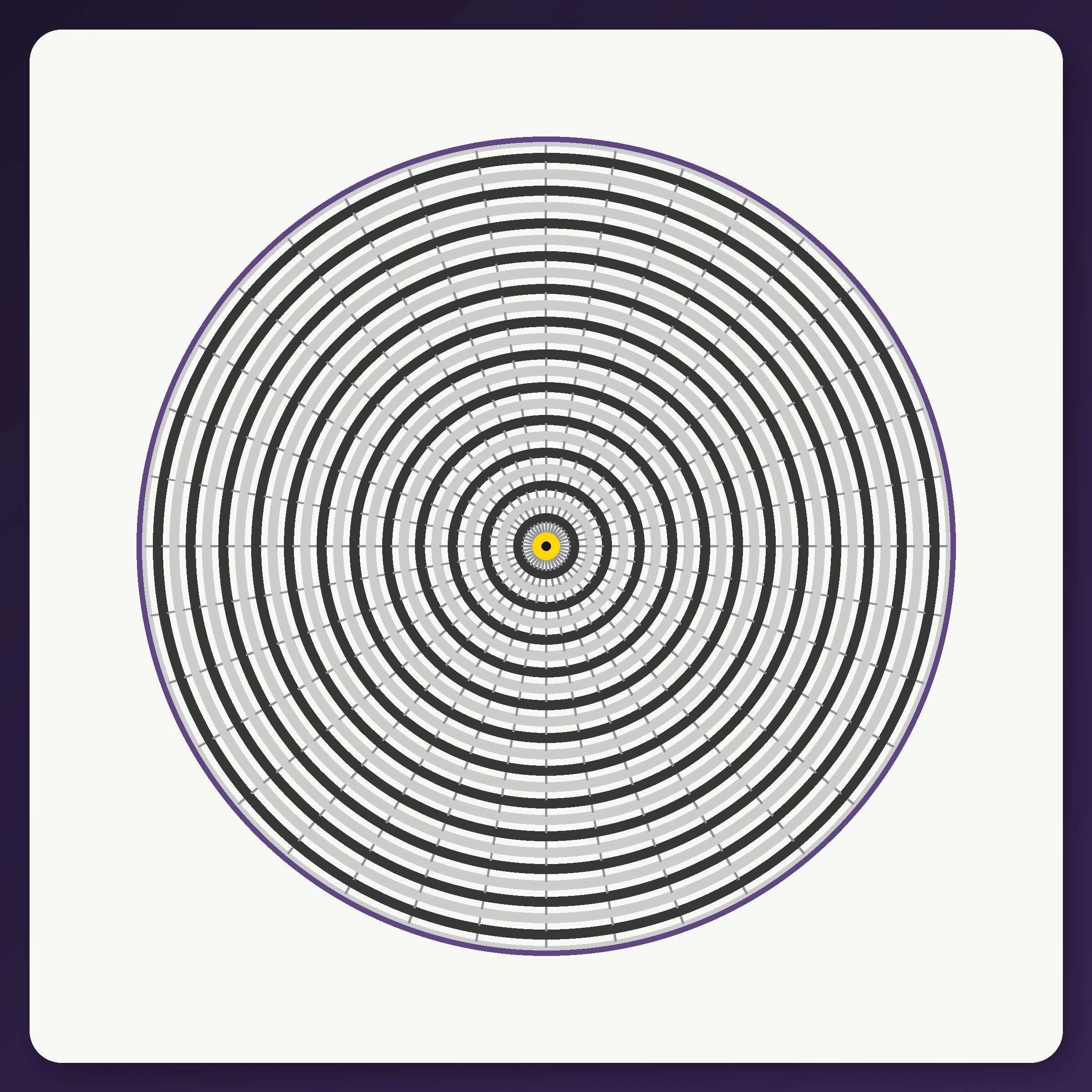
If the effect worked, the stationary rings may seem to move upward, expand, ripple, or slide despite remaining fixed.
This is the motion aftereffect, also called the waterfall illusion. Motion seen for several seconds changes how later motion signals are balanced, causing a stationary scene to appear to move in the opposite direction.
What Actually Changed?
The test image did not change. It is an ordinary static image with fixed rings, spokes, and a center marker.
What changed was the recent state of your visual system.
During adaptation, the downward-moving stripes repeatedly stimulated neurons that respond preferentially to downward motion. When the movement stopped, responses across direction-sensitive populations were temporarily unbalanced.
Signals representing the opposite direction became relatively stronger. A stationary pattern could therefore produce the experience of upward movement.
The aftereffect normally fades within a few seconds as the adapted responses recover.
Why Opposite-Direction Motion Appears
Visual motion is not represented by one neuron that simply reports “moving.” Different neural populations respond more strongly to different directions and speeds.
Perceived direction depends partly on relative activity across those populations.
After sustained downward motion, downward-sensitive responses become less responsive for a short time. When a stationary image follows, it does not physically favor any direction, but the adapted downward side contributes less than usual.
The remaining balance resembles the activity pattern that genuine upward movement would create.
A major review of the motion aftereffect explains that adaptation can occur at several stages of visual processing rather than through one simple case of neurons becoming tired.
Why It Is Called the Waterfall Illusion
Water moving down a waterfall provides a powerful natural adapter.
After staring at the falling water and then looking at nearby rocks, the rocks may appear to drift upward even though their positions remain stable.
Robert Addams published a famous description after visiting the Falls of Foyers in Scotland in 1834. The effect had been described much earlier, including an ancient account associated with Aristotle.
The Illusions Index history of the waterfall illusion covers these reports and later scientific explanations.
The Brain Responds to Illusory Motion
The aftereffect is not only a verbal judgment that the scene “seems active.” Motion-processing brain areas respond during the experience.
In a 1995 functional imaging study, researchers found increased activity in human cortical area MT while participants viewed a stationary stimulus that appeared to move after adaptation.
Area MT, also called V5, is strongly involved in visual motion processing.
Further evidence comes from a study using magnetic stimulation. Disrupting MT/V5 affected both perception and short-term storage of the motion aftereffect.
Why Fixation Matters
Keeping your gaze on the central marker concentrates adaptation within a consistent retinal region.
If your eyes follow the moving stripes, the stimulus shifts across the retina and adaptation becomes less stable. The resulting aftereffect may weaken or appear less orderly.
The effect is also partly location-specific. A region exposed to motion can show a stronger aftereffect than an unadapted part of the visual field.
That is why the adapter and test image use the same centered circular area.
Holding fixation while monitoring visual information elsewhere also draws on skills explored in Cognitive Train’s Focus & Attention hub.
Try a Related Attention Test
The demonstration works best when you hold your gaze steady and resist following the moving stripes.
Cognitive Train’s Attention Test measures sustained focus, selective attention, impulse control, and visual scanning:
The Reaction Time Test presents genuine visual changes and measures how quickly you respond, unlike the stationary movement perceived during the aftereffect.
Does Longer Adaptation Make It Stronger?
Within reasonable limits, watching the adapter longer generally makes the aftereffect stronger or longer-lasting.
The relationship is not unlimited. Adaptation develops rapidly at first and then approaches a ceiling, while contrast, speed, image size, fixation, and attention also influence the result.
A 20-second exposure is long enough for many viewers to notice the illusion without making the demonstration unnecessarily long.
People differ substantially. Some see obvious upward drift, others see subtle expansion or rippling, and some experience little under the same conditions.
How It Differs From Static-Motion Illusions
The Rotating Snakes Illusion and Peripheral Drift Illusion appear to move while you are looking at their stationary patterns.
The motion aftereffect has two separate stages. First you adapt to genuine movement. Then a different, physically stationary image appears to move.
The apparent direction is normally opposite to the adapter, making the effect useful for studying direction-selective visual mechanisms.
How It Relates to Lilac Chaser
The Lilac Chaser Illusion also depends on adaptation, but it adapts color and brightness rather than one continuous direction of motion.
Its green spot is a complementary afterimage created as lilac disks disappear in sequence. Motion aftereffects instead arise from an imbalance among direction-sensitive responses.
What It All Comes Down To
The motion aftereffect shows that visual perception depends on recent history.
After sustained movement in one direction, direction-sensitive responses adapt. When a stationary scene follows, the temporary imbalance favors the opposite direction and creates illusory motion.
The test image remains fixed, but your visual system reaches it in a changed state.
For more examples of apparent motion, false color, changing brightness, and distorted geometry, browse the full Optical Illusions guide. Cognitive Train’s brain tests explore attention, perception, speed, and reasoning, while its free brain training tools offer more ways to challenge visual processing.