Neon Color Spreading Illusion
The cyan disk has no outline and no colored fill, yet it may appear to float transparently over the black lattice.
Look at the center of the image below. Do you see a faint cyan circle resting over the grid?
The circular region may appear softly tinted, luminous, or covered by a transparent blue-green film. Its boundary can seem visible even though no circular outline has been drawn.
But the broad area inside the apparent disk is pure white. The only cyan pixels belong to short sections of the horizontal and vertical grid lines.
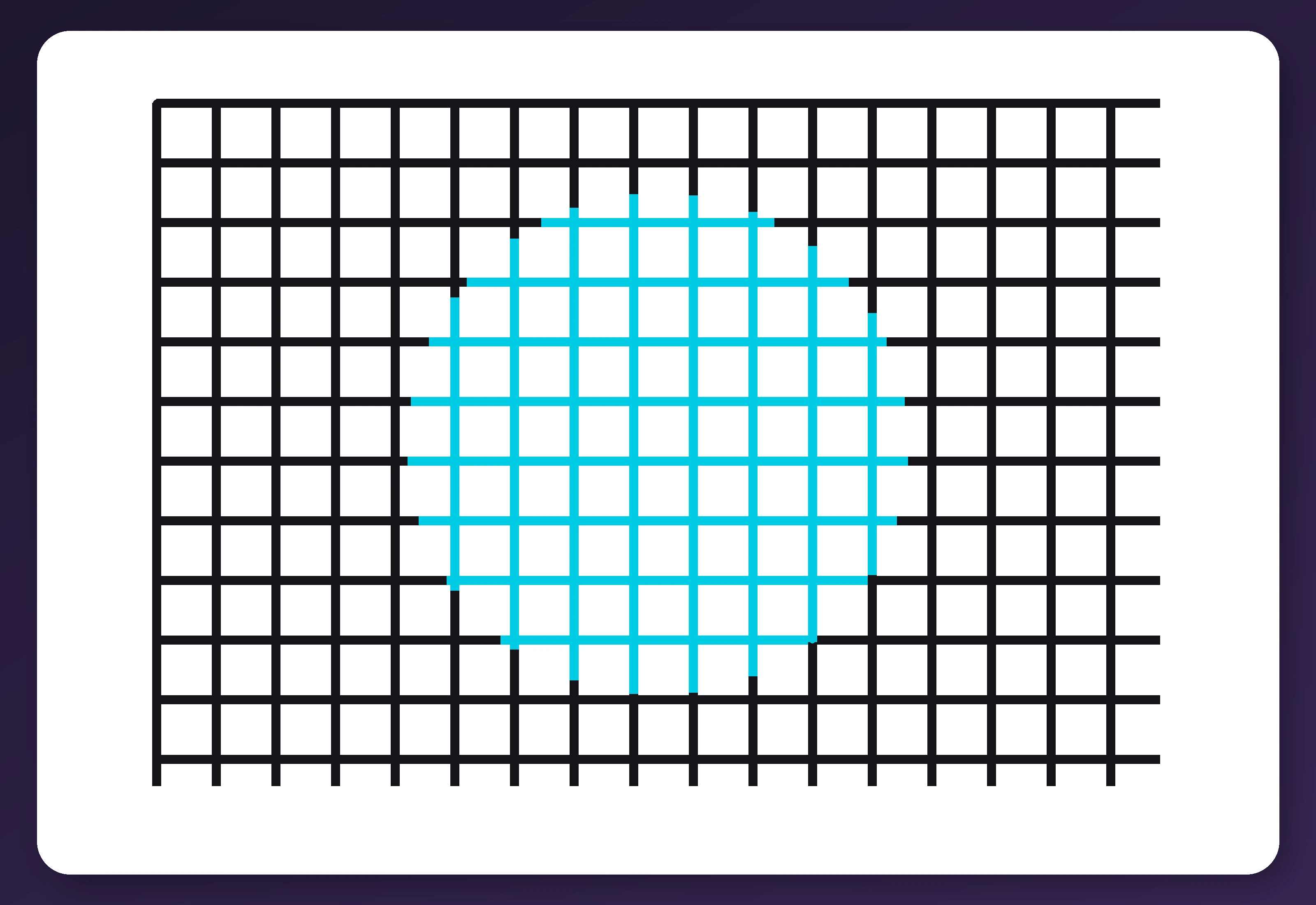
This is the Neon Color Spreading illusion, also known as neon-like color spreading.
The visual system connects the places where the grid changes color, constructs a boundary between them, and spreads a diluted version of the cyan across the resulting surface.
It belongs to the same broad family of constructed-color and contour effects as the Watercolor Illusion, Ehrenstein Illusion, and Subjective Neon Illusion.
What Is Actually Drawn?
The image begins as a regular lattice of black horizontal and vertical lines.
Where those lines pass through an imaginary circle, they change from black to cyan. When they leave the imaginary circle, they turn black again.
There is no physical edge connecting the transition points. There is also no translucent cyan layer covering the white gaps between the lines.
Despite that, the color transitions collectively define one circular region. The white spaces inside it may look slightly cyan, while the circle can appear to sit in front of the grid like a transparent filter.
The effect may vary with screen brightness and viewing distance. It is often easiest to see from slightly farther away, when the separate colored line segments group into one surface.
The Proof: The Interior Is Still White
The proof image draws the virtual circle used to determine where each grid line changes color.
It also samples one white point inside the circle and another white point outside it. Both samples are displayed as swatches at the bottom.
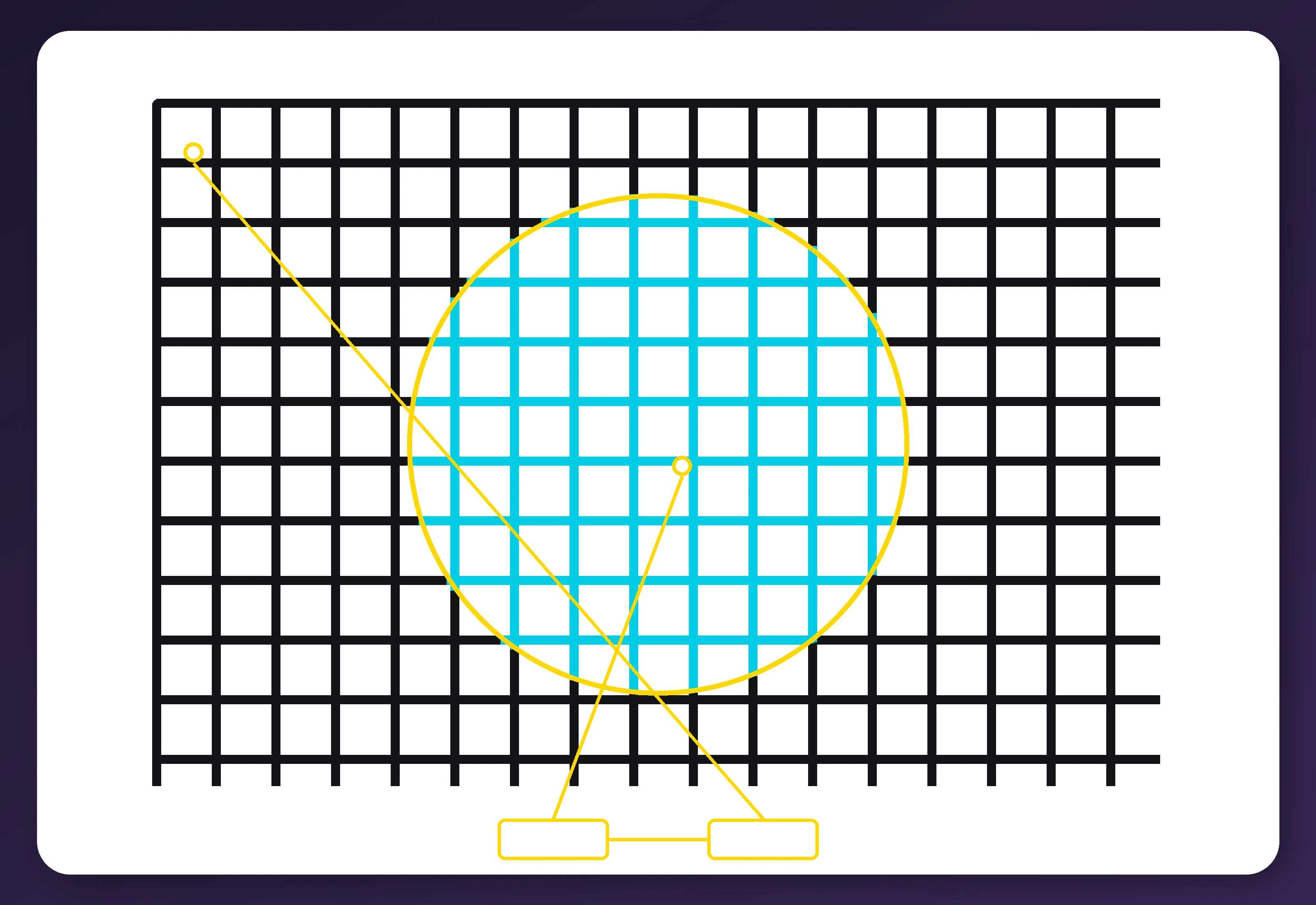
The apparent disk therefore does not come from a faint fill that is difficult to notice. It is constructed perceptually from the colored segments and their arrangement.
Why the Color Spreads Between the Lines
Each cyan segment continues directly into a black segment. The line does not stop when its color changes.
Those repeated transitions occur around the perimeter of one implied shape. Your visual system groups them because they are arranged consistently and belong to continuous grid lines.
The grouped transition points suggest a boundary even though no complete boundary exists. Once that region has been organized as one surface, the cyan signal appears to spread through the white spaces between the inducing segments.
The Kanizsa Triangle Illusion demonstrates related boundary completion without color spreading. There, separate black shapes cause the brain to construct the edges of a bright triangle that was never drawn.
Neon color spreading adds another step: the implied boundary becomes associated with a faint, transparent-looking colored surface.
Where the Illusion Came From
Dario Varin described a related chromatic-spreading effect in 1971 using colored arcs arranged around a virtual central shape.
Hans van Tuijl independently reported the phenomenon in 1975 and introduced the name neon-like color spreading.
In his original paper, van Tuijl described color spreading between subjective contours along with complementary color induction.
His classic lattice display used black lines whose central segments changed to another color. Those inset colored sections produced what appeared to be a delicate transparent shape resting over the grid.
The name “neon” refers to that glowing quality. No actual light or physical glow is present.
The Arrangement Matters More Than the Amount of Color
Adding more colored pixels does not automatically strengthen the illusion.
The colored pieces need to form a coherent structure. Their transition points must support one plausible boundary or surface.
Van Tuijl and Emanuel Leeuwenberg explored this issue in a 1979 study of neon color spreading and structural information.
The research compared different configurations and examined how the organization of the pattern related to the strength of the effect.
This helps explain why random cyan marks across a grid would not necessarily create a disk. In the current image, every color change lies on the same mathematically defined circular boundary.
The individual transitions become evidence for one global figure.
Why the Disk Can Look Transparent
The black lattice appears to continue beneath the cyan region rather than ending at its edge.
That continuation encourages the visual system to split the scene into layers. One layer contains the underlying grid. Another contains a translucent cyan surface placed over it.
This type of perceptual separation is sometimes called scission. One physical pattern is interpreted as two overlapping components.
A neural model developed by Stephen Grossberg and Arash Yazdanbakhsh examined how systems for boundary completion, surface filling-in, depth, and transparency could interact to produce neon spreading. Their account appears in a 2005 Vision Research paper.
The model proposes interacting boundary and surface processes rather than one simple color-smearing mechanism.
Try a Related Color Test
Neon color spreading creates a perceived tint where no physical surface tint exists. Cognitive Train’s Color Hue Test presents differences that are physically present and asks you to arrange them into smooth color gradients.
Brightness Relationships Change the Effect
The strength of neon spreading depends partly on the luminance relationships among the colored segments, the darker supporting lines, and the background.
In a 1989 study, Takeo Watanabe and Takao Sato varied luminance contrast while measuring color spreading and illusory contours.
The two perceptual effects responded differently to the contrast conditions. A configuration that supported strong color spreading did not necessarily produce an equally strong illusory contour.
This means the cyan tint and the apparent circular edge are related but not identical outcomes.
Cognitive Train’s Contrast Sensitivity Test explores a related visual ability by measuring how faint a real brightness difference can become before it is no longer visible.
How It Differs From the Watercolor Illusion
Neon color spreading and the Watercolor Illusion can both make a physically white region appear tinted.
Neon spreading typically occurs when continuous lines change from one color to another. Multiple transition points collectively define a virtual transparent shape.
The Watercolor illusion normally uses two differently colored contours running side by side around an enclosed region.
The appearance also differs. Neon spreading tends to look luminous, hazy, and transparent. Watercolor coloration more often looks like an opaque wash belonging to a solid surface.
Baingio Pinna and Stephen Grossberg compared the effects in a 2005 analysis of their geometry and neural mechanisms.
They argued that nearby color transitions may contribute to both illusions, while their different global boundary arrangements help determine whether the surface appears transparent or solid.
How It Relates to Other Color Illusions
The Bezold Effect shifts a target color toward finely interspersed neighboring colors. It does not normally create one transparent surface with an implied outline.
The White’s Illusion changes the apparent lightness of identical gray targets through striped grouping and surface organization.
The Checker Shadow Illusion uses a realistic cast shadow, causing the visual system to compensate for apparent illumination.
All four show that perceived surface color depends on surrounding organization rather than isolated pixel values.
Why Knowing the Circle Is White Does Not Remove It
After seeing the proof, you know that the white background is identical inside and outside the virtual circle.
The cyan disk may still return when you look at the original image.
Your conscious reasoning has learned how the file was constructed. The visual system continues grouping the color transitions, completing the boundary, and representing the center as one transparent surface.
What It All Comes Down To
The Neon Color Spreading illusion places colored segments inside otherwise dark continuous lines.
When the color transitions line up around one implied shape, the visual system connects them into a boundary and spreads a diluted color across the enclosed white area.
A circle with no outline and no fill can therefore appear as a faint cyan veil floating over the lattice.
For more examples of color, brightness, size, line, and depth distortions, browse the full Optical Illusions guide. Cognitive Train’s brain tests explore perception, attention, processing speed, and reasoning, while its free cognitive training tools offer more ways to challenge visual judgment.