Ehrenstein Illusion
The black spokes stop before the center, yet a bright white disk with a circular edge may appear between them.
Look at the empty region in the middle of the image below.
You may see a pale circular surface that appears slightly brighter than the surrounding background. Its edge can seem surprisingly clear, as though a white disk had been placed over the ends of the black lines.
No circle or bright fill was drawn there. The center and the rest of the cream background use exactly the same color.

This is the Ehrenstein illusion, an example of an illusory contour and brightness-enhancement effect.
The orderly endings of the radial lines provide enough evidence for the visual system to construct a surface that is not physically present in the image.
What Is Actually Drawn?
The image contains 28 dark line segments arranged around one center.
Each line points inward but stops at the same distance from the middle. Taken individually, the lines are simply disconnected spokes on a uniform background.
Together, their inner endpoints lie along an imaginary circle.
Your visual system groups those endpoints and treats them as evidence that one object or surface is interrupting the lines. The missing circular boundary is completed between the visible tips.
The central area may then appear brighter and slightly in front of the spokes, even though it has the same physical color as the background around it.
The Proof: The Center and Background Match
The proof image separates three parts of the effect.
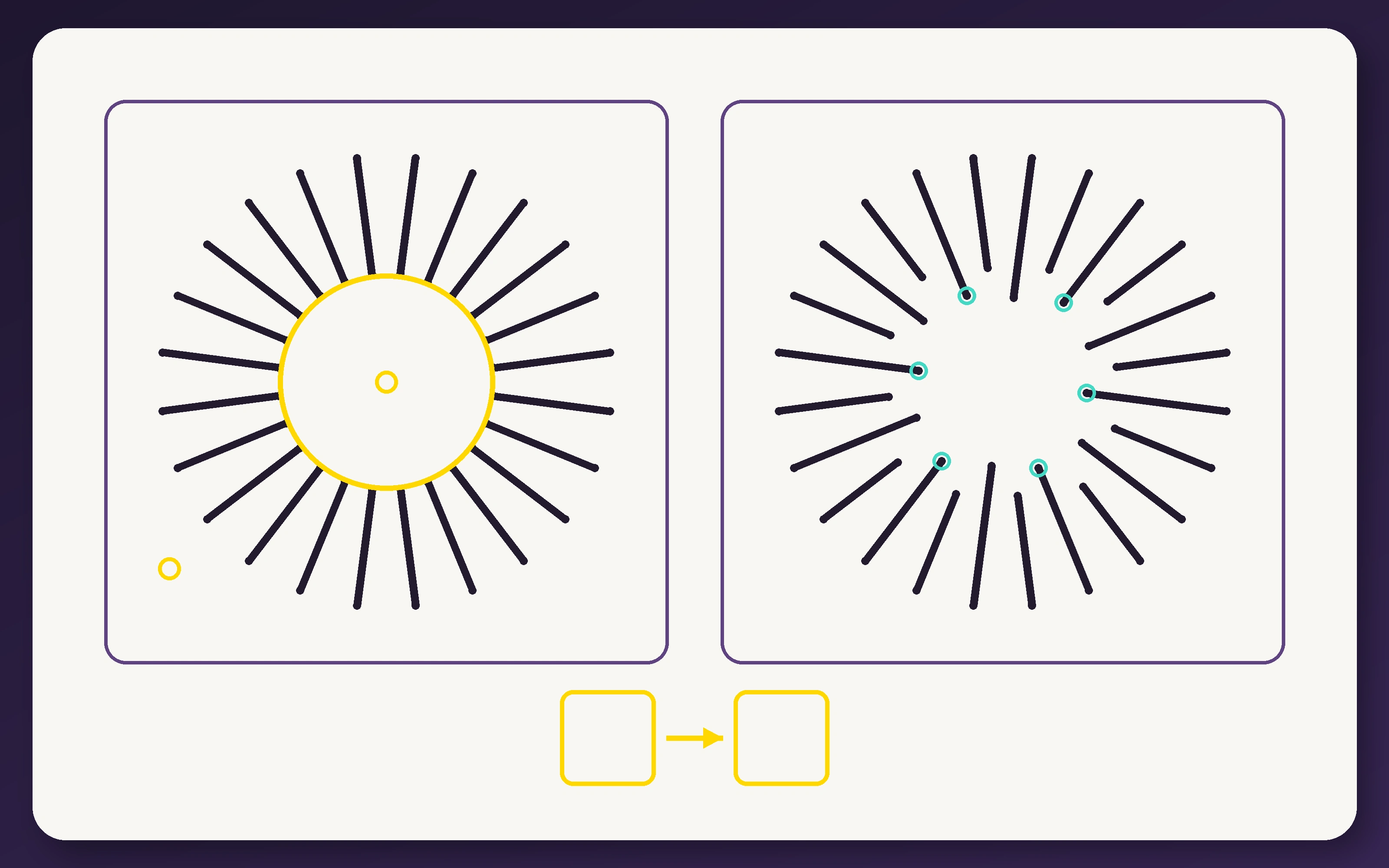
On the left, the gold circle identifies the boundary that perception adds between the line endings. The circle is an explanatory overlay and is not present in the main illusion.
On the right, the same number of spokes has been retained, but their inner endpoints no longer fall along one smooth circle. The central disk generally becomes weaker or less coherent.
The two swatches at the bottom come from the central and outer background regions. They have identical pixel values.
Why the Line Endings Form a Circle
Vision is highly sensitive to aligned edges and contour fragments.
When many line endings follow one smooth path, treating them as unrelated accidents would produce a complicated interpretation. Completing one hidden circular boundary provides a simpler and more organized explanation.
The line endings also point directly toward the missing contour. Their orientation is consistent with spokes being interrupted by a disk placed in front of them.
This is sometimes described as modal completion. The completed boundary appears visibly present rather than merely being understood as hidden behind something else.
The related Kanizsa Triangle Illusion creates a bright triangular surface from incomplete circles and angled line segments. Ehrenstein’s figure creates its boundary mainly from aligned line endings rather than corner-shaped inducers.
The Brightness Effect Is More Than a Missing Edge
The central disk does not merely have an apparent outline. It can also look brighter than the identical background surrounding it.
Walter Ehrenstein introduced the figure in 1941 while studying modifications of the Hermann brightness phenomenon.
The Scholarpedia history of the Ehrenstein illusion describes the original configuration and its relationship to brightness effects such as the Hermann Grid and Mach Bands.
The brightness and boundary are related, but they are not necessarily one indivisible process.
In a 2004 study by Baingio Pinna, modified Ehrenstein figures produced strong illusory contours and brightness enhancement even when they did not create a convincing impression of one surface hiding another.
The results showed that line endings can generate an apparent boundary and bright surface without requiring full depth-based object completion.
Why Drawing the Circle Can Weaken It
It seems reasonable to expect that adding a real circular outline would strengthen the perceived disk.
It often does the opposite.
A thin dark ring placed directly along the illusory boundary can reduce or eliminate the brightness enhancement. The real line replaces the need for the visual system to construct a boundary between separate endpoints.
Research on brightness and surface induction confirms that a thin black ring can weaken the classic Ehrenstein effect.
Michael Bach’s interactive Ehrenstein demonstration also shows the striking difference between an unwritten contour and an explicitly drawn circle.
What May Be Happening in the Visual Cortex?
One explanation focuses on neurons that respond strongly to the ends of lines and to contour fragments of particular orientations.
Activity generated by multiple aligned endpoints may interact across the intervening blank region, allowing the visual system to represent a continuous boundary where the retinal image contains none.
A review of neurophysiological research on illusory contours explains that contour completion involves interactions across visual cortical areas rather than one simple brightness calculation at the retina.
The result is a genuinely visual boundary. You do not merely reason that a circle ought to be present. A circle-like edge appears in experience.
Try a Related Contrast Test
The Ehrenstein illusion makes one uniform background region appear brighter because of surrounding contours.
Cognitive Train’s Contrast Sensitivity Test measures a different ability: detecting real brightness differences as a large letter gradually fades toward its background.
Noticing whether the illusory disk strengthens as you change fixation or viewing distance also draws on visual scanning and selective attention. Cognitive Train’s Attention Test measures those skills across four short tasks, with more exercises in the Focus & Attention hub.
How It Relates to Other Illusory-Surface Effects
The Neon Color Spreading Illusion uses colored line segments to create a broad transparent-looking surface where no colored fill exists.
The planned Subjective Neon Illusion combines illusory boundaries with color spreading, making an unwritten shape appear softly luminous.
The Mach Bands Illusion also creates nonexistent brightness changes, but it does so near transitions in a smooth luminance gradient rather than between radial line endings.
The Hermann Grid Illusion creates gray smudges at repeated intersections in peripheral vision. Ehrenstein’s figure instead creates one organized central surface with an apparent enclosing contour.
Why the Effect Varies
The illusion depends on line contrast, thickness, spacing, number of spokes, endpoint alignment, image size, and viewing distance.
A smaller figure may group more easily into one disk, while a very large central gap can make the endpoints feel too separated to connect.
Some viewers notice a sharply bounded bright circle. Others see only a faint glow or a subtle difference between the center and the surrounding background.
The variation does not change the physical construction. The center remains uniform in every case.
What It All Comes Down To
The Ehrenstein illusion arranges radial line endings along an imaginary circular boundary.
The visual system connects those separate endpoints, constructs an unwritten contour, and can make the enclosed background appear brighter than an identical area outside it.
Disrupt the endpoint alignment or add a real ring, and the effect can weaken. The illusion shows that boundaries and surfaces are actively built from incomplete visual evidence.
For more false contours, brightness effects, color spreading, and ambiguous figures, browse the full Optical Illusions guide. Cognitive Train’s brain tests explore perception, attention, speed, and reasoning, while its free brain training tools offer more ways to challenge visual processing.