Subjective Neon Illusion
The cyan color is confined to narrow spokes, yet a pale glowing disk may appear across the empty space between them.
Look at the center of the image below.
You may see a softly luminous cyan circle resting over the dark spokes. The circle can appear slightly transparent, as though a colored glass disk or neon glow had been placed across the pattern.
No circular outline or translucent fill was drawn. The broad spaces between the cyan lines have exactly the same cream background as the area outside the apparent disk.
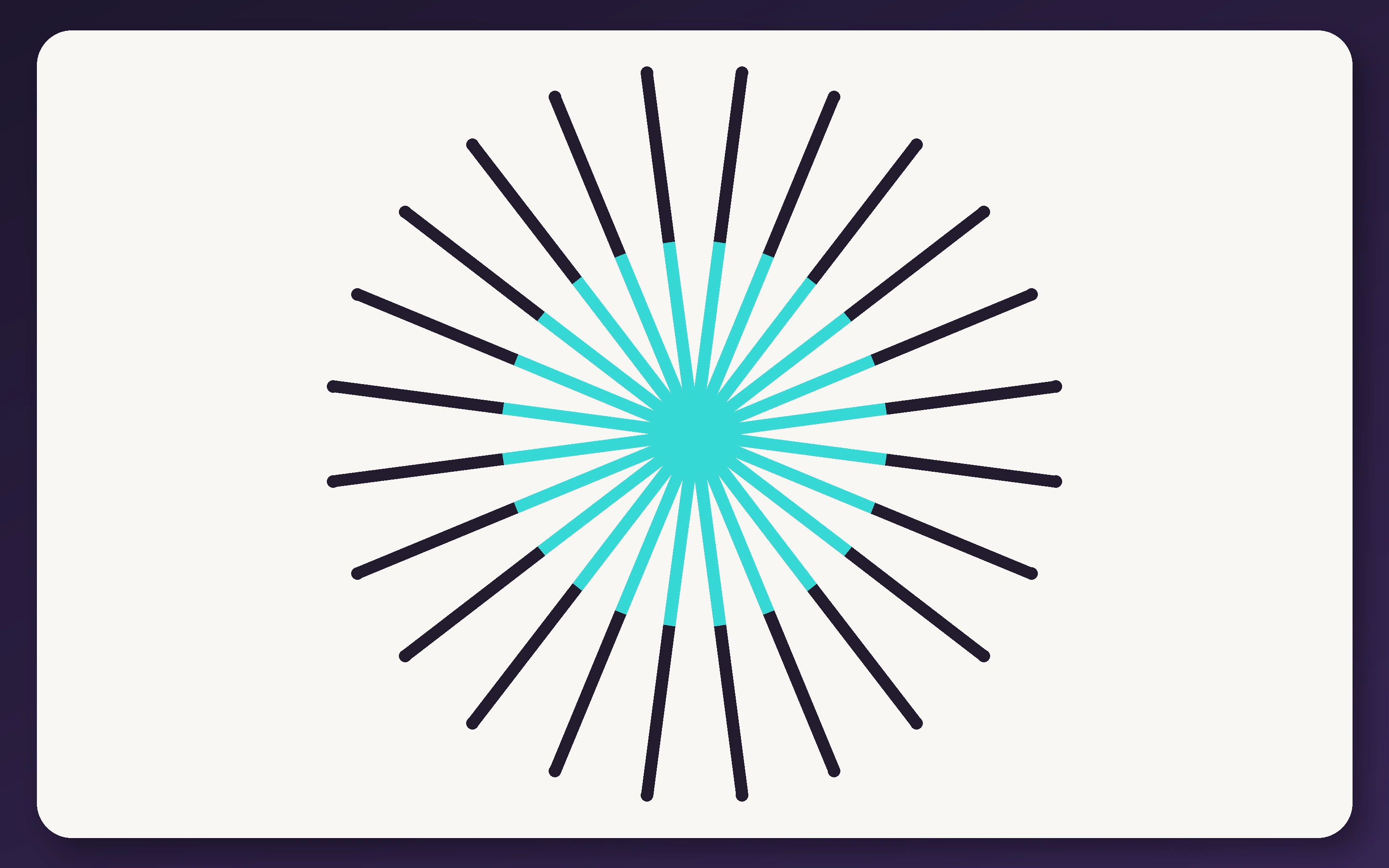
This is a Subjective Neon illusion, a colored variation of the Ehrenstein figure that combines illusory contours with neon color spreading.
The word subjective refers to the contour and surface being experienced even though they have no complete physical boundary in the image.
What Is Actually Drawn?
The display contains 24 continuous radial lines.
Each line is cyan near the center and changes to dark purple farther out. All of those color-transition points lie along one invisible circle.
The cyan segments do not widen to cover the spaces between neighboring spokes. They remain narrow lines from the center to the transition boundary.
However, the visual system groups the transitions into one circular contour. A diluted version of the cyan then seems to spread across the uncolored gaps enclosed by that contour.
The resulting disk may look brighter, hazier, or more transparent than an ordinary flat patch of cyan.
The Proof: The Background Never Changes Color
The proof image marks the circle formed by the aligned color transitions.
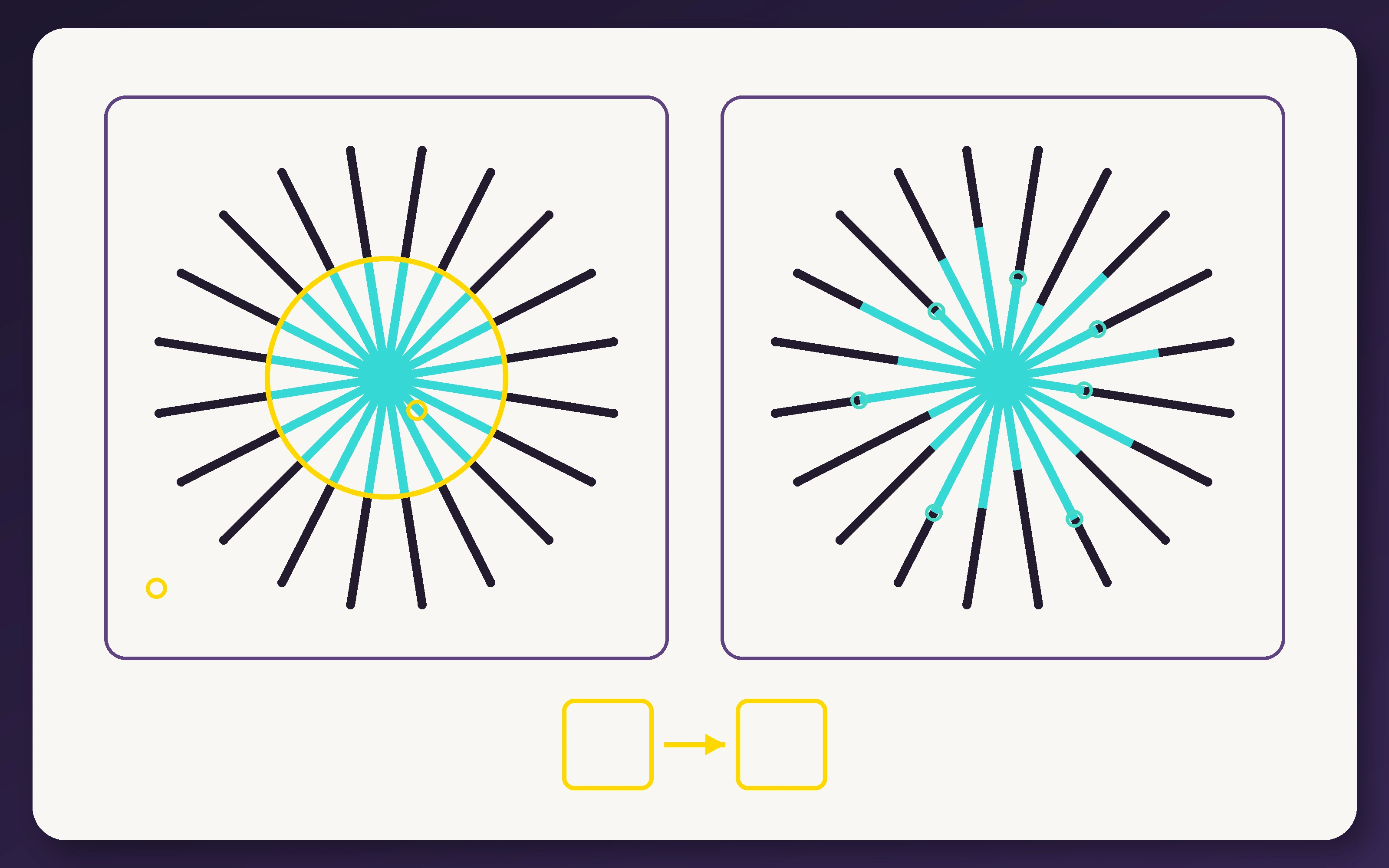
On the left, every cyan-to-dark transition falls along the gold circle. The gold line is only an explanatory overlay and is absent from the main illusion.
On the right, the same colors and number of spokes remain, but the transitions occur at irregular distances from the center. Without one coherent boundary, the circular veil generally becomes weaker or less stable.
The two isolated swatches at the bottom are identical. One represents the background between the cyan spokes, while the other represents the background outside the apparent disk.
Why the Transition Points Create a Boundary
The visual system searches for orderly relationships among separate edges and line endings.
When many color transitions follow one smooth circular path, treating them as parts of a shared boundary is more useful than processing them as unrelated local changes.
The spokes also continue through the transition rather than stopping there. This continuity encourages the dark outer lines to appear behind or beneath a transparent cyan surface.
The result resembles one layer placed over another: a dark radial pattern below and a translucent colored disk above.
The Ehrenstein Illusion creates a bright central disk from aligned line endings without using colored inner segments. Subjective Neon adds color continuity, making the unwritten surface appear softly tinted.
The Neon Effect in an Ehrenstein Figure
Christoph Redies and Lothar Spillmann studied this specific combination of an Ehrenstein figure and colored connecting elements.
In their study of the neon color effect in the Ehrenstein illusion, a colored cross connected dark arms across a central gap and produced a circular veil with the same hue as the colored inducer.
They found that good lateral and angular alignment was important. The colored and dark elements needed to support smooth continuation across the implied surface.
The researchers also concluded that the effect could not be explained simply by chromatic aberration or involuntary eye movements.
The current display extends that construction around a complete radial pattern. Every aligned transition contributes evidence for the same circular colored surface.
Color Spreading and the Contour Are Closely Related
The apparent cyan disk involves at least two noticeable features:
First, there is a circular boundary that was not physically drawn. Second, color appears across regions that contain no cyan pixels.
These features are closely connected, but they are not necessarily identical processes.
In experiments on luminance contrast, Takeo Watanabe and Takao Sato found conditions in which color spreading remained while the illusory contour weakened or disappeared.
This showed that a visible boundary is not always required for every local spreading effect.
However, a later study of color spreading and illusory contours found a strong relationship between contour visibility and broad global spreading.
When aligned elements created a coherent illusory boundary, the color tended to fill the area enclosed by it. Misalignment weakened both the contour and the larger colored surface.
The evidence therefore supports interaction rather than one process being a simple by-product of the other.
Why the Disk Looks Transparent or Luminous
The dark spokes continue through the cyan area without appearing cut apart.
This suggests that the underlying structure remains present beneath another layer. The visual system can separate the physical pattern into a dark base and a transparent colored overlay.
Because the cyan is perceived across a light background without a solid painted boundary, it may look like illumination rather than pigment.
The term “neon” describes this glowing appearance. The screen is not producing extra light inside the virtual disk beyond the light already emitted by the cream background and narrow cyan lines.
What Brain Imaging Suggests
Illusory color is not represented in exactly the same way as merely imagining a colored disk.
In a 2024 high-resolution fMRI study, researchers compared real color, imagined color, and neon color spreading.
Information about the illusory color could be decoded in superficial portions of primary visual cortex near the represented illusory boundaries. Imagined color showed a different cortical-depth pattern.
The results support the idea that illusory color depends on interactions and feedback within visual processing rather than being equivalent to deliberately picturing a color in your mind.
Try a Related Color Test
The Subjective Neon illusion produces a broad perceived tint where the physical color is confined to narrow lines.
Cognitive Train’s Color Hue Test measures your ability to discriminate and order color differences that are genuinely present:
The Contrast Sensitivity Test explores a related visual ability by measuring how faint a real brightness difference can become before it disappears into the background.
How It Differs From Neon Color Spreading
The Neon Color Spreading Illusion previously shown on Cognitive Train uses a rectangular lattice whose lines change from black to cyan inside a virtual circle.
That pattern demonstrates how multiple transition points distributed across a grid can create a transparent-looking disk.
Subjective Neon uses radial spokes based on the Ehrenstein configuration. Its transitions simultaneously create a circular subjective contour and a colored central surface.
The perceptual family is the same, but the geometry and grouping cues differ.
How It Differs From the Watercolor Illusion
The Watercolor Illusion uses two differently colored contours running beside one another around an enclosed region.
Its spreading usually appears like a faint opaque wash belonging to a solid figure.
Subjective Neon uses colored segments that continue into darker lines. The completed surface more often appears transparent, luminous, or layered over the underlying pattern.
How It Relates to the Kanizsa Triangle
The Kanizsa Triangle Illusion also creates boundaries and a bright surface without drawing the complete shape.
Kanizsa’s figure relies strongly on corner-shaped inducers and apparent occlusion. Subjective Neon uses aligned color transitions and continuous lines to support both contour completion and color spreading.
What It All Comes Down To
The Subjective Neon illusion places cyan segments inside dark continuous spokes.
When the color transitions align along one invisible circle, the visual system groups them into a subjective boundary. Cyan then appears to spread across the physically uncolored spaces enclosed by that boundary.
Disrupting the alignment weakens the circular surface, even though the same colors and similar amounts of cyan remain.
For more false contours, color spreading, brightness effects, and ambiguous figures, browse the full Optical Illusions guide. Cognitive Train’s brain tests explore perception, attention, speed, and reasoning, while its free brain training tools offer more ways to challenge visual processing.