Kanizsa Triangle Illusion
Your brain draws three sharp sides, fills in a bright surface, and places it in front, even though none of those things appear in the image.
Look at the center of the figure below. Most people see a crisp white triangle pointing upward. It appears to sit on top of three black circles and another triangle underneath it. The central shape may even look slightly brighter than the white background around it.
Now inspect its sides carefully. No line connects one corner to the next. No white triangle has been drawn. The background inside and outside the apparent shape is physically identical.
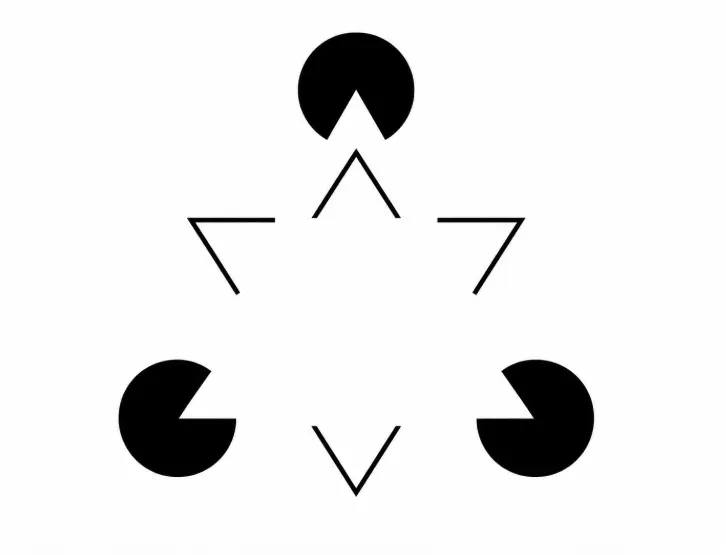
The Kanizsa Triangle is an example of an illusory contour, sometimes called a subjective contour. Your visual system creates a boundary where the image contains no continuous change in brightness, color, or texture.
The effect is more than recognizing a familiar shape. The triangle appears to have a definite edge, occupy the foreground, and partly cover the black figures beneath it.
What Is Actually Drawn?
The figure contains three black circular shapes with wedge-shaped sections removed. They are often called “Pac-Man” inducers because each resembles the video-game character with an open mouth.
Between them are three incomplete angles. Their gaps and line endings all point toward the corners of an upward-facing triangle.
Your brain treats those aligned interruptions as evidence that a white object is lying in front and hiding parts of the darker shapes. Once that interpretation takes hold, the missing sides are completed between the corners.
This is why the black forms do not usually look like random broken circles. They look like complete objects partly hidden behind a foreground surface.
Why Your Brain Completes the Triangle
Objects in everyday life are constantly obscured. A person passes behind a fence. A cup is partly hidden by a book. Tree branches vanish behind leaves and reappear farther away.
If the visual system treated every interruption as the end of an object, the world would appear fragmented. Instead, the brain connects compatible edges and assumes that surfaces continue behind whatever blocks them.
The Kanizsa Triangle activates this useful completion process without supplying a real foreground object. The openings line up too neatly to feel accidental. The simplest interpretation is that one triangular surface covers all three black circles.
This reflects the Gestalt principle of closure: separated visual elements are often organized into complete forms. But closure is only part of the effect. The brain also assigns the apparent triangle foreground status and treats the black shapes as continuing behind it.
A related skill is isolating a meaningful shape from distracting visual information. Cognitive Train’s test measures how quickly you can find a target figure inside a more complicated design:
Why the Triangle Can Look Brighter
The inside of the apparent triangle contains the same white pixels as the rest of the page. Nevertheless, many viewers experience it as slightly brighter, cleaner, or more solid.
Once the visual system decides that a foreground triangle is present, it does more than sketch three imaginary lines. It organizes the enclosed area as one coherent surface. That region can then appear perceptually different from the surrounding background even without a physical brightness boundary.
The Checker Shadow Illusion demonstrates another form of contextual brightness. There, shadow interpretation makes identical gray areas look different. In the Kanizsa Triangle, surface completion makes an unchanged white region seem more distinct.
Where the Kanizsa Triangle Came From
The illusion is named after Italian psychologist Gaetano Kanizsa, an influential researcher in Gestalt perception. Illusory contours had been noticed before his work, but his carefully arranged figures made the phenomenon especially clear.
In his 1976 article on subjective contours, Kanizsa showed that boundaries without physical lines can behave much like real contours. They can define surfaces, separate figure from ground, and influence how neighboring shapes are perceived.
The triangle became a compact demonstration of a larger principle: the visual system does not only detect boundaries already present in an image. It can construct boundaries when they provide the most coherent explanation of incomplete information.
Does the Brain Respond to the Missing Edge?
Neuroscience research indicates that illusory contours are represented in visual areas that also respond to real boundaries.
In a study by Tai Sing Lee and My Nguyen, researchers recorded responses from neurons in visual areas V1 and V2 while monkeys viewed Kanizsa-type figures. Neurons responded to the location and orientation of the perceived contour even though no physical line crossed their receptive fields.
The responses appeared earlier and more strongly in V2 than in V1. The timing was consistent with interaction between the two areas, including the possibility that feedback from V2 contributes to later responses in V1, rather than proving one exact processing sequence.
The finding does not mean the brain literally draws a glowing triangle. It shows that the inferred boundary is represented in a way that resembles the processing of a real edge.
Later work by Banica and colleagues examined whether Kanizsa contours could still be perceived when the surrounding inducing shapes were suppressed from awareness. The results found little evidence for reliable contour perception when the inducing context itself was not consciously available.
That supports the idea that the illusion depends on organizing the display as a whole, not merely reacting automatically to three isolated corners.
What Makes the Illusion Stronger or Weaker?
The Kanizsa Triangle is sensitive to how its pieces are arranged.
Alignment matters. The open wedges must point toward compatible corners. Rotating one away from the center weakens the triangle.
Distance matters. Moving the inducers too far apart creates a larger unsupported gap, making completion less convincing.
Support matters. The illusion becomes stronger when more of the implied boundary is suggested by physical edges. Researchers call this the support ratio.
Symmetry helps. A balanced arrangement makes one coherent foreground object more plausible than several unrelated gaps.
Contrast helps. Dark inducers against a bright background generally create a clearer figure than weak, low-contrast shapes.
Why Knowing the Trick Does Not Remove It
Once you know the triangle is not physically drawn, you can identify every component of the display. Yet the white triangle usually remains visible.
Knowledge does not erase the grouping cues. The openings still suggest occlusion, the line endings still point toward common boundaries, and the arrangement still favors one foreground surface over several unrelated accidents.
This is similar to Rubin’s Vase. Knowing that both the vase and faces are present does not prevent figure-ground organization from favoring one interpretation at a time.
What the Illusion Reveals
The Kanizsa Triangle demonstrates that perception is constructive. Your brain does not wait for every boundary to be supplied. It searches for the organization that best explains the fragments reaching the eyes.
That strategy is useful in cluttered real scenes, where objects are often partly hidden or interrupted. The illusion turns that strength against itself: the same system that helps you recognize incomplete objects confidently invents a foreground triangle from carefully aligned gaps.
This differs from the Hermann Grid Illusion, where gray patches appear at physically uniform intersections. The Kanizsa Triangle does not add scattered spots. It constructs a complete shape, surface, and depth relationship.
What It All Comes Down To
The Kanizsa Triangle contains no complete triangle, yet you see sharp edges, an enclosed surface, and an object apparently covering the shapes beneath it.
Your brain supplies those missing features because the completed triangle is the most coherent explanation of the available visual evidence.
For more examples of constructed edges, impossible depth, changing brightness, and competing figures, browse the full Optical Illusions guide. Cognitive Train’s brain tests explore attention, reasoning, processing speed, and related abilities, while its free brain training tools offer more ways to challenge perception and cognition.