Aim Test vs Reaction Time Test: Which One Is Right for You?
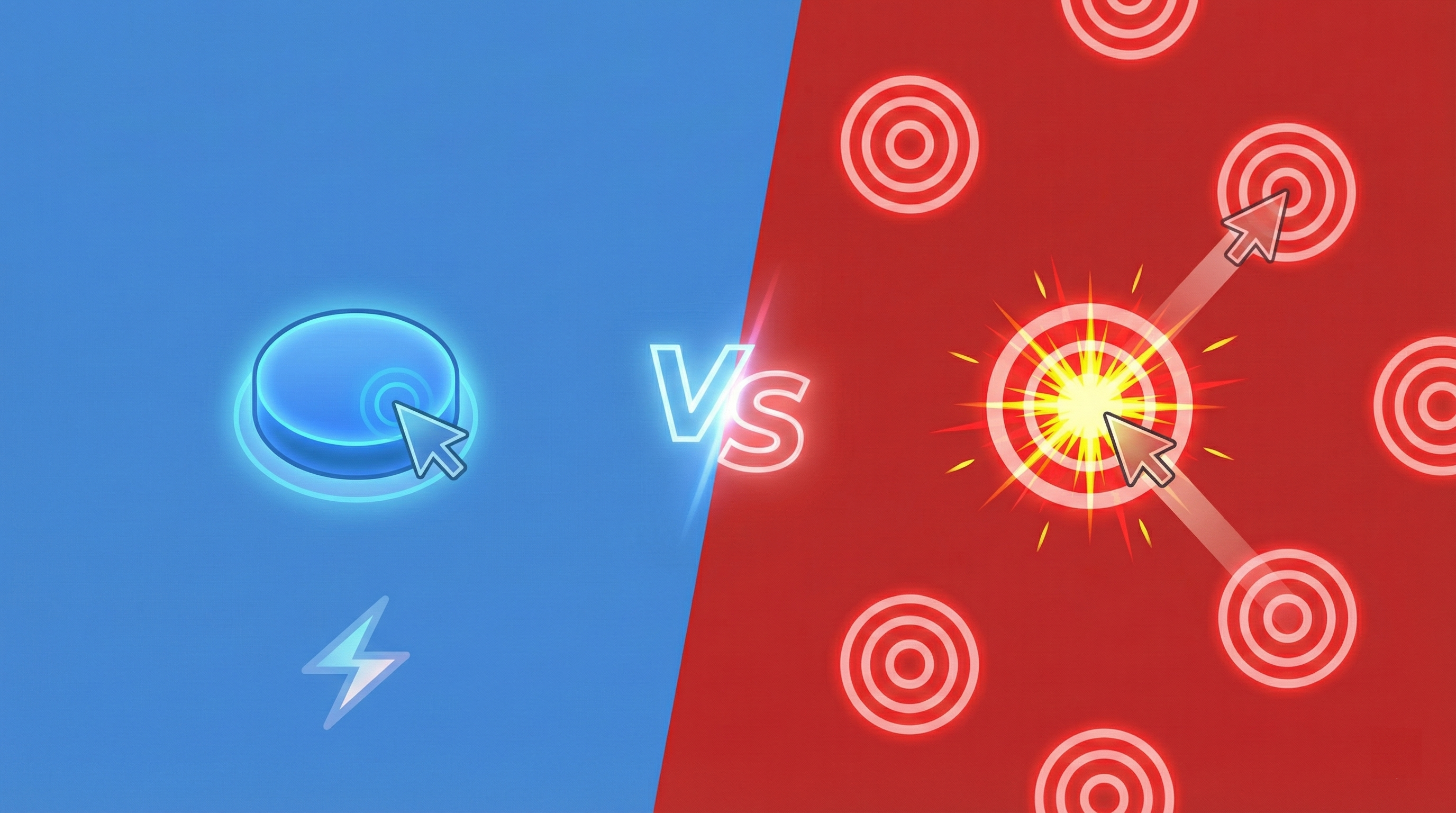
You want faster reactions. But when you search for ways to measure and improve them, you find two different types of tools: simple reaction time tests and aim tests. They both involve clicking as fast as possible—so what's the difference, and which one should you use?
The short answer: they measure different things. A reaction time test measures how quickly you can respond to a stimulus—pure speed from seeing something to clicking. An aim test measures that same speed plus the precision required to hit a specific target. Both are valuable, but they train different skills and suit different goals.
What a Simple Reaction Time Test Measures
A simple reaction time test strips everything down to the basics: wait for a signal, click as fast as possible. There's no aiming, no decision-making, no distractors. You're measuring the raw speed of your visual processing and motor response—how fast the signal travels from your eyes to your brain to your finger.
This is useful as a baseline. A large-scale study of 1,469 participants found mean simple reaction times of 231ms (213ms when corrected for hardware delays), with times increasing slightly with age. If you've never tested yourself, a simple reaction time test tells you where you stand without other variables complicating the picture.
Simple reaction tests are also better for isolating how specific factors affect your speed. Want to know if caffeine actually helps your reactions? Or how much lack of sleep is slowing you down? A simple test measures just the reaction component—no aiming variance mixed in—so you can see the effect more clearly.
What an Aim Test Measures
An aim test adds a critical layer: you don't just click fast, you click fast and accurately. Targets appear at random positions, and you need to move your cursor (or finger) to hit them. This engages your hand-eye coordination—the ability to translate visual information into precise motor movements.
Research on motor acuity in aiming tasks shows that aim tests measure the speed-accuracy tradeoff—the balance your brain constantly makes between moving fast and hitting precisely. This involves complex coordination between visual processing and motor execution.
This means aim test scores reflect a combination of reaction time and motor control. Someone with a 220ms simple reaction time might average 400ms on an aim test—not because they got slower, but because the aiming component adds time. That's not a flaw in the measurement; it's the point.
Testing vs Training: Both Tools Work for Improvement
Here's something many people miss: these "tests" aren't just for one-time measurement. They're training tools. Research confirms that reaction time is trainable—repeated practice on reaction tasks produces measurable improvements that transfer to real-world performance.
A study on vision training in athletes found that targeted practice reduced reaction times by over 10%, with improvements remaining stable over weeks. The key is consistency: brief daily sessions outperform occasional long sessions.
Both simple reaction tests and aim tests can serve as training tools. The question is which one better matches what you're actually trying to improve.
When Simple Reaction Time Tests Are Better
Choose a simple reaction time test when:
You want a pure baseline. If you're tracking how factors like sleep, caffeine, or aging affect your raw reaction speed, simple tests give cleaner data. There's no aiming variance to muddy the results.
Your real-world task is stimulus-response without precision. Think hitting the brakes when you see brake lights, starting a sprint when you hear the gun, or pressing a button when a notification appears. These situations reward pure speed—the target is obvious and doesn't require precise motor control.
You're building foundational speed first. If your simple reaction time is slow (say, 300ms+), there's more room for improvement there before adding the complexity of aiming. Get your baseline faster, then layer on precision training.
For sprint-specific reaction training, the Sprint Start Reaction Test simulates the actual "On your marks, set, GO!" sequence athletes face. For situations requiring impulse control alongside speed, the Go/No-Go Test trains you to react quickly while suppressing responses to the wrong stimuli.
When Aim Tests Are Better
Choose an aim test when:
Your real-world task requires precision under time pressure. Gaming is the obvious example—clicking on enemies, selecting abilities, or navigating menus all require fast and accurate movements. But this also applies to sports (hitting a ball, catching a pass), music (playing the right key at the right time), and many work tasks (quickly selecting interface elements).
You've plateaued on simple reaction time. Once you're consistently hitting 200-220ms on simple tests, you're approaching human limits for that specific skill. Further improvement requires training different aspects of performance—and aim tests target the motor precision that simple tests ignore.
You want training that feels more like your actual activity. If you're a gamer training for FPS performance, clicking stationary targets is closer to what you'll actually do than clicking a single button when the screen changes color. The specificity principle in motor learning suggests that practice should resemble the target task.
Multi-Target Aim Training: Adding Selective Attention
Standard aim tests present one target at a time. But many real-world situations involve multiple objects, distractors, and split-second decisions about what to click, not just clicking fast.
The Multi-Target Aim Trainer addresses this by presenting multiple targets simultaneously—some correct, some distractors. You configure which attributes define a "correct" target (color, shape, or size), then click only matching targets while ignoring others.
This trains selective attention: the ability to filter relevant information from noise while maintaining speed and accuracy. Research on visual selective attention shows this is a distinct cognitive skill from raw reaction time, and improvements can be observed even after relatively brief training sessions.
Multi-target training is particularly valuable for:
Team-based gaming. Distinguishing enemies from teammates in chaotic fights requires exactly this filtering ability. You can't just click fast—you need to click the right targets fast.
Sports with multiple players. A soccer goalkeeper tracking the ball among moving players, a basketball player finding the open teammate, a tennis player reading opponent positioning—all require filtering relevant visual information while preparing motor responses.
Driving hazard detection. Scanning traffic for potential hazards means processing multiple moving objects and identifying which ones require response. This is selective attention under time pressure.
A Practical Training Approach
Rather than choosing one tool exclusively, consider a progression:
Start with simple reaction time testing. Get your baseline. If it's above 250ms, there's room for quick gains with a few weeks of daily practice on the basic reaction test.
Add aim training once your baseline is solid. When simple reaction time is consistently under 230ms, start incorporating aim test sessions. You'll likely start around 400-500ms average—that's normal. Track improvement over time.
Progress to multi-target training for cognitive complexity. Once basic aim performance is consistent, the Multi-Target Aim Trainer adds the selective attention layer. This is where training starts to feel more like real performance situations.
Maintain variety. Periodically return to simple reaction tests to ensure your baseline isn't degrading. Different tools stress different components of the reaction-to-action chain, and maintaining all of them produces more robust real-world transfer.
The Bottom Line
Simple reaction time tests measure pure speed. Aim tests measure speed plus precision. Neither is universally "better"—they serve different purposes.
If you want to know your raw reaction speed or track how lifestyle factors affect it, use a simple reaction time test. If your goals involve precision under pressure—gaming, sports, or any task requiring fast accurate movements—an aim test is more relevant training. And if your real-world challenges involve filtering distractors while maintaining speed, the Multi-Target Aim Trainer adds that cognitive dimension.
The best approach for most people: test your simple reaction time to establish a baseline, then train with whatever tool most closely matches what you actually need to perform. Consistent practice—even just 5-10 minutes daily—produces measurable improvement regardless of which tool you choose.