Left Hand vs Right Hand Reaction Time – This Test Shows How Your Weak Hand Costs You in Sports, Music, and Gaming
You already know one hand is faster than the other. But do you know how much faster? And more importantly, do you realize how that gap affects your performance when both hands need to work together under pressure?
Research confirms what you might suspect: your dominant hand consistently outperforms your non-dominant hand in reaction time tasks. In one study, participants showed faster reaction times with their dominant hand compared to their non-dominant hand—the difference was consistent across the sample. If you've ever wondered whether you can actually improve reaction time, understanding this hand asymmetry is a good starting point.
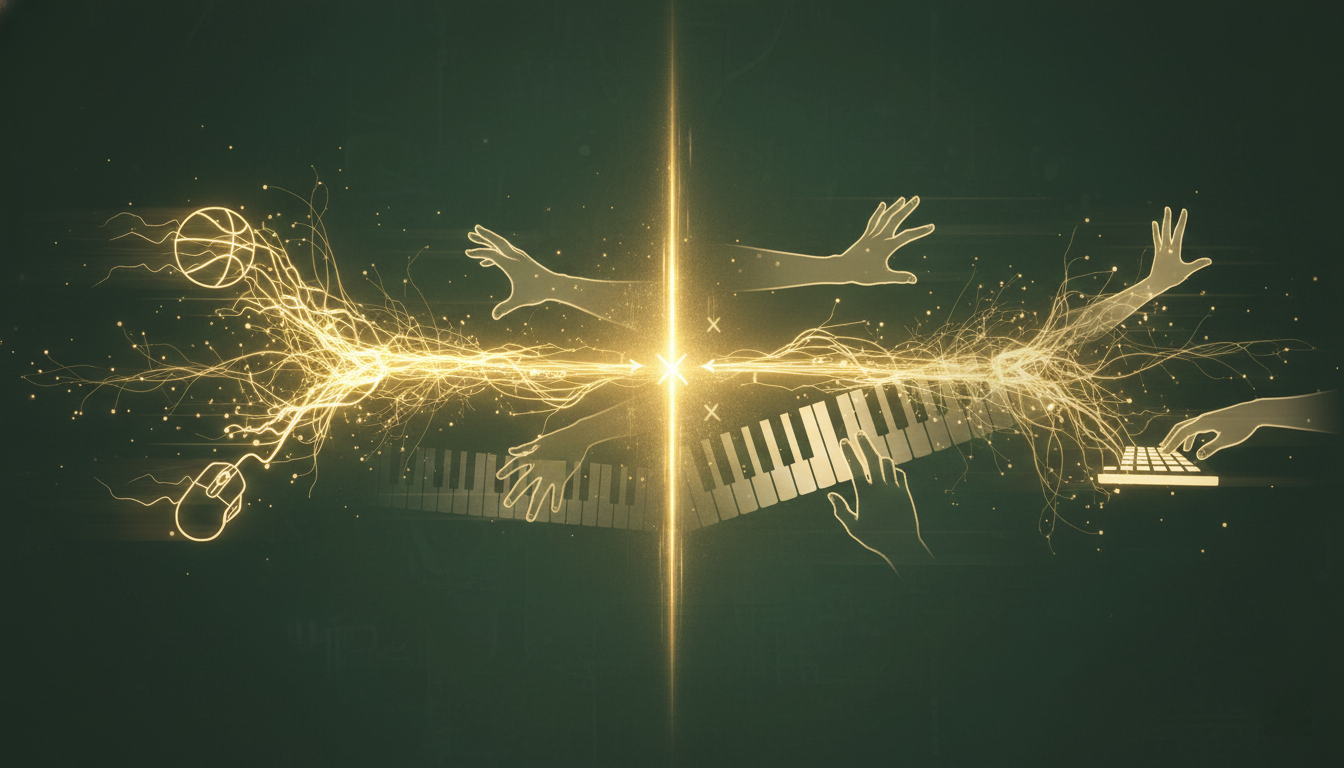
But here's what most people miss: that reaction time gap becomes a real problem in activities that require both hands to respond quickly and independently. Whether you're blocking a shot in basketball, playing a piano passage that demands rapid alternating hands, or executing a complex keyboard-and-mouse maneuver in a competitive game, your slower hand becomes the weakest link in the chain.
Why Your Non-Dominant Hand Is Slower
The reaction time difference between your hands isn't random—it's rooted in how your brain is organized. Your dominant hemisphere (typically the left hemisphere for right-handers) has developed more efficient neural pathways for motor control through years of preferential use.
Research from Penn State University found that the dominant hand shows shorter reaction times during hand selection tasks, suggesting a built-in bias in how quickly your brain can initiate movement with each hand. The dominant hemisphere appears specialized for predicting the complex forces involved in limb movement, while the non-dominant hemisphere handles different aspects of motor control like maintaining steady positions.
This specialization creates an asymmetry. When a stimulus demands an immediate response, your brain can mobilize your dominant hand faster because those neural circuits are more refined and frequently used. Your non-dominant hand, while perfectly capable, takes slightly longer to get the signal and execute the response. This is one reason why training reaction time often requires targeting each hand separately.
How Big Is the Gap?
The size of the gap varies by individual and task type, but research consistently finds measurable differences between hands.
Research examining reaction times in individual sports athletes—boxers, judokas, taekwondo practitioners, and others—found measurable differences in simple, recognition, and cognitive reaction times between dominant and non-dominant hands. Interestingly, the pattern wasn't uniform: athletes showed better simple reaction times with the left hand but better recognition and cognitive reaction times with the right hand, regardless of which was dominant.
This suggests the gap isn't just about raw speed. It's about how quickly each hand can respond to different types of demands—simple reflex versus complex decision-making.
Where the Gap Hurts You: Sports
In sports requiring bilateral coordination, your non-dominant hand can become a liability. Consider basketball: dribbling with your weak hand while scanning the court for passing lanes requires that hand to react just as quickly as your dominant one. Defenders know to force players toward their weak side precisely because that hand responds slower and less precisely.
Combat sports present even more demanding scenarios. Research on hand-eye coordination in combat sports players found these athletes demonstrated the shortest reaction times and lowest error rates in motor coordination tests compared to other groups. The reason? Their training explicitly develops both hands to respond rapidly and accurately. A boxer who can only block effectively with one hand or a tennis player who struggles with backhand volleys has an exploitable weakness.
Team sports add another layer of complexity. Catching a pass, blocking a shot, or controlling a ball often requires whichever hand happens to be in position—not necessarily your preferred one. If your weak-side reaction lags even slightly, that's the difference between a clean catch and a fumble, a successful block and a goal scored against you.
Where the Gap Hurts You: Music
Musicians face a unique bilateral challenge. Piano playing, in particular, demands that both hands execute complex, independent movements with precise timing—at speeds that push the limits of human motor control. This is why piano sight-reading and reaction time are so closely connected.
Studies on expert pianists reveal they develop remarkable finger independence that transcends normal neurophysiological and biomechanical constraints. This independence doesn't come naturally—it requires extensive training to overcome the brain's default tendency toward synchronized bilateral movement.
Brain imaging research shows that trained pianists exhibit different activation patterns during bimanual coordination tasks compared to non-musicians. Professional pianists showed significantly better synchrony between hands and required less brain activation to achieve the same coordination, indicating more efficient neural processing. For untrained individuals, that reaction time gap between hands translates directly into timing inconsistencies—the left hand lagging behind the right (or vice versa) in passages that demand perfect synchronization.
Guitarists, drummers, and string players face similar challenges. Any instrument requiring independent hand movements will expose weaknesses in your non-dominant side's reaction speed. The hand that can't keep up becomes the ceiling on how complex your playing can become.
Where the Gap Hurts You: Gaming
Competitive gaming creates perhaps the most measurable reaction time demands. In first-person shooters, your left hand typically controls movement via keyboard (WASD keys) while your right hand controls aiming and shooting via mouse. Both hands must respond instantly and independently to threats. Tools like the Dual-Stream Reaction Test specifically measure how well you can manage independent responses from each hand simultaneously.
Research comparing elite and amateur esports players found that elite players outperformed amateurs in visual-motor reaction time for both hands. The gap between hands still existed at both skill levels, but elite players had trained both to higher baselines.
In competitive gaming, where the difference between winning and losing a gunfight is measured in milliseconds, having one hand that responds noticeably slower than the other creates a tangible disadvantage. Your weaker hand's slower response to strafe commands or ability activations can cost you crucial moments.
Fighting games present an even more direct challenge, as complex input combinations often require rapid alternating keypresses that expose any asymmetry between hands. The Multitask Reaction Test and Choice Reaction Test can help identify where your weak points are when both hands need to work together under pressure.
Can You Close the Gap?
The good news: reaction time is trainable, and the gap between hands can be narrowed with deliberate practice. Research on aging and reaction time shows that targeted practice can offset natural decline at any age—and the same principle applies to closing the gap between your dominant and non-dominant hand.
Vision training research demonstrated that 81 athletes across multiple sports achieved a mean reduction in reaction times exceeding 10% through targeted training. The improvements proved stable over days and weeks, suggesting the brain establishes new, more efficient neural patterns.
The key is specifically training your weaker hand. General reaction training won't automatically transfer—you need to challenge the non-dominant side directly. This is why bilateral training programs exist for musicians, why athletes practice skills on both sides, and why gamers do aim training with both movement and precision components.
Some training approaches that research supports:
Deliberate weak-side practice: Spending dedicated time challenging your non-dominant hand with reaction-based tasks forces those neural pathways to develop. Using your non-dominant hand for everyday tasks can strengthen underlying motor circuits over time.
Hand-switching drills: Exercises that require rapid alternation between hands train not just each hand individually but the cognitive switching process between them—essential for activities requiring bilateral independence.
Sport or instrument-specific training: Practicing the actual movements you need to perform with your weak hand in context builds task-specific reaction speed, not just general reaction time.
Test Your Gap
Before you can improve, you need to know where you stand. A left vs right hand reaction time test gives you concrete data: your average reaction time for each hand, your best times, and most importantly, the gap between them.
Knowing how big the gap is changes how you approach training. A small gap might just need maintenance. A large gap indicates significant room for improvement—and a clear target for your practice.
Most people never measure this. They assume their weak hand is "a little slower" without quantifying what that means for their performance. Testing gives you the baseline. Retesting after training shows you whether your efforts are working.
The Bottom Line
Your dominant hand reacts faster than your non-dominant hand. This is neurologically normal. But in any activity demanding bilateral speed and coordination—whether you're defending a goal, playing a musical passage hands-together, or clutching a 1v1 in a competitive game—that gap becomes a performance limiter.
The reaction time difference between your hands isn't fixed. Athletes, musicians, and competitive gamers who reach elite levels have typically trained both hands to respond quickly and independently. They didn't eliminate the gap entirely, but they narrowed it enough that their weak side no longer holds them back.
Understanding your gap is the first step. Training to close it is how you stop your weak hand from costing you when it matters most.