Spinning Dancer Illusion
Is the dancer rotating clockwise or counterclockwise? The animation supports both directions.
Watch the dancer below for several seconds. Which way does the figure appear to turn?
You may see a clockwise rotation and find it difficult to imagine anything else. Another viewer may immediately see counterclockwise movement. The apparent direction can also reverse suddenly while you are watching.
The animation itself never changes direction. The reversal occurs in perception.

This is the Spinning Dancer illusion, also called the silhouette illusion.
It is a kinetic bistable illusion: one moving image supports two stable interpretations, and perception may alternate between them.
What Is Actually Animated?
The dancer was constructed as a three-dimensional pose rotating steadily around a vertical axis. Each frame shows its flat silhouette.
The figure completes the same rotation repeatedly. Its limbs do not reverse their physical frame order, pause, or begin travelling backward.
However, the silhouette removes nearly all information about which parts of the body are closer to you and which are farther away.
When the extended leg crosses the body, it could be passing in front. It could just as easily be passing behind. Each choice produces a different three-dimensional interpretation and an opposite apparent direction of rotation.
Why the Same Frames Support Opposite Directions
A flat projection records horizontal and vertical position but loses the sign of depth.
Imagine one pose with the raised foot pointing partly toward you. Reflect the pose through the plane of the screen so the foot points equally far away from you instead. The two versions can produce the same silhouette.
If the first version rotates clockwise, the depth-reflected version can produce the same two-dimensional frame sequence while appearing to rotate counterclockwise.
Your visual system therefore has to add missing depth information. Once it chooses which leg and arm are in front, the rotation appears stable and obvious.
Reassign those features to the opposite depth plane, and the dancer reverses without a single pixel changing.
The Proof: The Animation Never Reverses
The proof image shows the same three frames twice in the same playback order.
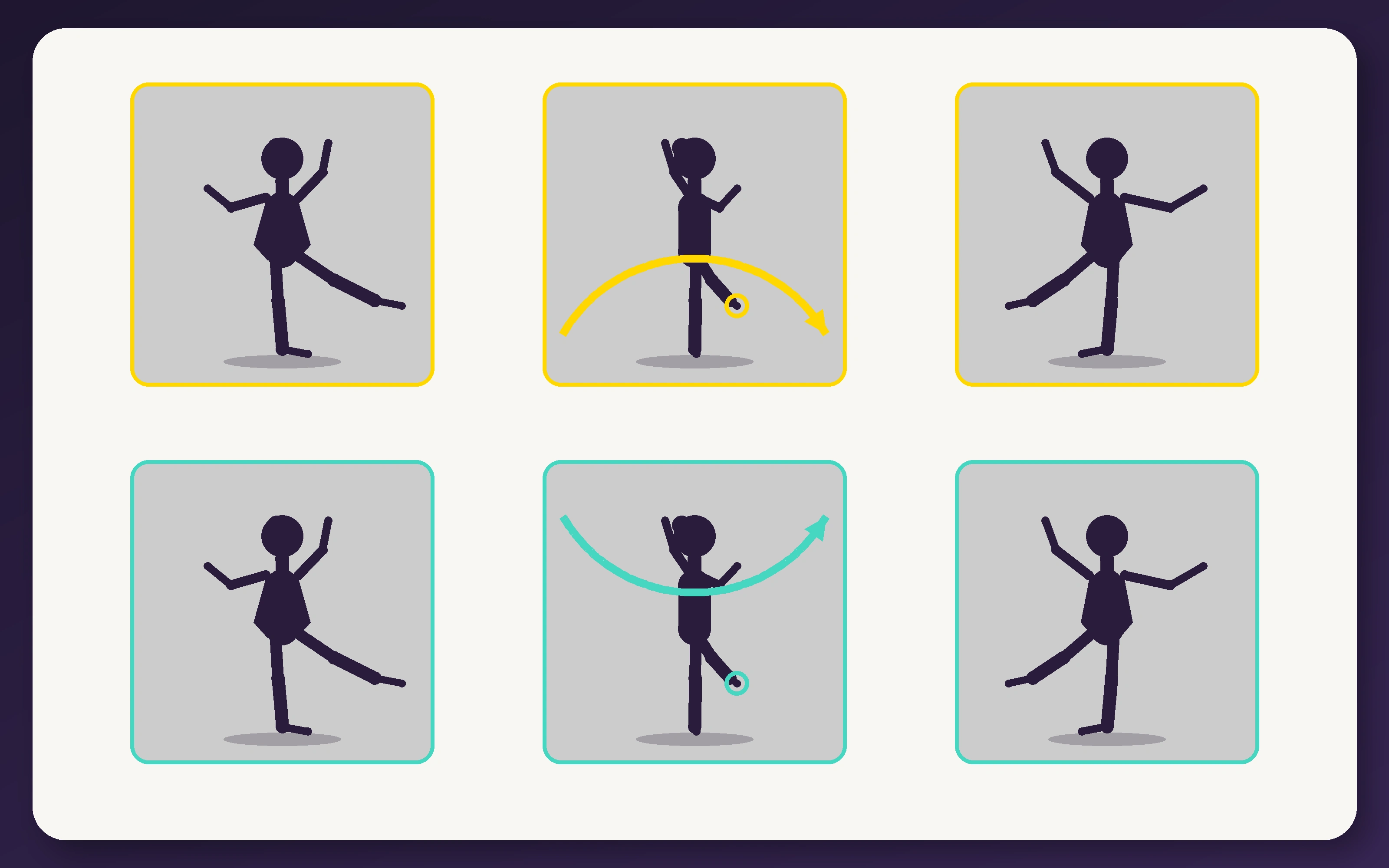
The marked foot occupies the same projected position in both rows. The difference is whether you interpret it as travelling through the near side or the far side of its circular path.
Adding a reliable depth marker would force one reading. Without that marker, both remain compatible with the animation.
Why One Direction Often Appears First
The two interpretations are possible, but they may not be equally likely under every viewing condition.
The famous version created by Japanese web designer Nobuyuki Kayahara in 2003 was viewed from a slightly elevated angle.
In a study by Nikolaus Troje and Matthew McAdam, researchers recreated the illusion while varying the virtual camera height.
They found evidence for a viewing-from-above bias. Observers tended to prefer the interpretation that made the figure appear to be viewed from above rather than below.
This could create an apparent clockwise preference in a particular animation without demonstrating a universal mental preference for clockwise motion.
Can You Make the Dancer Reverse?
Some people can switch direction deliberately, while others experience only spontaneous reversals.
Try concentrating on the extended foot when it crosses the body. Imagine that it has moved behind the supporting leg instead of in front. A blink or brief glance away may also loosen the current interpretation.
You can also focus on one arm and reinterpret whether it is moving toward you or away from you.
In a 2012 study using a silhouette spinner, participants could influence which direction they perceived, but intention did not give unlimited control over the illusion.
Sensory competition and spontaneous switching remained important even when viewers actively tried to maintain or reverse one interpretation.
What Removes the Ambiguity?
The illusion weakens when the animation gains dependable front-and-back information.
Shading can show which side of the body faces a light source. Visible facial features can reveal when the dancer faces toward you. Different colors on the near and far limbs can establish which one crosses in front.
Michael Bach’s Silhouette Illusion demonstration shows that adding lighting or other depth cues can disambiguate the rotation.
Transient occlusion cues have also been used experimentally to push perception toward one direction before returning viewers to the ambiguous silhouette.
Once the added cues disappear, the competing interpretation may eventually return.
It Is Not a Left-Brain or Right-Brain Test
The Spinning Dancer became widely shared online with claims that rotation direction revealed whether someone was “left-brained” or “right-brained.”
Those claims are not supported by the illusion or by established neuroscience.
Seeing one direction reflects how the visual system resolves missing depth at that moment. It does not diagnose creativity, mathematical ability, personality, intelligence, or dominance of one cerebral hemisphere.
Individual differences in switching can be studied scientifically, but one initial glance cannot provide a meaningful psychological profile.
Where the Illusion Came From
Nobuyuki Kayahara created the famous original silhouette animation in 2003.
It spread widely online several years later, often without Kayahara’s name and sometimes with unsupported personality claims attached.
The animation used on this page is an original Cognitive Train construction based on the same perceptual principle. It does not reproduce Kayahara’s dancer or frame sequence.
Try a Related Switching Test
Perceptual switching changes the interpretation of one constant stimulus. Cognitive task switching involves changing between explicit rules.
Cognitive Train’s Task Switch Test asks you to alternate between color and shape decisions while measuring accuracy, reaction time, and switch cost:
The Mental Rotation Test provides a related spatial challenge by asking whether shapes remain identical after rotation or have been reflected.
How It Relates to Other Ambiguous Illusions
The Necker Cube Illusion switches between two possible depth orientations without changing its lines.
The Duck-Rabbit Illusion changes when a duck’s bill is reorganized as a rabbit’s ears. My Wife and My Mother-in-Law reassigns the same facial features to two people of different ages.
The Spinning Dancer adds continuous motion. The ambiguity concerns not only which body part is in front, but also which direction the complete figure is rotating.
It differs from the Motion Aftereffect, where real movement produces later illusory motion in a stationary image, and from the Rotating Snakes Illusion, where a completely static pattern appears to move.
What It All Comes Down To
The Spinning Dancer contains a fixed animation whose silhouette provides no reliable front-and-back information.
The visual system can interpret the same projected limbs as travelling through either side of three-dimensional space. Those depth assignments produce opposite apparent rotations.
The dancer never reverses, but your reconstruction of the dancer can.
For more ambiguous figures, false motion, impossible objects, and size distortions, browse the full Optical Illusions guide. Cognitive Train’s brain tests explore perception, attention, speed, and reasoning, while its free brain training tools offer more ways to challenge visual thinking.