Necker Cube Illusion
The lines never move, but the cube suddenly turns itself inside out.
Look at the wireframe cube below. At first, one square face probably appears closest to you. Keep looking without tracing the lines too carefully. After a few seconds, the cube may flip: the face that seemed to be at the front moves to the back, while the opposite face comes forward.
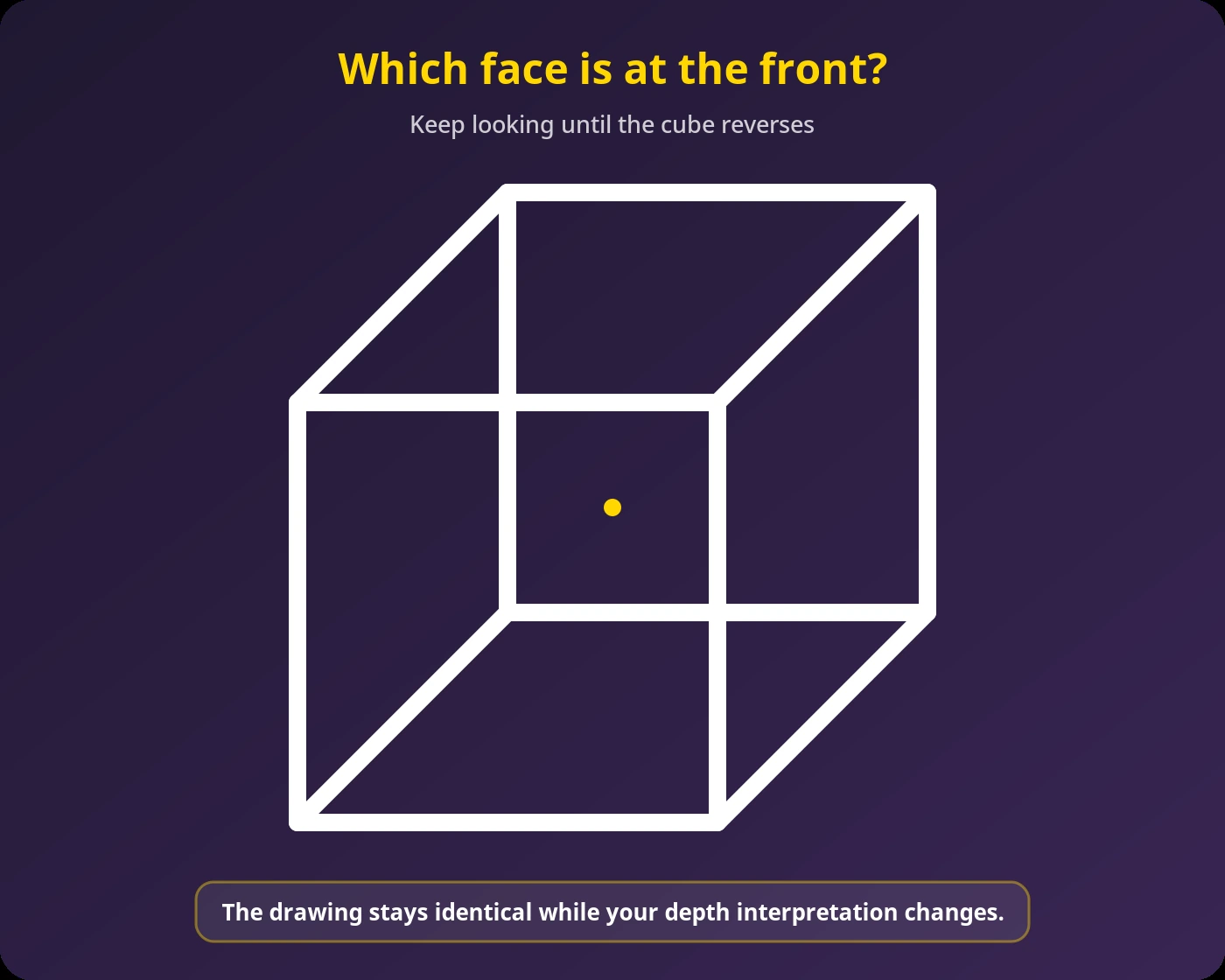
The image itself never changes. No line moves, no shading reverses, and no animation is running. The flip happens entirely in perception.
The Necker Cube is a classic example of bistable perception: one visual stimulus supports two stable interpretations, but your brain normally commits to only one at a time. When the balance changes, the entire three-dimensional structure seems to reverse in an instant.
Why the Cube Is Ambiguous
A normal cube contains depth information that tells you which corners are closer. Binocular vision, perspective, shading, overlap, and motion can all help establish its orientation.
The Necker Cube removes most of those clues. It is made from two offset squares joined by four diagonal lines, with every edge drawn at equal strength. Nothing clearly states which square lies in front.
Your brain nevertheless interprets the flat drawing as a three-dimensional object. It chooses one square as the nearer face and treats the connecting lines as edges receding into depth.
The opposite interpretation is equally compatible with the drawing. The supposed back face can become the front, reversing the direction of every connecting edge without changing a single line.
What Changes When the Cube Flips?
The reversal is not limited to one corner. Your whole interpretation changes together.
A line that seemed to travel away from you now appears to approach. A corner that looked hidden behind the cube becomes a near corner. The upper surface may become the underside, and the cube can seem to tilt from an above-view to a below-view.
This all-or-nothing reorganization shows that the brain is not interpreting each line independently. It groups the lines into one coherent spatial model. When one depth relationship reverses, the rest must reverse with it.
The same broader principle appears in Rubin’s Vase. There, one border can belong either to a vase or to two faces. In the Necker Cube, the competing interpretations are two orientations of the same object.
Can You Control the Flip?
You can influence the cube, although control is rarely perfect. Looking toward one corner or mentally treating one square as the front can make the corresponding orientation more likely.
Research by Meng and Tong found that selective attention can bias bistable perception. Participants could increase the dominance of a chosen interpretation, but attention did not give them unlimited power to freeze it permanently.
Try looking closely at the lower-left square and imagining it as a window facing you. Then move your attention toward the upper-right square. The cube may reverse shortly afterward.
That mental manipulation draws on spatial visualization. Cognitive Train’s test measures a related ability by asking you to recognize objects after they have been turned in three-dimensional space:
Why the Cube Eventually Reverses
If one interpretation is reasonable, why does the brain not simply keep it?
One explanation involves adaptation. Neural populations supporting the current orientation may gradually become less dominant, allowing the competing interpretation to take over. Once the second orientation has dominated for a while, the balance can shift again.
Attention, eye movements, expectations, and moment-to-moment brain activity also influence when a reversal occurs. There is no single internal clock that makes every observer flip at the same rate.
In an EEG study by Piantoni and colleagues, participants watched a Necker Cube and reported each reversal. Periods in which one interpretation remained stable for longer were associated with higher posterior alpha activity. The study involved a small sample, but it linked spontaneous fluctuations in brain activity with how long a percept persisted.
The important point is that the stimulus does not force the change. The reversal reflects changing competition inside the perceptual system.
Where the Necker Cube Came From
The illusion is named after Swiss crystallographer Louis Albert Necker, who described an ambiguous drawing in 1832 while discussing crystal shapes.
He noticed that the same flat rhomboid could appear to project in two opposite directions. The observation later became a standard cube drawing and one of psychology’s best-known demonstrations of perceptual ambiguity.
The Necker Cube is especially valuable to researchers because the physical image can remain perfectly constant while conscious experience changes. That makes it possible to study differences associated with perception rather than differences in the stimulus itself.
Does the Brain Choose One Correct Answer?
There is no correct front face in the basic drawing. Both orientations fit the available information.
The cube is therefore different from a puzzle with one hidden solution. Your brain is not repeatedly making and correcting an error. It is moving between two equally defensible interpretations of incomplete depth information.
This also separates the Necker Cube from the Penrose Triangle. The Penrose Triangle presents one apparently solid object whose parts are globally inconsistent. The Necker Cube presents two possible, internally consistent cubes.
One is impossible; the other is undecidable.
Why You Usually See the Cube From Above
Although both interpretations are possible, they may not feel equally likely. Many viewers initially see the cube as though looking down on it, with its top surface visible.
This is often called the view-from-above bias. Everyday vision provides more experience looking down at objects resting below eye level than looking upward at objects above us. The visual system may therefore favor the interpretation that matches that familiar viewpoint.
Adding a small amount of shading or emphasizing selected edges can overpower the ambiguity and stabilize one orientation. Once reliable depth clues are supplied, the cube stops reversing because one interpretation becomes much more plausible than the other.
Why You Cannot See Both Cubes Clearly at Once
You can understand that two orientations are possible, but conscious perception usually presents one organized cube at a time.
The two interpretations assign opposite depth values to the same lines. One edge cannot simultaneously recede and approach within one coherent spatial model. The alternatives therefore compete rather than combine.
During a reversal, the image may briefly feel unstable or flat, but the transition is usually rapid. One complete interpretation replaces the other.
This mutual exclusivity is a defining feature of bistable perception. The brain does not give you a transparent mixture of both possibilities. It settles on one usable account of the scene until the competing account takes over.
What the Necker Cube Reveals About Vision
The cube shows how much three-dimensional structure your brain adds to a flat image. The drawing supplies lines, but perception supplies front and back, above and below, near and far.
In ordinary life, that constructive process is useful. Visual input is often incomplete, and the brain must quickly choose the interpretation most likely to describe the world.
The Necker Cube removes the evidence needed to choose confidently. Instead of refusing to interpret the drawing, the brain builds one cube, then another.
For more examples of ambiguous figures, impossible objects, invented contours, and contextual brightness, browse the full Optical Illusions guide. Cognitive Train’s brain tests explore perception, attention, processing speed, and reasoning through short interactive assessments.
What It All Comes Down To
The Necker Cube never physically turns. What reverses is the brain’s answer to an unresolved question: which face is closest?
Because the drawing supports two equally plausible depth arrangements, perception cannot settle permanently. It commits to one coherent cube, holds it for a while, and then reorganizes the same lines into the opposite orientation.
That simple flip exposes a central fact about vision. You do not merely receive the geometry in front of you. Your brain continually interprets it, chooses among possibilities, and constructs the three-dimensional world you experience.
Explore more free brain training and cognitive testing tools across Cognitive Train.