Duck-Rabbit Illusion
Do you see a duck looking left or a rabbit looking right?
Look at the drawing without trying to force either interpretation. The long shapes on the left may appear to be a duck’s open bill. The rounded form on the right then becomes the back of its head.
Now reinterpret those same long shapes as a rabbit’s ears. The rounded right edge becomes the rabbit’s nose, and the animal faces the opposite direction.
No line moves or changes. The same marks support two complete animals.
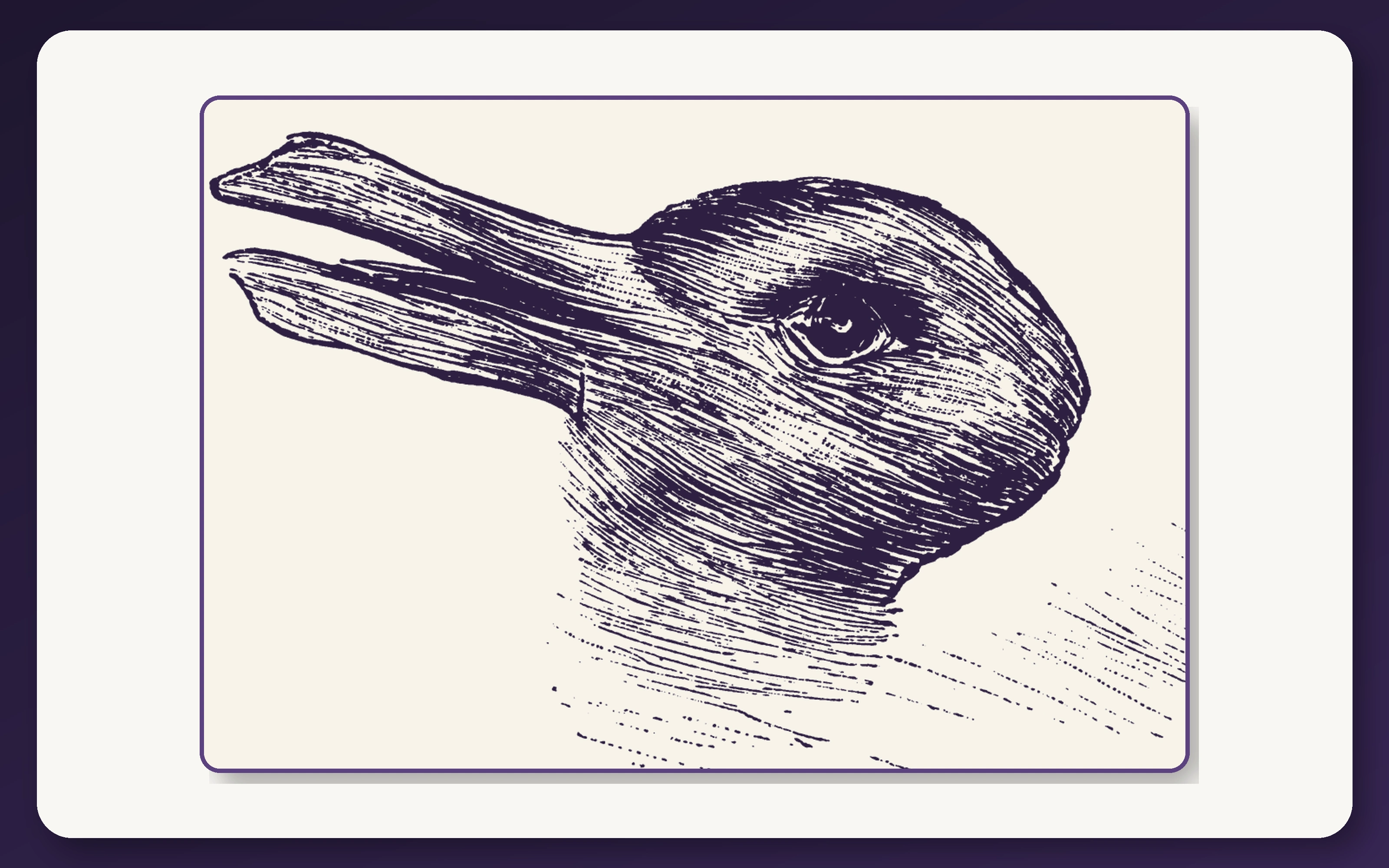
This is the Duck-Rabbit illusion, one of the best-known ambiguous figures in psychology and philosophy.
What Is Actually Drawn?
The figure contains one eye, one rounded head, and two long projections extending to the left.
In the duck interpretation, the projections are the upper and lower parts of an open bill. The eye belongs to a bird facing left, and the rounded right side forms the back of its head.
In the rabbit interpretation, the projections become two ears lying backward. The eye belongs to a mammal facing right, and the rounded edge becomes its nose and muzzle.
The picture provides enough information for either reading but not enough to force one permanently.
How to See the Duck
Focus on the left side first.
Treat the upper projection as the top of a bill and the lower projection as its lower half. The gap between them becomes the open mouth.
The central eye now belongs to a duck whose head points left. Once that organization stabilizes, the two long forms may stop looking ear-like.
How to See the Rabbit
Keep the same eye, but reverse the direction of the animal.
The two projections become long ears extending behind the head. The far-right rounded point becomes the rabbit’s nose.
The same physical eye remains in place, but its relationship to the surrounding shape changes.
The Proof: One Drawing, Two Organizations
The proof image shows two unchanged copies of the original figure.
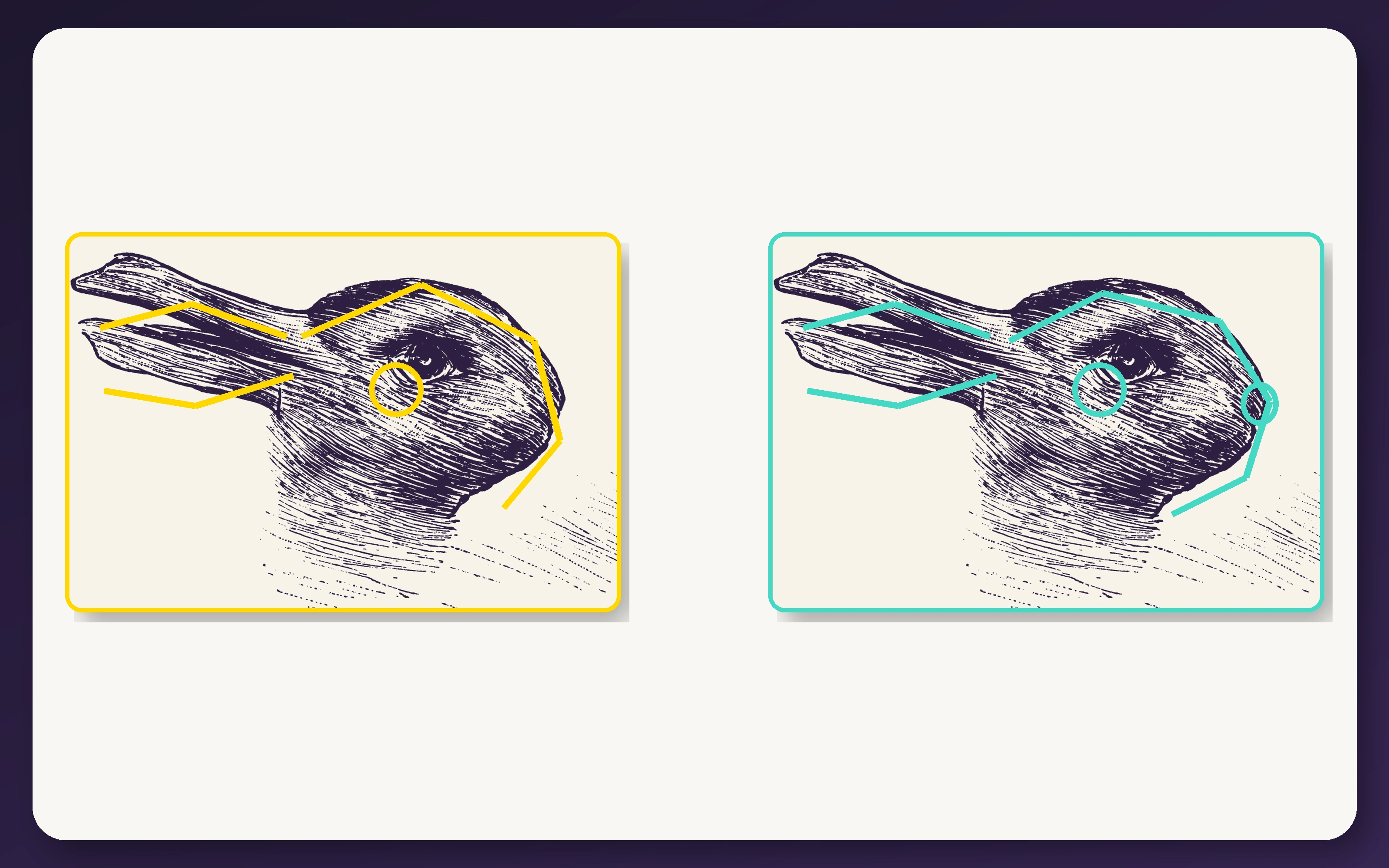
Nothing underneath the overlays differs. The transformation occurs when the visual system changes which object each contour belongs to and which direction the head faces.
Why You Usually See One Animal at a Time
The drawing is ambiguous, but the percept normally is not.
At any moment, the long shapes tend to function as either a bill or a pair of ears. The rounded right edge becomes either the back of a duck’s head or the front of a rabbit’s face.
Those assignments are incompatible inside one stable interpretation. The visual system therefore settles on one organization, then may reverse to the other.
A review of ambiguous-figure research describes this as bistable perception: the stimulus remains fixed while conscious perception alternates between interpretations.
Reversals may happen spontaneously, but attention, fixation, prior knowledge, and context influence which interpretation dominates.
The Necker Cube Illusion produces a related reversal between two depth orientations, while Rubin’s Vase alternates between a central vase and two profiles.
Where the Duck-Rabbit Came From
The earliest known version appeared anonymously in the October 23, 1892 issue of the German humor magazine Fliegende Blätter.
Its caption asked, “Which animals are most like each other?” The answer printed below was “Rabbit and Duck.”
The original publication and public-domain image are documented by Wikimedia Commons and the Illusions Index.
Psychologist Joseph Jastrow later reproduced the figure while arguing that perception involves active mental interpretation rather than passive registration of sensory input.
The image also became famous through philosopher Ludwig Wittgenstein, who used it to discuss the difference between seeing marks and seeing those marks as a particular thing.
Why Being Told the Answer Helps
Some viewers see only one animal until the alternative is pointed out.
The instruction “treat the beak as ears” directs attention to a different grouping and gives the visual system a new object hypothesis to test.
Research has found that knowing a figure is reversible makes reversals easier to discover and report.
In a 2011 study, participants viewed pairs of identical ambiguous figures. Most initially saw both figures the same way, but a relational prompt, such as imagining one animal interacting with the other, allowed many to see one as a duck and the other as a rabbit.
The result demonstrates how top-down context can shape which valid organization reaches awareness.
Does Easy Switching Reveal Your Personality?
Online versions often claim that seeing the duck first proves one personality type while seeing the rabbit proves another.
The figure does not provide a reliable personality diagnosis.
First perception can be influenced by recent experience, instructions, image orientation, fixation, cultural familiarity, and variation in perceptual competition.
Some studies report associations between ambiguous-figure reversal and measures such as creativity or inhibitory control, but those findings do not justify reading someone’s character from one glance at one image.
What Inhibition May Contribute
Switching requires the dominant interpretation to lose its hold while the competing one becomes stronger.
A 2017 study reported that participants exposed to a demanding inhibition task experienced fewer reversals and sometimes took longer to reach the first reversal.
The result suggests that cognitive control may contribute to flexible switching, although sensory adaptation, attention, expectations, and object knowledge also matter.
Try a Related Cognitive Flexibility Test
The Duck-Rabbit changes when the same visual information is reorganized under a different interpretation.
Cognitive Train’s Task Switch Test measures a more explicit form of flexibility: changing between color and shape rules while tracking the reaction-time cost of each switch.
The Trail Making Test provides another switching challenge by requiring you to alternate between numbers and letters. The Stroop Test measures how well you suppress an automatic reading response when it conflicts with ink color.
How It Relates to Other Ambiguous Illusions
My Wife and My Mother-in-Law reassigns the same central features to a young woman and an older woman.
The Necker Cube reverses between two depth orientations, while Rubin’s Vase switches figure and background.
The planned Spinning Dancer Illusion uses missing depth information to make the same silhouette appear to rotate clockwise or counterclockwise.
All keep the physical stimulus stable while perception changes.
Why Knowing Both Animals Does Not Merge Them
Once you know the trick, you can switch more deliberately. That does not usually make you see a fused animal whose bill is simultaneously experienced as ears.
Each interpretation imposes a coherent structure on the whole image. Combining the incompatible roles would weaken both.
This is why reversal feels like a genuine change in what is seen rather than merely remembering a second label.
What It All Comes Down To
The Duck-Rabbit contains one fixed set of contours that can form two animals facing opposite directions.
The duck’s bill becomes the rabbit’s ears. The back of the duck’s head becomes the rabbit’s face and nose. The eye stays physically unchanged while its role shifts.
The illusion shows that perception is not a simple copy of an image. The visual system selects, groups, and interprets evidence, and the same evidence can support more than one stable result.
For more ambiguous figures, impossible objects, false motion, and size distortions, browse the full Optical Illusions guide. Cognitive Train’s brain tests explore perception, attention, speed, and reasoning, while its free brain training tools offer more ways to challenge visual thinking.