Are Online Reaction Time Tests Accurate? What's Reliable and What's Not
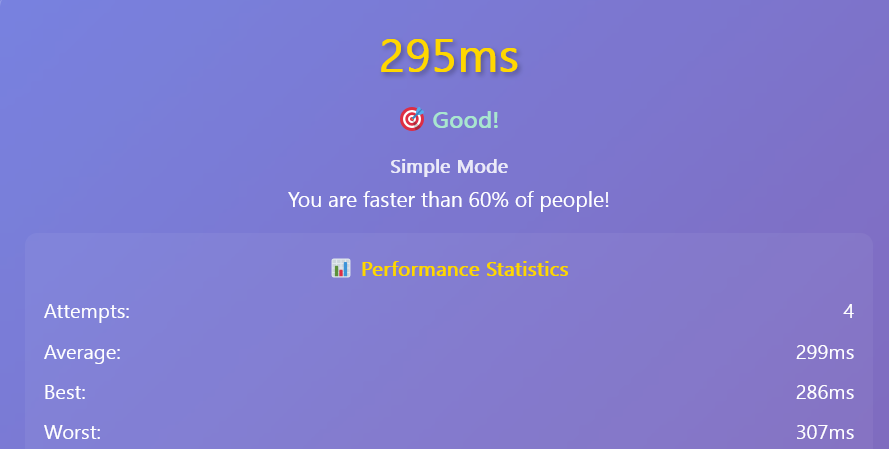
You take an online reaction time test and get 215ms. You take it again on your phone and get 280ms. Which number is real? Can you trust either of them?
Online reaction time tests can be accurate enough for practical purposes, but the number you see isn't a pure measure of your neural speed. It includes delays from your screen, your mouse or touchscreen, your browser, and the testing environment itself. Understanding what these tests actually measure—and what they don't—helps you use them effectively without being misled by the numbers.
What the Number Actually Includes
When a reaction time test shows you scored 220ms, that's the total time from when the stimulus appeared on your screen to when the test registered your click. But that 220ms includes more than just your brain and muscles.
Your monitor has display lag—the time between when your computer sends the signal and when the pixels actually change. Modern gaming monitors minimize this delay, while older monitors or TVs can introduce noticeable lag. The difference can be significant enough to affect your measured score.
Your input device adds delay too. Wired mice tend to have minimal latency, while wireless devices vary depending on their technology. Touchscreens on phones and tablets generally introduce substantially more delay than a mouse, which is why mobile scores tend to run significantly higher than desktop scores for the same person.
Browser rendering and JavaScript execution introduce additional variance. The exact timing depends on your device's processing power, what else is running, and how the test is coded. Well-designed tests minimize this, but it's rarely zero.
These technical factors stack up. An ideal desktop setup might add only a few milliseconds of overhead, while an older phone with a budget touchscreen could add enough delay to make a meaningful difference in your measured result.
Does This Mean Online Tests Are Useless?
Not at all. The key is understanding what you're comparing.
Online tests are excellent for tracking your own performance over time on the same setup. If you score 230ms today and 210ms after two weeks of practice, that improvement is real—the technical delays stayed constant, so the change reflects your actual performance gain.
They're also useful for relative comparisons. If you score 250ms on a simple reaction test and 380ms on a choice reaction test, that difference tells you something meaningful about how decision-making affects your speed, regardless of the absolute delays in the system.
What they're not good for is making precise claims like "my reaction time is exactly 215ms" or comparing your score directly to someone using different hardware. The person who scored 200ms might be using a gaming setup with minimal lag, while your 230ms might include extra delay from your laptop's touchpad.
The Testing Conditions Problem
Even if the technical setup were perfect, your reaction time varies significantly based on when and how you test.
Research shows reaction time follows a circadian rhythm, with most people performing best in late morning and early evening. Test yourself at different times of day and you'll see noticeable variation just from your body's natural rhythm.
Sleep deprivation has dramatic effects. Even one night of poor sleep can substantially slow your reactions. Similarly, caffeine can provide a temporary speed boost, though the effect diminishes for habitual users who've built tolerance.
Your focus and preparation matter too. If you're anticipating the stimulus—finger hovering over the mouse, eyes locked on the target area—you'll score faster than if you're relaxed and responding naturally. This is why some people can "game" simple reaction tests by holding near-constant tension, producing scores that don't reflect how they'd actually respond in real situations.
Good tests try to control for this by randomizing the timing and including false-start penalties, but you can't fully eliminate the strategy element.
How Test Design Affects Accuracy
Not all online reaction time tests are created equal. Design choices significantly impact how reliable the results are.
Tests that use simple color changes (like shifting from blue to red) tend to be more consistent than tests relying on complex visual changes. The simpler the stimulus, the less room for ambiguity about when it actually appeared.
Tests that require multiple trials and average the results are more reliable than single-attempt measurements. Your reaction time has natural variance—even under identical conditions, you won't produce the same number twice. A good test accounts for this by collecting enough trials and reporting the median or average, which smooths out random fluctuations.
Tests that exclude outliers (extremely fast or slow responses) give you a cleaner picture of your typical performance. If you accidentally clicked early on one trial, or got distracted and took much longer to respond on another, those shouldn't dominate your score.
Some tests calculate consistency metrics like standard deviation alongside your average time. This tells you how stable your performance is, which can be just as important as raw speed. Someone with a slightly slower average but tight consistency might be more reliable under pressure than someone with a faster average but high variance.
Comparing Yourself to "Average" Scores
Many online tests show you how you compare to the average person. These comparisons can be misleading.
The often-cited average of around 250ms for visual reaction time comes from research studies using standardized lab equipment—specialized reaction time devices that eliminate the variable delays present in consumer hardware. That number represents pure human performance without technical overhead.
When an online test tells you the "average" is higher than lab values, that number likely includes the technical delays of whatever hardware most test-takers are using. It's not directly comparable to lab results, though it's still useful for seeing where you stand relative to other people taking the same test.
Age affects these comparisons significantly. Reaction time peaks in the late teens to early twenties, then gradually slows with age. Someone in their sixties scoring the same as someone in their twenties is performing quite differently relative to their age group. Some tests adjust for this, most don't.
When Accuracy Actually Matters
For most practical purposes, perfect accuracy doesn't matter much.
If you're an athlete wanting to improve your reaction time for your sport, what matters is whether you're getting faster, not whether your absolute score is perfectly calibrated. Track your progress on the same setup, train consistently, and use the trend to guide your practice.
If you're a gamer wanting to work on your reflexes, practical training tools give you the coordination and speed that transfers to actual gameplay, regardless of whether your measured time matches lab standards.
If you're concerned about age-related cognitive decline or want to monitor how sleep or other factors affect your performance, the relative changes matter more than the absolute values. A noticeable increase in your reaction time over weeks or months might signal something worth investigating, even if both measurements include some technical delay.
The main exception is if you're trying to make claims about your performance relative to published research or clinical norms. In those cases, the technical differences between online tests and lab equipment make direct comparison unreliable.
How to Get the Most Reliable Results
If you want online test results that are as accurate as possible:
Use a wired mouse and a modern monitor. This minimizes input lag and display lag, reducing the technical overhead and putting you closer to the conditions of lab equipment.
Test on the same device every time. Consistency in hardware means your scores reflect actual changes in performance rather than switching between different input methods.
Close other programs and browser tabs. This reduces system load and makes the test's timing more consistent.
Take multiple measurements at the same time of day. Your circadian rhythm affects reaction time, so testing consistently helps isolate real changes from daily variation.
Look for tests that report median scores rather than averages, and that give you standard deviation or other consistency metrics. This gives you a fuller picture than a single average number.
Don't obsess over small differences. Even with good hardware, random variance means your "true" score is probably a range rather than a precise number. Focus on trends over time rather than individual measurements.
The Bottom Line
Online reaction time tests aren't perfectly accurate in the sense that they give you a pure measure of your neural and muscular speed. They include technical delays, they're affected by your hardware and testing conditions, and they don't control for all the variables that lab studies can.
But for tracking your own improvement, understanding relative differences between different types of reaction tasks, or getting a general sense of your performance, they're useful tools. The key is knowing what the numbers actually represent and not treating them as absolute measurements of some fixed biological constant.
Your reaction time isn't a single number—it's a distribution that shifts based on your preparation, your physical state, and the context of the task. Online tests give you a window into that distribution, as long as you understand their limitations.