Penrose Staircase Illusion
Every flight appears to climb, yet following the stairs around the loop brings you back to the same place.
Choose one landing in the image below and trace the staircase clockwise. Each step seems slightly higher than the previous one.
After four turns, however, the stairs return to the landing where you began. That point would have to be both higher than the start and exactly the same height as the start.
No ordinary staircase can do this. The drawing combines locally believable flights into one globally impossible structure.

This is the Penrose Staircase, also called the impossible staircase or endless staircase.
It is an impossible object: a two-dimensional picture that supports convincing local interpretations but cannot be assembled into one consistent object in ordinary three-dimensional space.
Where the Impossibility Appears
Each individual flight looks normal. It has level treads, vertical risers, and a landing that appears to connect naturally with the next flight.
The contradiction only becomes obvious when you track height around the entire circuit.
Suppose the first landing is level zero. The first flight rises above it, the second rises farther, the third rises again, and the fourth continues upward. Yet its final landing merges with level zero.
The image therefore asks one location to occupy two different heights at once.
The related Penrose Triangle Illusion creates the same kind of conflict with three beams instead of four flights of stairs.
The Proof: Change the Viewpoint
The main image uses forced perspective. The physical start and finish are separated in depth and height, but they align when seen from one carefully selected direction.
The proof image shows the construction from that special viewpoint on the left and from a slightly shifted viewpoint on the right.
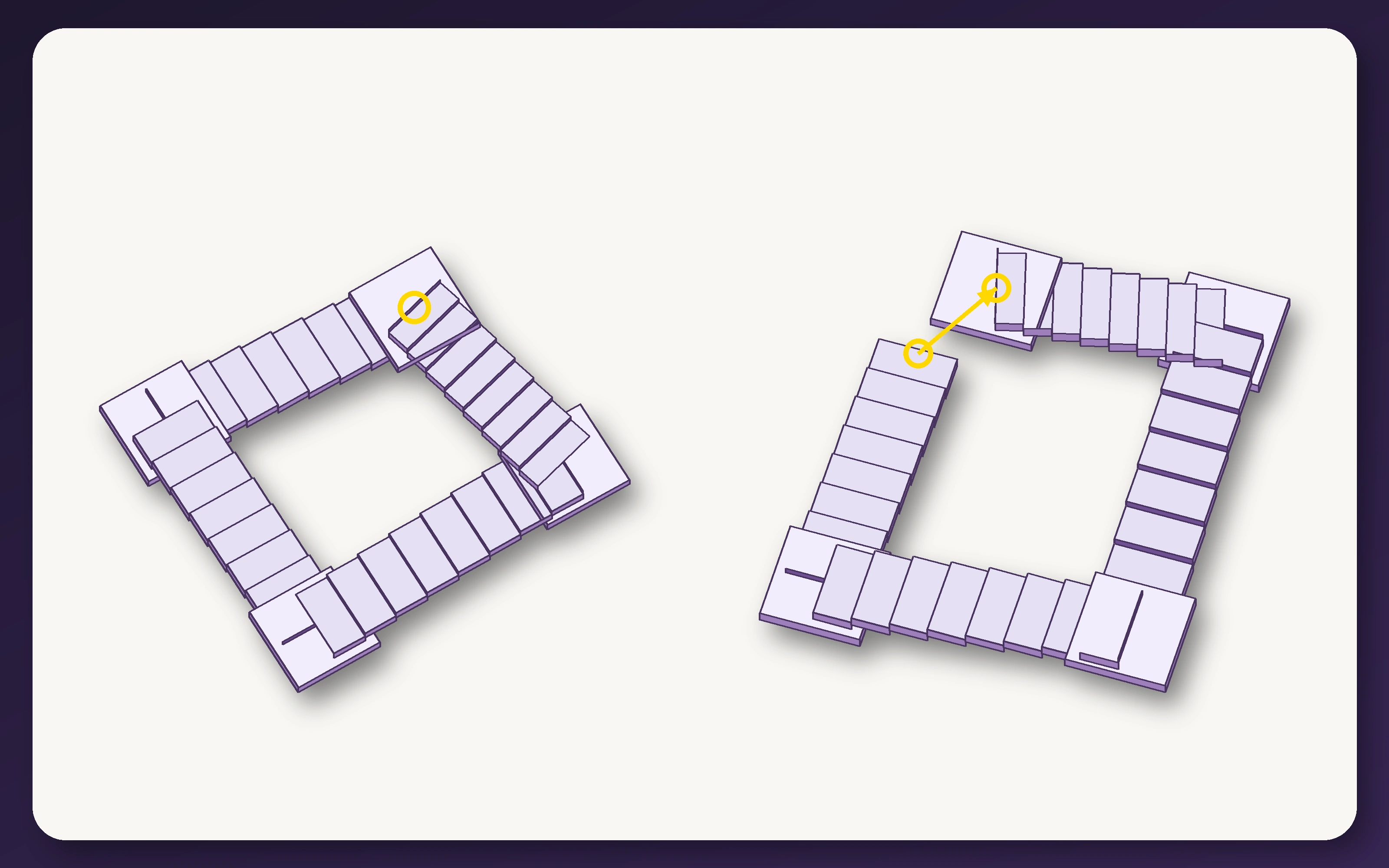
This is how real sculptures and camera demonstrations can reproduce impossible objects. They do not build the contradictory object itself. They build separate pieces that line up only from one viewing position.
The Ames Room Illusion uses a related forced-perspective strategy. A distorted room looks ordinary from one fixed viewpoint, making people inside appear dramatically different in size.
Why the Brain Accepts Each Flight
Pictures provide depth cues rather than direct access to three-dimensional structure.
Parallel edges, visible risers, overlapping surfaces, shading, and familiar stair geometry all suggest a solid staircase. Within any small region, those cues agree.
Your visual system can therefore settle on a reasonable local interpretation before it has checked whether every part fits into one global model.
Lionel Penrose and Roger Penrose described this principle in their 1958 paper on impossible objects. Their staircase was composed of acceptable individual flights whose connections made the complete picture inconsistent.
The image does not fail because one step is badly drawn. It succeeds because every small section looks ordinary enough to postpone rejection of the whole.
Local Consistency vs. Global Consistency
The staircase exposes a basic tension in perception.
Local consistency asks whether nearby lines and surfaces form a plausible piece of an object. Global consistency asks whether all those pieces can belong to one object at the same time.
The Penrose Staircase passes the local test and fails the global one.
This distinction also separates impossible figures from ambiguous figures. The Necker Cube Illusion has two possible three-dimensional interpretations, and perception can switch between them. The staircase offers many convincing local interpretations but no single possible global interpretation.
What Brain Research Suggests
Impossible figures do not merely look unusual. The visual system has to represent familiar object parts while also detecting that their spatial relationships cannot all be true.
In a 2012 fMRI study using an impossible trident, impossible figures produced stronger activity in object-sensitive regions of the ventral visual pathway and in a superior parietal region involved in spatial processing.
The researchers interpreted this pattern as evidence that perception attempts to represent the three-dimensional object while detecting and resolving contradictions among its depth cues.
The planned Impossible Trident Illusion shows the same conflict in a different form: one end appears to contain three rounded prongs while the other contains only two rectangular bars.
Penrose, Escher, and the Endless Staircase
The staircase became famous through the exchange between the Penroses and Dutch graphic artist M.C. Escher.
Roger Penrose had been inspired by Escher’s work before developing his own impossible figures with his father. After their paper appeared, they sent it to Escher.
Escher used the continuous staircase in his 1960 lithograph Ascending and Descending, placing two lines of figures on a rooftop stairway where one group climbs forever while the other descends forever.
The history is documented by Museum Escher in The Palace.
Try a Related Spatial Reasoning Test
Recognizing why the staircase cannot exist requires tracking orientation, depth, and height across several connected parts.
Cognitive Train’s Spatial Reasoning Test measures mental rotation, cube-net folding, and mirror-image recognition in one assessment:
For focused practice with viewpoint changes, the Mental Rotation Test asks you to distinguish genuinely rotated shapes from mirror images. More spatial tools are collected in the Spatial Reasoning hub.
Why Knowing the Trick Does Not Flatten the Stairs
Once you understand the contradiction, you can deliberately trace the loop and identify where the heights stop making sense.
The individual flights may still look solid and climbable.
That persistence shows that seeing a plausible local surface and judging whether the complete structure is possible are partly different operations. Knowledge can expose the conflict without removing the depth cues that created it.
What It All Comes Down To
The Penrose Staircase consists of four ordinary-looking flights joined into an extraordinary loop.
Every local section appears to rise normally, but the complete route returns to its starting point. The same landing must therefore be both above itself and level with itself.
The illusion works because perspective can make separated endpoints align, while the visual system accepts each convincing section before fully resolving the global contradiction.
For more impossible objects, ambiguous figures, false motion, and distorted geometry, browse the full Optical Illusions guide. Cognitive Train’s brain tests explore perception, attention, speed, and reasoning, while its free brain training tools offer more ways to challenge visual thinking.