Impossible Trident Illusion
Three rounded prongs enter from one side, but only two rectangular beams emerge from the other.
Look first at the left end of the object below. It appears to contain three separate cylindrical prongs.
Now follow those prongs toward the right. The same object seems to finish as only two rectangular beams.
Nothing is hidden behind another object, and no branch visibly ends. The drawing asks three pieces to become two while still looking locally solid at both ends.

This is the Impossible Trident, also known as the impossible fork, blivet, devil’s tuning fork, or two-pronged trident.
It belongs to the family of impossible objects: flat drawings whose local depth cues suggest a three-dimensional structure that cannot exist as one consistent object in ordinary space.
Where the Contradiction Occurs
The left side is easy to interpret. Three shaded tubes have separate rounded ends and parallel shafts.
The right side is also easy to interpret. Two broad rectangular beams have clear top surfaces, lower faces, and end faces.
The trouble lies in the transition between them.
The upper half of the middle cylinder appears to belong to the upper beam, while its lower half appears to belong to the lower beam. Contours that define one object locally are reassigned to another object a short distance away.
No continuous three-dimensional surface could preserve all those relationships. A physical fork cannot contain three separate prongs at one end and only two unbroken beams at the other without a visible split, merger, or termination.
The Proof: Cover One End at a Time
The proof image separates the two locally convincing interpretations.
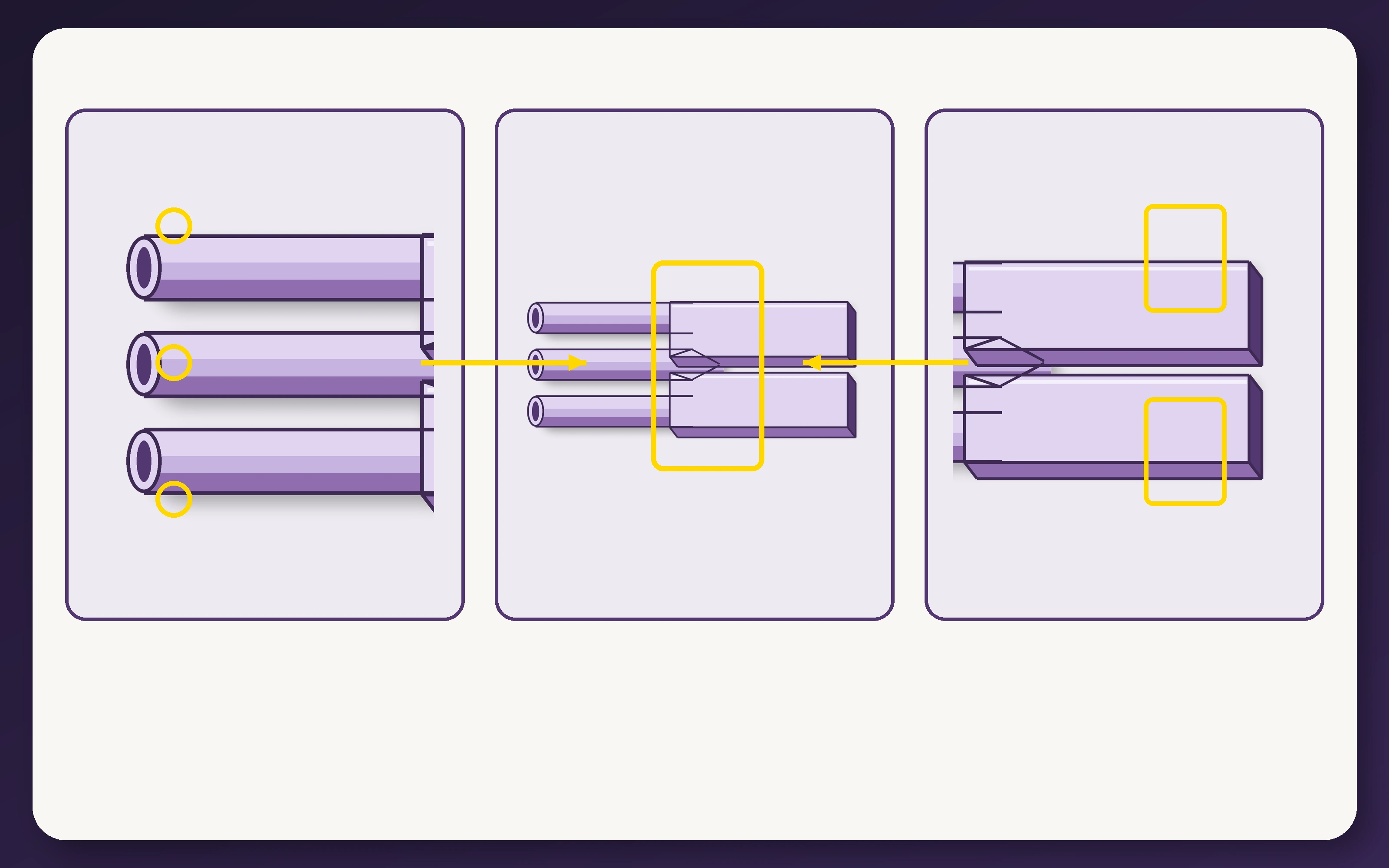
The left panel supports three cylinders. The right panel supports two rectangular beams. Neither cropped view is especially strange.
The middle panel forces both interpretations into one object. The gold box marks the region where contours change their apparent ownership and make the count impossible.
This is why covering part of the figure can make the remaining section look completely ordinary. The impossibility is global rather than confined to one obviously malformed line.
Why the Visual System Tries to Build an Object
A line drawing does not provide depth directly. The visual system infers surfaces from boundaries, shading, overlap, parallelism, and familiar object shapes.
Rounded caps and long highlights suggest cylindrical rods. Straight corners and shaded side faces suggest rectangular beams.
These cues are processed rapidly and locally. Each region supplies enough information for the brain to form a plausible interpretation before it has checked whether the interpretations agree across the entire drawing.
The Penrose Staircase Illusion works through a similar local-versus-global conflict. Every individual stair flight looks possible, but the complete route rises continuously and still returns to its starting height.
Possible and Impossible Objects Begin Similarly
Research suggests that impossible objects are not rejected at the earliest stage of perception.
In a study comparing possible and impossible objects, both types automatically organized attention as unified objects. Differences became clearer when observers had more time to process the detailed three-dimensional structure.
The researchers concluded that possible and impossible objects can share similar initial perceptual organization, while the contradiction emerges during later, more detailed processing.
That fits the experience of the trident. You first see one solid object. Only after inspecting the prong count and tracing the contours does its structure become impossible.
What Brain Imaging Found
The trident has also been used directly in brain-imaging research.
In a 2012 fMRI study using a two-pronged trident task, researchers compared impossible and matched possible versions of the figure.
The impossible condition produced stronger responses in regions associated with visual object processing and spatial analysis. This is consistent with the brain representing the object-like form while also working through conflicting three-dimensional cues.
Another fMRI adaptation study of possible and impossible objects found similar initial representation in high-level object-sensitive visual areas, with differences appearing more clearly in later behavioral processing.
Together, these findings suggest that impossibility is not detected before an object representation forms. The visual system first constructs something coherent enough to recognize, then encounters structural relationships it cannot reconcile.
Where the Impossible Trident Came From
American psychologist D. H. Schuster published the figure in 1964 under the name three-stick clevis.
Schuster reported that he had noticed the basic design in an advertisement in an aviation journal. The figure later became widely known under names including impossible fork, blivet, and devil’s tuning fork.
The Illusions Index history of the Impossible Trident records Schuster’s publication and explains why the object violates consistent Euclidean geometry.
How It Differs From the Penrose Triangle
The Penrose Triangle Illusion contains three beams that appear to meet at ordinary right-angled corners while forming a globally impossible loop.
The trident does not close into a loop. Instead, it changes its number and type of parts across the image.
Both figures exploit locally reasonable depth cues. The Penrose Triangle produces inconsistent connections around a circuit, while the trident produces inconsistent counting and surface ownership along one object.
How It Differs From Ambiguous Figures
The Necker Cube Illusion can be interpreted in two different but individually possible ways. Either face can appear to be in front, and perception may switch between them.
The impossible trident is not simply a reversible drawing with two valid interpretations. The three-prong and two-beam readings are each plausible locally, but they cannot describe the entire figure simultaneously.
This is why it is often called an undecidable figure rather than merely an ambiguous one.
Try a Related Spatial Reasoning Test
Recognizing the contradiction requires tracking how contours, surfaces, and object parts connect across space.
Cognitive Train’s Spatial Reasoning Test measures mental rotation, cube-net folding, and mirror-image recognition in one assessment:
The Mental Rotation Test focuses on deciding whether shapes remain identical after rotation or have been reflected. More tools for object transformation and three-dimensional visualization are available in the Spatial Reasoning hub.
Why Knowing It Is Impossible Does Not Turn It Into Lines
Once you understand the trick, you can identify the contradictory transition immediately.
The left side still tends to look like three cylinders, and the right side still tends to look like two beams.
Conscious knowledge tells you that the complete object cannot exist, but it does not stop the visual system from assigning depth and surface structure to each local region.
The illusion persists because object perception is automatic enough to survive correction by reasoning.
What It All Comes Down To
The Impossible Trident combines three rounded prongs with two rectangular beams.
Each end is locally convincing, but the contours between them change ownership in a way no physical surface could reproduce. Three object parts become two without a legitimate split or merger.
The brain initially organizes the drawing as one solid object, then encounters a contradiction when it tries to construct a detailed global model.
For more impossible objects, ambiguous figures, false motion, and distorted geometry, browse the full Optical Illusions guide. Cognitive Train’s brain tests explore perception, attention, speed, and reasoning, while its free brain training tools offer more ways to challenge visual thinking.