How to Use the Aim Test to Actually Improve (Not Just Measure)

You've taken the aim test a dozen times. Your score goes up some days, down others. You're tracking numbers, but are you actually getting better? Most players treat aim tests as scoreboards—ways to measure current ability rather than tools for building new ability. That's the wrong approach.
An aim test becomes a training tool when you use it systematically to identify weaknesses, track specific improvements, and apply progressive overload. The difference between measurement and improvement is structure: knowing what to practice, how to make it harder over time, and when each type of practice matters.
The Problem with Just Measuring
Taking an aim test once and looking at your score tells you almost nothing useful. You get a number, maybe compare it to a benchmark, and that's it. You haven't learned what's limiting your performance or what to work on next. This is similar to the limitation of single reaction time test measurements—one data point doesn't reveal patterns or specific weaknesses.
Taking the same test repeatedly without changing anything is only marginally better. You might improve slightly through raw repetition, but progress stalls quickly because you're not systematically addressing your actual limitations. You're just hoping repetition alone will make you better.
The underlying issue: measurement without diagnosis and progression. If you don't know whether your misses come from slow target acquisition, imprecise mouse control, or rushed clicking, you can't fix the right problem. If you don't gradually increase difficulty, you plateau at whatever your comfortable level happens to be.
Turn Testing Into Diagnosis
Each aim test run should answer a specific question about your current performance. Don't just look at overall accuracy—pay attention to where and how you're missing.
Do you miss more targets at the edges of the screen than in the center? That suggests your accuracy degrades with larger mouse movements, meaning you should practice wide flicks specifically. Do you hit the first few targets easily but accuracy drops as the test continues? That indicates fatigue or loss of focus, suggesting you need shorter, more intense practice sessions rather than long grinding.
Are you missing targets because you're clicking too early (before your cursor is actually positioned) or too late (hesitating even when lined up)? Early clicks suggest you're prioritizing speed over precision—slow down and establish accuracy first. Late clicks suggest overcorrection or lack of confidence—you need to trust your aim and reduce hesitation.
The Multi-Target Aim Trainer helps with this diagnostic process by letting you see whether you're hitting wrong targets (attention/selection problem) or missing targets entirely (motor control problem). If you frequently click distractors instead of correct targets, your issue isn't aim precision—it's target discrimination under time pressure.
Progressive Overload for Aim Training
Improvement requires systematically increasing difficulty over time. The principle is borrowed from strength training: you need to consistently work at the edge of your current ability, not in your comfort zone.
Start with target size. If you can hit large targets consistently, make them smaller. Keep making them smaller until your accuracy drops below a level you're comfortable with—that's your working difficulty. Train at this level until it becomes comfortable, then make targets smaller again.
Add time pressure once you've established baseline accuracy. If you can hit targets accurately with unlimited time, add a time limit that forces faster clicking. Gradually reduce the time allowed until you're working near your speed-accuracy limit.
Increase target count and density. More targets on screen simultaneously means less time per target and more complex decision-making about movement efficiency. This builds the scanning and prioritization skills that matter in real gaming scenarios.
The key principle: always train at a difficulty level that challenges you but remains achievable. A common rule of thumb is to aim for settings where you're hitting around 60-80% of targets—high enough that you're succeeding more than failing, but low enough that you're being pushed. If you're hitting under 50%, it's likely too difficult to generate useful learning. If you're hitting over 90% easily, it's too easy to drive improvement.
Structure Your Practice Sessions
Random, unstructured practice generates limited improvement. Structured sessions with specific goals work better.
Start each session with a diagnostic run at your standard settings. This establishes your baseline for the day and helps you notice patterns over time. Are you consistently worse on certain days? That might relate to sleep, caffeine, or other factors worth tracking.
Focus on one specific weakness per session. If your diagnosis shows you're weak on edge-of-screen targets, spend the session practicing large mouse movements. If you're missing due to rushed clicking, practice slowing down and confirming cursor position before clicking. Trying to fix everything at once usually means fixing nothing effectively.
End with a performance run at settings that feel achievable. This builds confidence and gives you a tangible success to remember. Training should end on a positive note when possible—it affects motivation for the next session.
For session length and frequency, shorter and more frequent generally beats longer and sporadic. Many players find that focused 10-15 minute sessions daily generate more improvement than an hour of unfocused grinding once a week, though optimal duration varies by individual.
Track the Right Metrics
Overall accuracy percentage is useful but incomplete. Track specific components of your performance to identify exactly what's improving and what's stagnating.
Separate your accuracy by target size if possible. You might maintain high accuracy on large targets while small-target accuracy isn't improving, indicating that precision is your current bottleneck rather than general target acquisition speed.
Track time per target, not just total time. If you're completing tests faster but time per target is actually the same, you're just getting faster at moving between targets (which matters), but your actual click execution speed hasn't improved. Pure clicking speed is a separate component from aim accuracy.
Note the pattern of misses during a session. Do you start strong but accuracy degrades? That's a fatigue or focus issue. Do you start poorly but improve as you warm up? That suggests insufficient warm-up or needing more time to reach peak performance.
Keep records simple enough that you'll actually maintain them. A spreadsheet with date, settings, accuracy, and one-line notes about what felt difficult works better than elaborate tracking that you'll abandon after a week.
When to Use Different Test Types
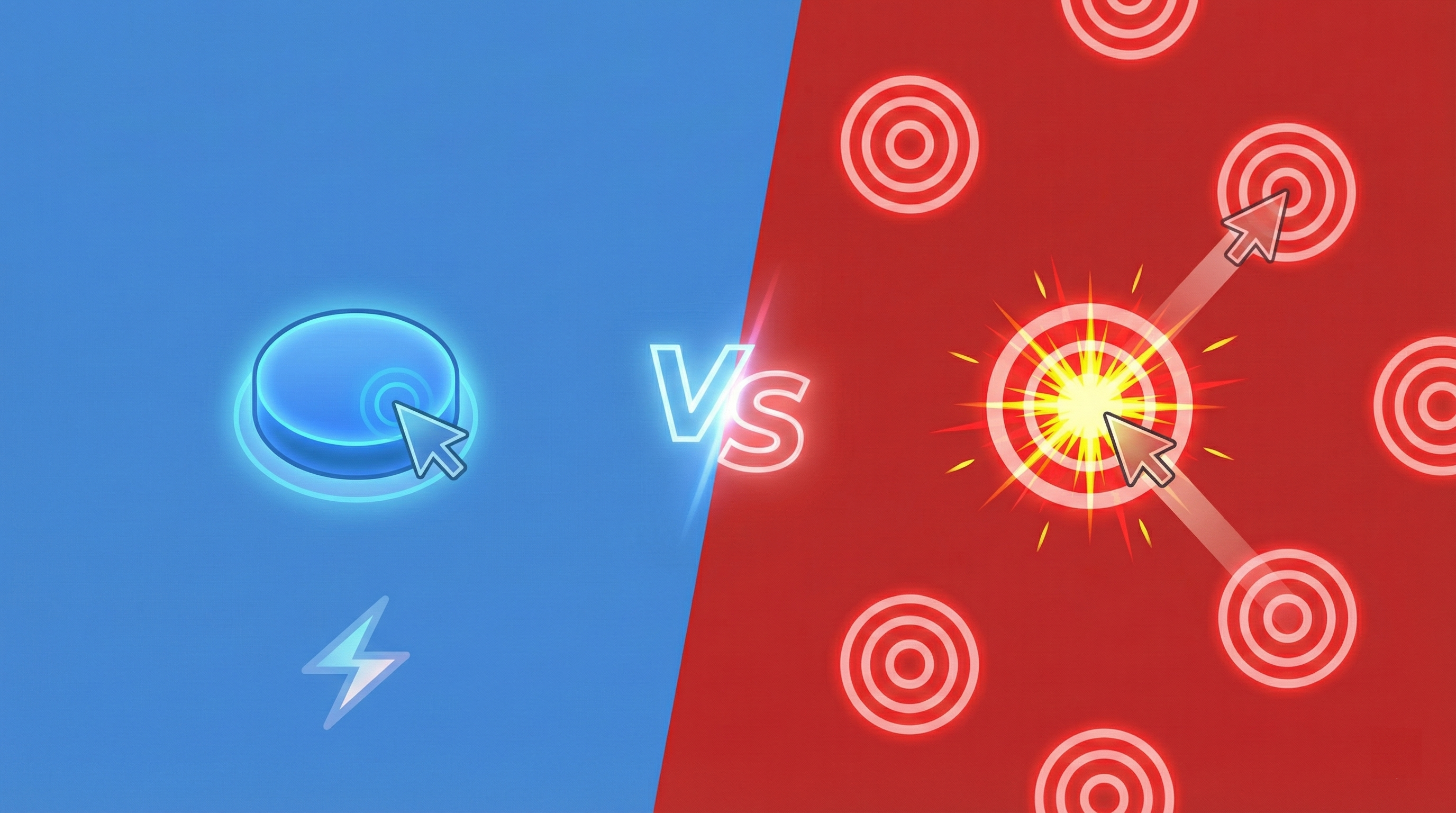
The basic aim test and multi-target trainer serve different purposes in your improvement plan. Use each for what it does best.
Basic aim tests work well for establishing fundamental accuracy and tracking raw mouse control improvement. When you're working on basic cursor positioning and click timing, simple tests without complications give you cleaner feedback about whether those fundamentals are improving. If you're unsure which type of test suits your needs, understanding the difference between aim tests and reaction time tests can help clarify your training focus.
The Multi-Target Aim Trainer becomes valuable once basic accuracy is solid. It adds target discrimination, attention management, and decision-making under pressure—skills that matter more in actual gaming than pure clicking ability. If you can already hit isolated targets reliably, multi-target training develops the next layer of skill.
Alternate between them based on what you're currently working on. If precision is your bottleneck, basic tests with small targets address that directly. If target selection in chaotic situations is your issue, multi-target with distractors and filters trains that specifically.
Transfer Training to Actual Performance
Aim test improvement doesn't automatically transfer to in-game performance. You need to bridge the gap deliberately.
Test conditions differ from game conditions in several ways. Tests typically use stationary or predictably moving targets; games include erratic movement. Tests happen in isolation; games happen while dodging damage, tracking teammates, and managing resources. Tests measure pure aim; games require aim integrated with game knowledge and positioning.
To improve transfer, make your training conditions gradually more game-like. If you play fast-paced shooters, practice with time pressure and moving targets. If you play tactical games, practice slower but extremely precise clicking on small targets. Match your training difficulty to what your actual game demands—understanding what aim training actually improves helps you focus on transferable skills.
Regularly compare your test performance to your in-game performance. If your test accuracy is high but your hit rate in games is significantly lower, the problem isn't aim mechanics—it's applying those mechanics under game pressure. That requires playing the actual game while focusing specifically on aim, not just doing more aim tests.
Common Training Mistakes
Training at too-easy settings feels productive but generates minimal improvement. If you can hit targets comfortably, you're reinforcing existing ability rather than building new ability. Aim for settings where you're successful but challenged.
Conversely, training at impossibly difficult settings just builds frustration. If you're missing most targets, you're not getting useful feedback about what adjustments would help. There's a productive difficulty zone—find it and stay there. This relates to the broader question of whether to prioritize speed or accuracy in your training approach.
Inconsistent practice makes progress hard to assess. If you practice three times one week, skip two weeks, then practice five times in three days, you can't tell what's working. Regular practice with reasonably consistent frequency lets you actually see trends.
Ignoring fatigue and forcing practice when your performance is clearly degraded often does more harm than good. If your accuracy is noticeably worse than normal and you're making errors you typically don't make, that session probably isn't generating useful learning. Sometimes the better choice is to stop and return when fresh.
Set Meaningful Goals
Vague goals like "get better at aim" don't provide useful direction. Specific, measurable goals let you know whether training is working.
Instead of "improve accuracy," try "maintain above X% accuracy on medium targets with Y-second time limit." The specificity tells you exactly what you're working toward and when you've achieved it.
Set process goals, not just outcome goals. "Practice aim training four times this week" is often more useful than "reach X% accuracy" because you control the process but not always the outcome. Consistent process tends to generate good outcomes eventually.
Build progression into your goals. Once you hit your target accuracy at current settings, the goal should evolve: maintain that accuracy with smaller targets, or with less time, or with more distractors. Continuous progression prevents stagnation.
The Bottom Line
An aim test measures current ability. Aim training systematically builds new ability. The difference is structure: diagnosing specific weaknesses, applying progressive difficulty, tracking relevant metrics, and deliberately connecting practice to performance.
Take the test with specific questions in mind. What's limiting your current performance? Where are you missing and why? Which type of difficulty would address your current bottleneck?
Practice at the edge of your ability, not in your comfort zone. Make training gradually harder as you improve. Keep difficulty in the productive zone where you're challenged but not overwhelmed.
Track specific components of performance, not just overall scores. Know which aspects are improving and which aren't, so you can adjust focus accordingly.
Most players never improve beyond their initial plateau because they treat aim tests as scoreboards instead of training tools. Turn measurement into diagnosis, add progressive difficulty, and your aim test becomes an actual improvement system instead of just a number tracker.