Rubin's Vase Illusion
Why the same image keeps becoming a vase, then two faces, then a vase again.
At first glance, Rubin's Vase looks almost too simple to be famous. It is just a black-and-white image: a white vase in the middle, or two black faces in profile. The strange part is not that both interpretations are possible. The strange part is that your brain usually treats them as rivals. One version pops forward. The other drops into the background. Then, sometimes, they swap.
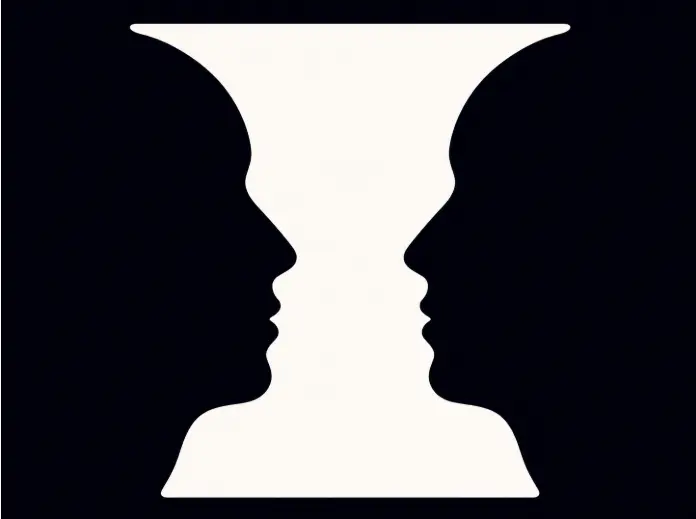
That is why this picture has lasted for more than a century. Rubin's Vase is not just a visual trick. It is one of the clearest demonstrations that seeing is not passive. Your eyes receive the same image each time, but your brain does not settle on a single meaning. It has to decide what is the figure, what is the background, and which interpretation gets priority.
If you want more examples like this, the optical illusions guide collects classic visual illusions by type, from size distortions to impossible objects and motion effects.
What Makes This Illusion Different
Many optical illusions distort size, color, or motion. Rubin's Vase does something more basic. It makes the brain choose what counts as the object and what counts as the space around it. In vision science, this is called figure-ground organization.
Normally, figure-ground assignment happens so quickly that you never notice it. A coffee mug on a table appears as the object, while the table and room recede into the background. But in Rubin's Vase, the boundary is deliberately balanced. The same contour can belong either to the vase or to the faces. Your visual system cannot fully commit to both at the same time, so perception alternates.
That is the important point: the illusion is not about failing to see. It is about the brain having two valid interpretations and only one spotlight.
Visual attention also determines which details stand out and which fade into the surrounding scene. To test how quickly you notice small visual changes, Cognitive Train has a free comparison task:
Where Rubin's Vase Came From
The illusion is named after the Danish psychologist Edgar Rubin, whose 1915 work on visual perception helped establish the modern study of figure and ground. Rubin used examples like this to show that perception is structured. The world does not arrive in consciousness as a neutral list of shapes. The brain organizes it, ranks it, and decides what belongs to what.
Rubin's broader insight has held up remarkably well. The basic problem his illusion exposes is still central to perception research: when a single edge could belong to more than one object, how does the brain assign ownership?
Why Your Brain Flips Between the Vase and the Faces
The short answer is competition. The longer answer is that several layers of visual processing are competing at once.
First, the image contains a shared border. The curved line that outlines the vase is the exact same line that outlines the profiles of the faces. Your brain has to decide which side of that border is the object.
Second, both interpretations are meaningful. Human faces are especially powerful visual stimuli. We are quick to detect them, even in crude outlines. But symmetrical vessel-like shapes are also coherent, stable objects. The image offers your brain two sensible answers, not one sensible answer and one absurd one.
Third, attention can bias the result. If you look toward the center and think “vase,” the central shape often stabilizes. If you attend to the outer dark regions and think “faces,” the profiles become dominant. That does not mean perception is completely voluntary. It means top-down attention can nudge which interpretation wins the contest.
This is one reason Rubin's Vase is so useful in psychology. It reveals that perception is neither a simple camera recording nor a pure act of imagination. It is a negotiation between the visual input in front of you and the expectations, biases, and priorities of the brain looking at it.
What the Research Shows
Modern research on ambiguous figures has largely confirmed Rubin's basic insight. In a 2001 brain-imaging study by Uri Hasson and colleagues, researchers used modified face-vase images to examine whether the interpretation reaching awareness was reflected in category-selective regions of the visual brain. Although the local contours stayed the same, activity differed depending on whether the image was organized as faces or as a vase.
The result matters because it shows that the switch is not merely a change in what viewers call the picture. The brain groups the same visual information differently depending on which interpretation becomes dominant.
A later study by Michael Pitts and colleagues examined the early stages of figure-ground segregation using face-vase images and electrical recordings from the scalp. The results indicated that the visual system begins separating the figure from the ground early in processing, before the viewer gives a conscious report of what they see.
A broader review by Gerald Long and Thomas Toppino examined decades of research on reversible figures. Their review describes perceptual switching as the product of several interacting processes, including properties of the image, neural adaptation, attention, expectations, and previous experience. No single mechanism explains every reversal.
Can You See Both at Once?
Not clearly, and that is part of the point. You can know that both interpretations are present. You can even experience a rapid wobble between them. But most people do not experience a fully combined “vase and two faces” perception for more than a fleeting instant.
The reason is that figure-ground assignment works by commitment. To perceive something as the figure is to give it the edge, the shape, and the foreground status. The competing interpretation loses those privileges. Rubin's Vase puts the same border up for grabs, so one interpretation usually has to step back while the other steps forward.
That is why the illusion feels more alive than a static trick image. It is not just that there are two answers. It is that your mind keeps renegotiating which one gets to count as reality.
Can You Control Which Image You See?
You can influence it, but you may not be able to hold one interpretation indefinitely. Looking directly at the white center tends to favor the vase. Moving your attention toward the dark profiles tends to favor the faces. Thinking about a face or a vase before viewing the image can also make that interpretation appear more quickly.
However, deliberate control is limited. After staring for long enough, the unwanted interpretation may return even when you are trying to suppress it. Reversible figures remain unstable partly because the same visual evidence continues to support both possibilities.
This tension between focused attention and automatic switching is one reason ambiguous figures are useful for studying conscious perception. The stimulus stays fixed while subjective experience changes.
What Rubin's Vase Tells Us About Everyday Vision
It is tempting to think of this as a special case, something that only matters inside psychology textbooks. But the principle is everywhere. Every time you instantly separate an object from cluttered surroundings, your brain is solving a version of the same problem. It is deciding where objects begin and end, which surfaces belong together, and what should be ignored.
Usually that system works beautifully. The cost of that speed is that the visual system has to make assumptions. Rubin's Vase is memorable because it strips the process bare. Instead of giving you one obvious figure, it gives you a boundary that can plausibly belong to either side.
The same ability matters when you search a crowded shelf, follow a player moving across a field, or spot a road sign against a complicated background. The brain must separate the relevant figure from everything surrounding it before you can recognize or act on it.
Cognitive Train's brain tests page includes assessment-style tools that explore attention, processing speed, reasoning, and other aspects of mental performance.
A Common Myth: “What You See First Reveals Your Personality”
Rubin's Vase is often used in social-media posts that claim your first interpretation says something deep about your personality, relationships, or hidden motives. There is no good evidence for that. The illusion is valuable because it demonstrates figure-ground competition and perceptual ambiguity, not because it secretly diagnoses character.
What you see first can be influenced by attention, contrast, prior exposure, screen size, image proportions, and even what someone has just told you to look for. That makes it interesting psychology, but not personality testing.
Try Another Visual Search Challenge
Rubin's Vase shows how the brain chooses one interpretation from competing visual information. A related challenge is detecting the one item that breaks an otherwise consistent pattern.
What It All Comes Down To
Rubin's Vase endures because it turns an invisible mental operation into something you can feel happening. One moment there is a vase. The next there are two faces. The drawing does not change, but your experience of it does.
That is the lesson packed inside the illusion: vision is an active construction. The brain is always deciding what matters, what belongs together, and what should fade into the background. Most of the time, it makes those decisions so smoothly that you never notice. Rubin's Vase is what happens when the machinery becomes visible.
For more ways your perception can be misled, browse the full Optical Illusions guide. For broader brain training tools and cognitive exercises, explore the rest of Cognitive Train.