Auditory vs Visual Reaction Time: Which Is Faster and Why
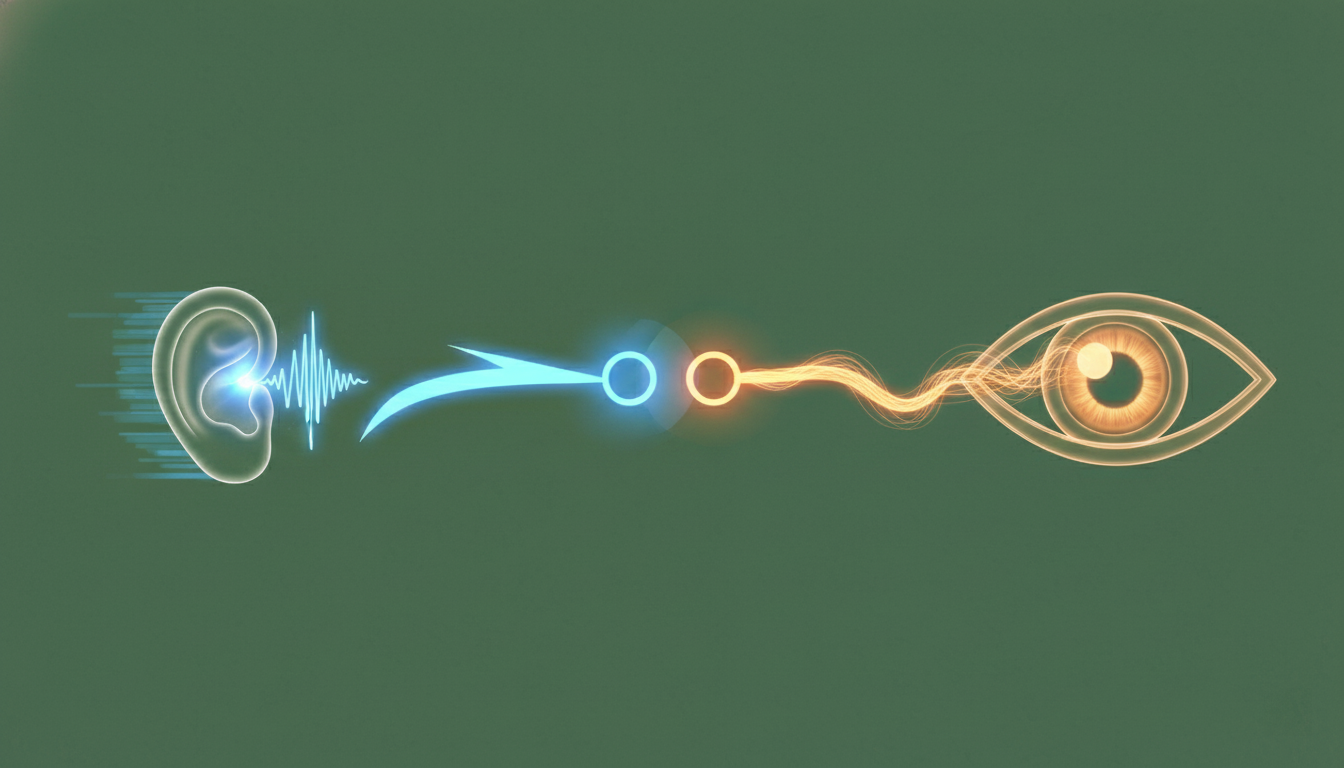
If someone fires a starting gun and flashes a light at the exact same moment, which one will you react to first? For most people, the answer is sound. Auditory reaction times are consistently faster than visual ones—a finding that shows up across decades of research and has real implications for everything from sports to driving to emergency response systems.
But why? And does it matter which sense you train? Understanding the difference between auditory and visual processing can help you choose the right training approach and interpret your reaction time test results more accurately.
The Speed Difference Is Real
Research comparing sensory modalities has consistently found that people respond faster to auditory stimuli than visual ones. The difference isn't huge in absolute terms—typically a few tens of milliseconds—but it's consistent and statistically reliable across studies.
This gap persists even when controlling for factors like stimulus intensity, attention, and practice. Whether you're testing trained athletes or untrained participants, sounds generally trigger faster responses than lights.
Why Sounds Win
The auditory advantage comes down to neural architecture. Several factors contribute:
Shorter Neural Pathways
The auditory pathway from ear to motor cortex appears to be more direct than the visual pathway. Research on auditory-motor integration suggests that sound signals travel from the cochlea through the brainstem to the auditory cortex with relatively few synaptic relays. Visual information, by contrast, undergoes more extensive processing—edge detection, motion analysis, object recognition—before reaching areas that can trigger motor responses.
Faster Initial Encoding
The mechanical-to-electrical transduction in the ear happens quickly. Hair cells in the cochlea respond almost instantaneously to sound pressure waves. Photoreceptors in the retina, while remarkably sensitive, involve a chemical cascade (the phototransduction process) that takes slightly longer to generate electrical signals.
Evolutionary Pressure
From an evolutionary standpoint, fast auditory reactions make sense. Predators often approach from outside your visual field, but sound travels in all directions. An ancestor who could react quickly to a snapping twig—before visually locating the threat—had a survival advantage. This may have selected for faster auditory-motor connections over generations.
When Visual Reactions Matter More
Despite the auditory speed advantage, most real-world situations rely heavily on visual reaction time. Consider:
Driving — Brake lights, pedestrians stepping off curbs, traffic signals, and lane changes all require visual detection. You might hear a horn, but by then the visual information was already available. Training visual reactions directly applies to driving safety.
Most Sports — Tennis players watch the ball, not listen for it. Basketball players read defenders' movements visually. Goalkeepers track the ball with their eyes. While some sports use auditory cues (starting guns, referee whistles), moment-to-moment gameplay is overwhelmingly visual. The left vs right hand reaction difference matters here too—your non-dominant side is often slower regardless of modality.
Gaming — Video games present visual stimuli almost exclusively. Your target acquisition and click speed training all depend on visual processing speed, not auditory reaction time.
Reading and Work — Responding to emails, catching typos, noticing UI changes—professional tasks are predominantly visual.
When Auditory Reactions Matter
Certain contexts specifically reward fast auditory processing:
Sprint Starts — Track and field uses starting guns precisely because auditory reactions are faster. Athletes who train with the Sprint Start Reaction Test in audio mode are practicing the exact modality they'll use in competition.
Music Performance — Musicians responding to cues from conductors or other players often rely on auditory signals. Staying in sync with a tempo requires fast auditory-motor coupling.
Emergency Response — Alarms, sirens, and verbal commands are auditory. First responders and medical professionals often react to sounds before visual confirmation is possible.
Dangerous Environments — Factory floors, construction sites, and other hazardous workplaces use auditory warnings because they don't require line-of-sight and trigger faster responses.
Should You Train Both?
It depends on your goals. If you're training for general cognitive sharpness, practicing both modalities makes sense. The Auditory Reaction Time Test and the standard visual Reaction Time Test challenge different neural pathways, and improvement in one doesn't automatically transfer to the other.
If you're training for something specific—a sport, driving, gaming—match your training to the demands. A sprinter should emphasize auditory training. A gamer should focus on visual. Someone working on decision-making speed might try the Choice Reaction Test, which adds cognitive load to visual responses.
For divided attention training, the Dual-Stream Reaction Test challenges you to monitor multiple visual channels simultaneously—a different skill from single-modality speed but equally relevant for real-world performance. And if impulse control is your weakness, the Go/No-Go Test trains response inhibition regardless of modality.
Comparing Your Own Results
Want to see the auditory-visual difference for yourself? Test both and compare:
First, establish your visual baseline with the standard Reaction Time Test. Do several sessions to get a stable average.
Then test your auditory reaction time with the Auditory Reaction Time Test. Make sure your volume is set to a clearly audible level—stimulus intensity affects reaction time, so a barely-audible beep won't give you accurate results.
Most people find their auditory times are noticeably faster. If yours aren't, it could indicate that your audio setup introduced delays, or simply that individual variation exists. Not everyone shows the same gap, even if the population average favors auditory processing.
Does the Gap Close with Training?
Both auditory and visual reaction times improve with practice, but research suggests the modality gap persists. Training your visual reactions makes them faster, but it doesn't eliminate the auditory advantage—you're improving both from their respective baselines.
That said, the practical difference often matters less than overall improvement. If your visual reaction time drops meaningfully through training, you're better prepared for visual tasks regardless of whether auditory reactions remain faster in absolute terms.
What About Combined Stimuli?
Research on multisensory integration shows that presenting auditory and visual stimuli together can produce faster reactions than either alone. This "redundant signals effect" suggests the brain can integrate information from multiple senses to speed up responses. Some researchers believe this reflects parallel processing, where whichever modality finishes first triggers the response.
This has practical implications: warning systems that combine sound and light (like ambulance sirens paired with flashing lights) may trigger faster reactions than either stimulus alone.
Common Questions
Are some people faster with visual than auditory?
Individual variation exists, and some people may show a smaller gap or even reversed results. However, population-level studies consistently find auditory reactions are faster on average. If your visual reactions test faster, check your audio setup for latency issues.
Does age affect the gap?
Reaction times slow with age for both modalities. Research on whether the auditory-visual gap changes with age shows mixed results—some studies find it persists, others suggest it may narrow slightly in older adults.
Which should I focus on improving?
Train for what you need. Athletes in visually-dominated sports should emphasize visual training. Sprinters and others responding to auditory cues should train with sound. For general cognitive fitness, doing both provides broader benefits.
Final Thoughts
Your ears beat your eyes—at least when it comes to raw reaction speed. The auditory system's more direct pathway to motor response gives it a consistent edge over visual processing. But faster doesn't always mean more important. Most real-world demands are visual, so visual reaction training remains valuable regardless of the modality gap.
Test both, understand your personal baseline for each, and train according to your actual needs. The auditory-visual difference is interesting science, but practical improvement in either modality serves you better than obsessing over which one is theoretically faster.