Contrast Effect — Meaning, Examples & How to Avoid It
Mind · Cognitive Biases · Judgment & Decision-Making family
Test yourself — can you spot the bias in each scenario? Take the Cognitive Bias Spotter Test. Jump to the test ↓
What Is the Contrast Effect? Simple Definition
The contrast effect is the distortion of perception or judgment that occurs when we evaluate something immediately after encountering something very different. The prior experience becomes a reference point, and whatever we assess next is judged relative to that reference rather than on its own terms. Something good looks worse after something excellent; something mediocre looks better after something terrible. The thing itself has not changed — only the comparison point has.
A simple illustration: a lukewarm room feels cold after a hot shower but warm after stepping in from freezing weather. The temperature is the same in both cases; the contrast with the prior experience is what changes the perception. The contrast effect operates identically in social, financial, and aesthetic judgments — with equally distorting results.
This page is part of the cognitive biases guide on our free brain training and cognitive testing tools, alongside interactive tools covering memory, attention, reaction time, and decision-making.
Contrast Effect Meaning & Psychology
The psychological study of contrast effects has a long history in perception research. Sherif, Taub & Hovland (1958) documented assimilation and contrast effects in judgment, showing that the introduction of an anchor stimulus systematically distorts subsequent evaluations in the direction away from the anchor — what is now called a contrast effect — or toward it, depending on the distance between the anchor and the target stimulus. When the anchor is far from the target, contrast occurs: the target is judged as more different from the anchor than it actually is. When the anchor is close to the target, assimilation occurs: the target is judged as more similar to the anchor than it actually is.
The contrast effect in social judgment was demonstrated compellingly by Kenrick & Gutierres (1980), who interrupted male university students watching Charlie's Angels — a television programme featuring three highly attractive female leads — and asked them to rate the attractiveness of a photograph of an average-looking woman. Those interrupted during the programme rated the woman significantly less attractive than a control group who were not watching it. Exposure to exceptionally attractive prior stimuli had depressed ratings of an objectively unchanged target through contrast. The same photograph, the same rater, a different viewing context — and a systematically different judgment.
Why the contrast effect occurs
The contrast effect reflects the fundamental structure of human perception, which is comparative rather than absolute. We do not perceive loudness, brightness, weight, attractiveness, or price as fixed quantities — we perceive them relative to a current reference level that is set by recent experience. This comparative architecture is generally adaptive: it allows the perceptual system to remain sensitive to change and to relative differences rather than becoming saturated by absolute values. The cost is that the reference level shifts with context, and judgments that feel absolute are actually relative to whatever happened to be encountered immediately before.
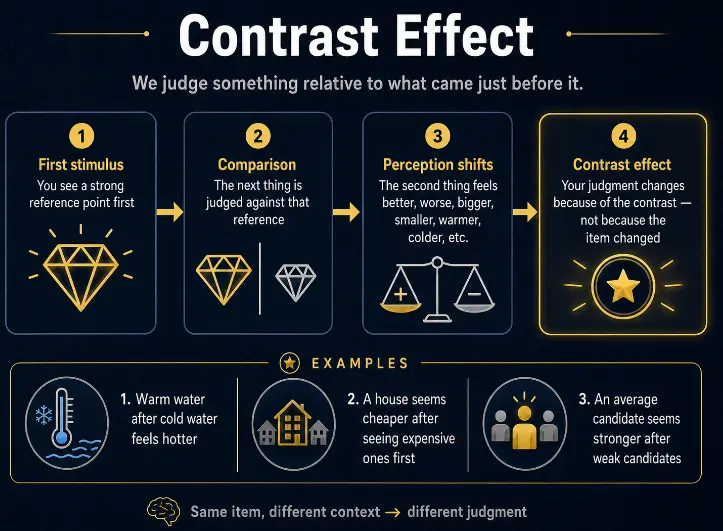
The contrast effect: the same item judged in different contexts produces different evaluations — warm water feels hotter after cold, a house seems cheaper after expensive ones, an average candidate seems stronger after weak ones.
Contrast Effect in Real Life — Examples
In salary negotiation and property pricing, the contrast effect is one of the most practically significant cognitive biases. A salary offer of £50,000 feels generous after a discussion anchored at £40,000, and inadequate after a discussion anchored at £65,000 — even if the candidate's independent assessment of fair market value is £52,000 in both cases. The contrast with the prior anchor, not the independent assessment, dominates the immediate perception. This is why skilled negotiators invest heavily in setting the opening number, and why the sequence of offers matters enormously to how each is received.
In retail, the contrast effect is exploited through the presentation of high-priced items before lower-priced ones. A £300 jacket displayed next to a £1,200 coat feels like a bargain; the same jacket displayed next to a £150 shirt feels expensive. The jacket's absolute value has not changed; the contrast with the adjacent item has. Luxury car dealerships use this deliberately — showing the fully-optioned top-of-range model first makes every subsequent option feel modestly priced by comparison. This overlaps closely with the anchoring bias, where the first number encountered disproportionately shapes subsequent numerical judgments.
In job interviews and academic grading, the contrast effect produces systematic unfairness. A candidate assessed after a series of weak candidates benefits from contrast — they appear stronger than their absolute performance warrants. A strong candidate assessed after an outstanding one appears weaker. A student's essay graded after a series of poor essays receives a higher mark than the same essay graded after a series of excellent ones. In both cases, the evaluation is influenced by what came before rather than by the independent quality of the work being assessed.
Contrast Effect in Relationships and Social Perception
The contrast effect shapes how people evaluate potential romantic partners, friends, and colleagues. Exposure to idealised representations of attractiveness — in advertising, social media, or entertainment — systematically lowers ratings of real people encountered subsequently, as Kenrick and Gutierres demonstrated. The same person who would have been perceived as attractive before exposure to exceptional prior stimuli is perceived as less attractive after it. This has practical implications for self-perception and relationship satisfaction: sustained exposure to highly curated, idealised representations of people shifts the reference point upward, making real people — and real relationships — seem less appealing by contrast.
In performance evaluation and social comparison, the contrast effect means that how good or capable a person appears is substantially determined by who they are being compared to at the time of judgment. A competent employee surrounded by highly exceptional colleagues may be consistently undervalued; the same employee in a less capable team may be consistently overvalued. Neither evaluation reflects the employee's absolute performance — both reflect the contrast with the current reference group. This connects directly to in-group bias, where group membership affects which comparison standards are applied.
Contrast Effect vs. Anchoring Bias
The contrast effect and the anchoring bias are related but distinct. Anchoring refers specifically to the disproportionate influence of the first number or piece of information encountered on subsequent numerical judgments — the anchor pulls subsequent estimates toward it. The contrast effect is broader and operates in the opposite direction: the extreme prior stimulus pushes the subsequent judgment away from it. In anchoring, a high opening offer pulls subsequent estimates upward; in the contrast effect, a very high prior experience makes the next experience seem lower by comparison. Both reflect the context-dependence of human judgment, but through different mechanisms and often in opposite directions.
How to Avoid the Contrast Effect
Establish independent criteria before encountering comparison stimuli
The most reliable defence against the contrast effect is to define what you are looking for — and at what level — before you encounter the stimuli that will set your reference point. In job interviews, establish the criteria for an acceptable candidate before beginning the interview sequence, and score each candidate against those criteria rather than against each other. In property searches, determine your price range and requirements before viewings, and evaluate each property against those requirements rather than against the one you saw immediately before.
Introduce deliberate time gaps between comparisons
The contrast effect is strongest for stimuli encountered in close temporal sequence — the reference point set by a recent extreme experience fades over time as the perceptual system adapts to a new baseline. Introducing deliberate gaps between high-contrast comparisons reduces the distorting effect of the most recent prior stimulus. If you have just viewed an exceptional candidate, property, or product, waiting before making your assessment of the next one allows the reference point to reset toward a more neutral baseline.
Ask whether your evaluation would change with a different prior context
A direct counter to contrast bias is to ask explicitly: "Would I evaluate this differently if I had encountered it first, or after something very different?" If the answer is yes — if you can identify a plausible prior context that would shift your evaluation significantly — that is a signal that contrast is influencing your current judgment. Recognising the contingency of the evaluation on context is the first step to adjusting it toward a more accurate absolute assessment. This same question is central to countering the framing effect — both biases involve presentation context distorting evaluation of the same underlying reality.
The Deeper Point
The contrast effect is a reminder that human judgment is fundamentally relational rather than absolute. We do not assess things on a fixed scale; we assess them against whatever reference point is currently active, and that reference point is set by recent experience in ways we neither choose nor notice. The result is that the same thing — the same person, the same price, the same performance — can produce radically different evaluations depending entirely on what was encountered immediately before.
Countering the contrast effect does not mean ignoring comparison entirely — comparative judgment is often useful and sometimes necessary. It means being alert to when the comparison being made is the product of accidental sequencing rather than deliberate and appropriate selection, and applying independent standards as a check on judgments that feel natural but are actually the product of context.
Related biases worth exploring alongside this one: anchoring bias, which similarly operates through reference point manipulation; decoy effect, which deliberately introduces comparison stimuli to steer choice toward a target option; and halo effect, which reflects a different kind of context-dependent judgment distortion — where one positive attribute creates a generalised positive impression across unrelated dimensions.
The Cognitive Bias Spotter Test below puts that understanding to work — see if you can identify the contrast effect and the other nine biases when they appear in realistic scenarios.