In-Group Bias — Meaning, Examples & How to Overcome It
Mind · Cognitive Biases · Social Judgment family
Test yourself — can you spot the bias in each scenario? Take the Cognitive Bias Spotter Test. Jump to the test ↓
What Is In-Group Bias? Simple Definition
In-group bias is the tendency to favour people who belong to the same group as you — giving them more trust, more generosity, more benefit of the doubt, and more positive evaluations — simply because of that shared membership, regardless of individual merit.
In simple terms: we treat people like us better than people unlike us, even when the grouping is trivial or arbitrary. The group does not need to be meaningful — shared nationality, workplace, sports team, or even a randomly assigned label is enough to activate preferential treatment toward in-group members and harsher judgment toward out-group members.
This page is part of the cognitive biases guide on Cognitive Train, alongside interactive tests and tools covering memory, attention, and decision-making.
In-Group Bias Meaning & Psychology
The systematic study of in-group bias began with Henri Tajfel's minimal group paradigm experiments in the early 1970s. Tajfel and colleagues assigned participants to groups based on entirely trivial criteria — ostensibly their preference for paintings by Klee versus Kandinsky, or simply a random coin flip. Despite the groups having no history, no shared interest, and no competitive relationship, participants consistently allocated more resources to in-group members and less to out-group members when given the opportunity to distribute rewards. The mere act of categorisation — knowing you are in group A and someone else is in group B — was sufficient to produce discriminatory behaviour.
This led Tajfel and Turner to develop Social Identity Theory, which proposes that people derive a significant part of their self-esteem from the groups they belong to. Because the status of the group reflects on the individual, people are motivated to see their own group as better than others — and to behave in ways that maintain or enhance that perceived superiority. In-group bias is, in this framework, not a side effect of group membership but one of its core psychological functions.
In-group favouritism vs out-group derogation
In-group bias operates through two distinct mechanisms that are worth separating. In-group favouritism is the positive side: extending more trust, warmth, generosity, and charitable interpretation to in-group members. Out-group derogation is the negative side: applying harsher standards, less trust, and more negative attributions to out-group members. Research suggests that in-group favouritism is generally stronger and more consistent than out-group derogation — people are more reliably generous to their own group than they are hostile to others — but both mechanisms are present and can operate independently.
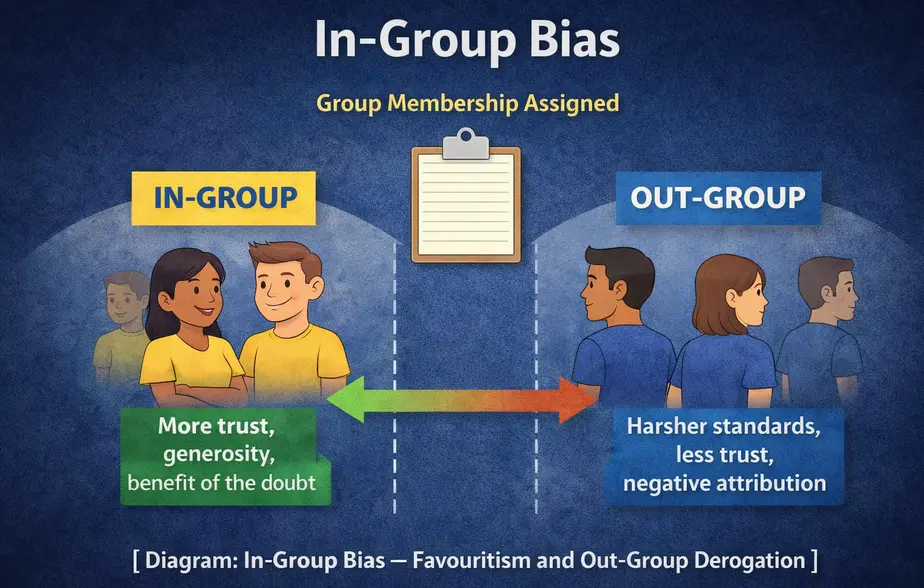
In-group bias in action — the same group assignment that extends trust and generosity inward applies harsher standards and negative attribution outward.
In-Group Bias in Real Life — Examples
In-group bias operates across virtually every social grouping humans form. Sports fans attribute wins to their team's skill and losses to bad luck or referee error — while applying the exact opposite interpretation to the opposing team. People rate the work of someone from their own country, university, or professional background more favourably than objectively identical work from someone outside those groups. In mock jury studies, jurors are consistently more lenient toward defendants who share their demographic background and harsher toward those who do not.
Even groups formed minutes earlier on arbitrary grounds show the effect. In one well-known classroom demonstration, students told they are "blue eyes" or "brown eyes" begin treating each other differently within hours — the in-group extending privileges and the out-group experiencing discrimination, purely on the basis of a label applied that morning. The speed with which in-group bias activates suggests it is not learned through experience of specific groups but is a general-purpose social mechanism that attaches itself to whatever category distinctions are currently salient.
In-Group Bias in the Workplace
In professional settings, in-group bias shapes hiring, promotion, mentorship, and resource allocation in ways that are difficult to detect precisely because they feel like natural preference rather than discrimination.
In hiring, in-group bias means that candidates who share the interviewer's educational background, industry history, communication style, or cultural markers receive more charitable interpretation of their CV and more positive evaluation of their interview performance — independent of actual qualification. This is compounded by the halo effect: once an interviewer feels an affinity with a candidate, that positive impression spreads across all evaluation dimensions. The result is that hiring decisions consistently overrepresent people similar to those already in the organisation, which drives homogeneity over time without any explicit discriminatory intent.
In team dynamics, in-group bias creates fault lines between departments, seniority levels, or professional specialisations. Marketing and engineering teams within the same company can develop genuine out-group attitudes toward each other — attributing their own team's successes to competence and the other team's failures to character, while applying the reverse interpretation to the other side. This is a direct application of the fundamental attribution error operating along in-group lines: good outcomes are attributed to the in-group's qualities, bad outcomes to the out-group's.
Mentorship and sponsorship patterns are also significantly affected. Senior employees are more likely to informally mentor, advocate for, and create opportunities for junior employees who remind them of themselves — sharing their background, communication style, or career path. This produces compounding advantages for in-group members and compounding disadvantages for those outside it, across entire career trajectories, without any single decision being explicitly discriminatory.
In-Group Bias in Politics and Society
Political polarisation is substantially driven by in-group bias operating at the level of party identity. Research consistently shows that people evaluate identical policies more favourably when told their preferred party supports them, and less favourably when told the opposing party does. Policy positions are often not the cause of group identity — they are a consequence of it. People adopt the positions associated with their group and then generate reasons to support those positions, rather than forming independent views and then finding the group that matches them.
In-group bias also shapes how people process news and information about political events. Actions taken by in-group politicians are evaluated charitably — attributed to principle, necessity, or context — while identical actions by out-group politicians are attributed to incompetence or bad character. This is not hypocrisy in the conventional sense; it is the automatic operation of in-group favouritism and out-group derogation on political judgment, producing genuinely different perceptions of identical events depending on who performed them.
In-Group Bias in Psychology — Research and Evidence
Tajfel and Turner's minimal group paradigm remains one of the most replicated findings in social psychology. The robustness of the effect across cultures, age groups, and types of group categorisation suggests it reflects a deep feature of human social cognition rather than a culturally specific learned behaviour.
Tajfel, Billig, Bundy and Flament (1971) established in their foundational minimal group paradigm experiments that even trivial, meaningless group categorisation is sufficient to produce in-group favouritism in resource allocation. Subsequent research has examined the conditions under which in-group bias is stronger or weaker: it is amplified when group identity is made salient, when groups are in competition, when individual members feel their group's status is threatened, and when the evaluative dimension is ambiguous enough to allow bias to operate without being obvious.
Notably, in-group bias is reduced — though not eliminated — when people are asked to evaluate out-group members as individuals rather than as group representatives, a finding with direct implications for how workplaces and institutions can be structured to reduce its effects.
How to Avoid and Overcome In-Group Bias
Individualise evaluation
In-group bias is strongest when people are evaluated as members of a category rather than as individuals. Structured evaluation processes that require assessors to engage with specific, individual evidence — particular achievements, specific responses, documented outcomes — rather than forming a global impression reduce the influence of group membership on judgment. Blind CV screening, standardised interview scoring, and anonymised work assessments all operationalise this principle.
Make the bias explicit in group processes
In team discussions and hiring panels, naming in-group bias explicitly — before evaluation begins — has been shown to reduce its influence. When evaluators are reminded that they may be applying different standards to in-group and out-group members, they are more likely to apply conscious scrutiny to their judgments. This does not eliminate the bias but introduces a corrective check that is absent when the bias operates silently.
Increase contact with out-group members as individuals
The contact hypothesis, supported by decades of research, proposes that direct, individualising contact with out-group members under conditions of equal status and shared goals reduces out-group derogation. This is why diverse teams with genuine interdependence — where each member's contribution is necessary for shared success — show reduced in-group bias compared to homogeneous teams or diverse teams where members work independently. The key is contact that makes individual characteristics salient rather than group membership.
Examine resource allocation decisions
In professional settings, one of the most reliable ways to detect in-group bias is to audit resource allocation — who receives mentorship, sponsorship, development opportunities, and stretch assignments. If these consistently track group membership rather than performance, in-group bias is likely operating. Making allocation decisions visible and requiring them to be justified against explicit criteria reduces the space for bias to operate undetected.
The Deeper Point
In-group bias is one of the most fundamental and ancient features of human social cognition. The capacity to distinguish "us" from "them" and to prioritise the interests of "us" almost certainly evolved in environments where group membership was a matter of survival — where your group's success was directly tied to your own. The problem is that this mechanism now operates in contexts where group boundaries are arbitrary, the stakes are not survival, and the cost of out-group derogation falls on individuals who have done nothing to warrant it.
Understanding in-group bias does not make you immune — the pull of group identity is too deep and too automatic for awareness alone to neutralise it. But it changes how you design evaluation processes, how you interpret your own strong positive reactions to people who are similar to you, and how you build teams and institutions that need to make fair judgments across group lines.
Related biases that interact closely with this one: the halo effect, which amplifies in-group favouritism by spreading positive impressions from group affinity across all evaluation dimensions; the fundamental attribution error, which operates asymmetrically along in-group lines; and confirmation bias, which ensures that in-group members' positive actions are noticed and remembered while their failures are explained away.
The Cognitive Bias Spotter Test below puts that understanding to work — see if you can catch in-group bias and the other nine biases when they appear in realistic scenarios.