Decoy Effect — Meaning, Examples & How to Avoid It
Mind · Cognitive Biases · Judgment & Decision-Making family
Test yourself — can you spot the bias in each scenario? Take the Cognitive Bias Spotter Test. Jump to the test ↓
What Is the Decoy Effect? Simple Definition
The decoy effect is the tendency for people to change their preference between two options when a third, strategically inferior option — the decoy — is introduced to the choice set. The decoy is not meant to be chosen. Its purpose is to make one of the original two options look more attractive by comparison, shifting the decision in a predictable direction. The decoy changes the context of the choice without changing the options themselves, and that contextual shift is enough to alter what people decide.
Also known as the asymmetric dominance effect or the attraction effect, it is one of the most practically important cognitive biases in consumer behaviour — used deliberately in pricing strategies, subscription models, and product line design across virtually every consumer industry.
This page is part of the cognitive biases guide on our free brain training and cognitive assessment platform, alongside interactive tools covering memory, attention, reaction time, and decision-making.
Decoy Effect Meaning & Psychology
The decoy effect was first identified and named by Huber, Payne & Puto (1982), who demonstrated that adding an asymmetrically dominated option to a choice set systematically violated the classical economic principle of regularity — the assumption that adding a new option to a set can only reduce or maintain, never increase, the probability that any existing option is chosen. In their experiments, the introduction of a decoy reliably increased the market share of the option it was designed to favour, directly contradicting the rational choice model.
An option is asymmetrically dominated when it is clearly inferior to one option in the choice set on all relevant dimensions, but only partially inferior to the other. This asymmetry is the key: the decoy provides an unambiguous basis for preferring the target option over the decoy, which makes the target seem like a strong choice — and that sense of relative superiority spills over into the comparison between the target and the competitor.
Subsequent research by Simonson (1989) extended understanding of the effect by showing that people under preference uncertainty — when they are not sure what they want — tend to choose options that are easy to justify. A dominated option makes the target easy to justify: "I chose this because it is clearly better than the alternative." This justifiability account explains why the decoy effect is stronger when decisions feel difficult or consequential, and when people expect to explain their choices to others.
Why comparison drives choice
The decoy effect illustrates a fundamental feature of human decision-making: preferences are not fixed, pre-existing quantities that people consult when choosing. They are constructed in the moment, shaped by the comparison set available. When only two options are present, neither dominates the other — one is better on some dimensions, the other on others — and the choice is genuinely difficult. When a decoy is added, one option suddenly dominates another, providing a clear reason to prefer it. The comparison set has changed; the preferences have changed with it.
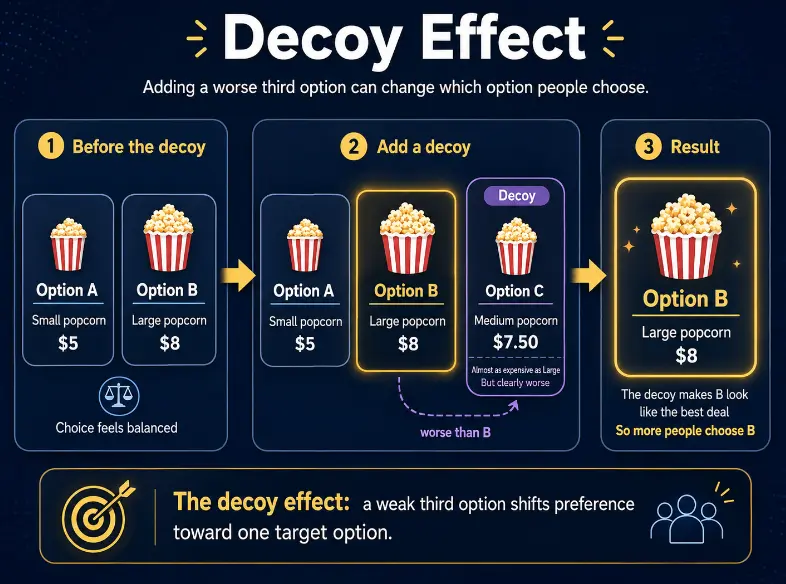
The decoy effect: a medium popcorn priced at $7.50 — almost as expensive as the large but clearly worse value — shifts preference toward the large. The decoy is not meant to be chosen; it is meant to make the target look like the obvious choice.
Decoy Effect in Real Life — Examples
The cinema popcorn example is the most widely cited illustration. Presented with a small popcorn at £3 and a large at £7, many people choose the small — the large feels expensive. Add a medium at £6.50 as a decoy, and the large suddenly looks like outstanding value: for just 50p more than the medium, you get the largest size. The medium is the decoy — nobody needs it, but its presence makes the large the obvious choice. Sales of the large increase substantially, which is exactly the outcome the pricing was designed to produce.
The Economist subscription example, popularised by Dan Ariely, is another classic case. Offered a choice between a web-only subscription and a print-plus-web subscription at a higher price, most people chose the cheaper web-only option. When a print-only subscription was added at the same price as the print-plus-web option, it served as a decoy: print-plus-web now clearly dominated print-only (same price, more access), making the combined subscription appear to be exceptional value. The proportion choosing the more expensive combined option increased sharply — the decoy had done its work.
In software and service pricing, the three-tier model — basic, standard, and premium — frequently uses the standard tier as a decoy designed to make the premium tier appear attractively priced. The standard tier is priced and featured to be clearly inferior to the premium option relative to the price difference, shifting the majority of customers toward the higher-margin product. The basic tier anchors the bottom of the range; the standard tier functions as the decoy; the premium tier is the target.
Decoy Effect in Career and Life Decisions
The decoy effect is not confined to consumer markets. In hiring decisions, a weaker candidate on a shortlist can function as a decoy that makes one of the stronger candidates appear more clearly superior — not because their absolute qualities have changed, but because the comparison set now includes an option that one of them unambiguously outperforms. The same mechanism operates in property viewings, where estate agents sometimes show an overpriced or poorly presented property before showing the target property, making the target appear better value by contrast.
In personal decisions — where to live, which offer to accept, which course of study to pursue — the options that happen to be available for comparison shape preferences that feel entirely internal and self-determined. The presence of an obviously inferior option in the consideration set can shift the apparent attractiveness of the remaining options in ways that the decision-maker does not notice and would not endorse if they did.
Decoy Effect vs. Compromise Effect
The decoy effect is closely related to but distinct from the compromise effect, also described by Simonson. While the decoy effect operates by introducing an asymmetrically dominated option that makes the target look superior, the compromise effect operates by introducing an extreme option that makes the middle option look like a sensible, moderate choice. A very expensive premium product makes a mid-range product feel like the reasonable compromise between excess and inadequacy. Both effects exploit context-dependent preference construction, but through different mechanisms — the decoy provides a dominated comparison; the compromise provides an extreme anchor. Both are discussed in the context of anchoring bias, since both involve the use of reference points to shape perceived value.
How to Avoid the Decoy Effect
Evaluate options independently before comparing them
The decoy effect operates through comparison — it only works when options are evaluated relative to each other rather than against independent criteria. Before looking at a choice set, establish what you actually need: what are the relevant attributes, what levels of those attributes are acceptable, and what price range is appropriate? Evaluating options against these pre-established criteria, rather than against each other, reduces the power of the decoy to distort the comparison.
Ask why a particular option is present
When a choice set contains an option that seems clearly inferior on most dimensions to another option at a similar or higher price, ask why it is there. Inferior options do not appear in well-designed product lines by accident — they are placed deliberately to make another option look more attractive. Recognising the decoy's function as a comparison anchor rather than a genuine choice is the first step to neutralising its effect on your preference.
Remove the decoy mentally and reconsider
A practical counter-measure is to mentally remove the suspected decoy from the choice set and reconsider the remaining options on their merits. If your preference between the remaining options changes significantly when the decoy is present versus absent, the decoy has been doing work on your judgment that it has no legitimate claim to do. Your preference should be based on the options themselves, not on what the decoy makes them look like by comparison. This connects to the corrective for framing effect: strip away the contextual presentation and assess the underlying value directly.
The Deeper Point
The decoy effect is a direct demonstration that preferences are not discovered but constructed — assembled in the moment from the comparison set available, the attributes made salient by the presentation, and the relative positions of the available options. This is a fundamentally different picture of decision-making than the rational choice model assumes, and it has significant practical implications: the choices that are made available to you, and the order and framing in which they are presented, shape what you want in ways you do not notice and cannot easily correct for without deliberate effort.
Understanding the decoy effect does not mean refusing to use comparison when making decisions. Comparative evaluation is often sensible — relative value is real, and context matters. It means being alert to the possibility that the comparison set has been constructed to steer you toward a particular option, and applying independent criteria as a check on preferences that feel natural but may be the product of deliberate design.
Related biases worth exploring alongside this one: anchoring bias, which similarly uses reference points to shape perceived value; framing effect, which shows how presentation context changes evaluation without changing the underlying facts; and representativeness heuristic, which reflects the broader tendency to use available comparisons as shortcuts to judgment rather than evaluating options on their absolute merits.
The Cognitive Bias Spotter Test below puts that understanding to work — see if you can identify the decoy effect and the other nine biases when they appear in realistic scenarios.