Anchoring Bias — Meaning, Examples & How to Overcome It
Mind · Cognitive Biases · Information Processing family
What Is Anchoring Bias? Simple Definition
Anchoring bias is the tendency to rely too heavily on the first piece of information you encounter — the "anchor" — when making decisions or estimates. Everything that follows gets judged in relation to that initial number or idea, even when it is irrelevant.
In simple terms: whoever sets the first number in a conversation has an outsized influence on where that conversation ends. A high opening price makes a lower price feel like a bargain. A low initial estimate makes a higher one feel excessive. The starting point shapes the finish line.
Test yourself — can you spot the bias in each scenario? Take the Cognitive Bias Spotter Test. Jump to the test ↓
A car salesman opens the negotiation by showing you a model priced at $55,000. You were planning to spend $35,000. By the end of the conversation, you settle on $42,000 and feel like you got a deal. You did not get a deal. You got anchored. The $55,000 figure — arbitrary, strategically placed — became the reference point against which every subsequent number was measured. $42,000 feels reasonable only in relation to $55,000. Compared to your original budget, it is $7,000 over.
Anchoring bias is the tendency to rely disproportionately on the first piece of information encountered — the anchor — when making subsequent judgments or decisions. Once an anchor is set, all estimates, evaluations, and negotiations adjust from that starting point, and those adjustments are almost always insufficient. The anchor pulls the final judgment toward itself even when it is irrelevant, arbitrary, or clearly manipulated. This effect was first formally described by Tversky and Kahneman (1974), the same researchers who identified the availability heuristic, and it has since become one of the most replicated findings in behavioural science. This page is part of the cognitive biases guide on our cognitive testing and training site, alongside tools covering memory, attention, and decision-making.
The Original Experiment
In Tversky and Kahneman's original demonstration, participants were shown a spinning wheel — rigged to stop at either 10 or 65 — and then asked to estimate the percentage of African countries in the United Nations. Participants who saw the wheel land on 65 gave estimates around 45%. Those who saw it land on 10 gave estimates around 25%. The wheel was obviously random and completely irrelevant to the question. It did not matter. The arbitrary number it produced pulled the estimates toward itself by roughly 20 percentage points. This is the anchoring effect in its purest form: an irrelevant initial value systematically distorting a subsequent judgment.
The finding has since been replicated with legal sentencing, salary negotiations, real estate valuations, medical diagnoses, and retail pricing — across cultures, professional groups, and levels of expertise. Experts are somewhat less susceptible than novices in their own domain, but not immune. Even judges, who are explicitly trained to evaluate evidence independently, show anchoring effects in sentencing decisions when exposed to an initial number before deliberating.
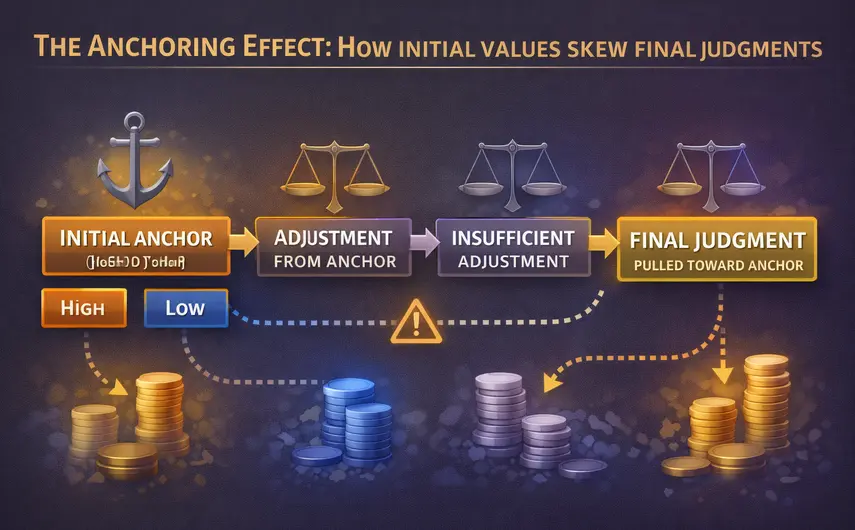
The anchoring effect — whether the initial value is high or low, the final judgment is pulled toward it through a process of insufficient adjustment.
Why the Brain Does This
Two mechanisms have been proposed to explain anchoring, and both are probably operating simultaneously.
Insufficient adjustment
When people start from an anchor and adjust toward what they think is the correct answer, they tend to stop adjusting too soon — typically as soon as they reach a value that seems plausible. The adjustment process is effortful and people terminate it prematurely. This means the final answer retains a strong influence from wherever the adjustment started. A high anchor produces a high final estimate; a low anchor produces a low one — not because the anchor is treated as correct, but because the adjustment away from it is systematically too small.
Confirmatory hypothesis testing
When an anchor is presented, the brain begins selectively retrieving information consistent with that anchor being approximately correct. If the anchor is $55,000 for a car, the brain starts generating reasons why that price range might be reasonable — features, brand value, market comparisons — rather than neutrally evaluating the car's worth. This selective evidence retrieval then feeds back into the estimate, pulling it further toward the anchor. Chapman and Johnson (1999) demonstrated this mechanism, showing that anchors activate anchor-consistent knowledge and suppress anchor-inconsistent knowledge during the judgment process.
Where Anchoring Bias Shows Up
In salary negotiation
Whoever names a number first in a salary negotiation sets the anchor for the entire conversation. A candidate who opens with $95,000 will almost always end up with a higher offer than one who waits for the employer to name a figure — because the employer's opening offer becomes the anchor from which upward adjustments feel large and downward adjustments feel natural. Research by Galinsky and Mussweiler (2001) confirmed that first offers are the single strongest predictor of final settlement prices in negotiations, more so than any subsequent argument or counter-offer. The anchor dominates.
In retail pricing
The "was $199, now $99" pricing strategy works entirely through anchoring. The original price — which may never have reflected actual market value — serves as the anchor, making $99 feel like a bargain regardless of what the item is actually worth. Luxury retailers use the same mechanism by displaying their most expensive items prominently at the entrance: after seeing a $4,000 handbag, a $400 one feels reasonable. The anchor shifts the entire reference frame within which subsequent prices are evaluated.
In legal sentencing
A study by Englich, Mussweiler, and Strack (2006) asked experienced legal professionals to determine a sentence after rolling a pair of dice — rigged to show either 3 or 9. Those who rolled a 9 recommended sentences averaging 8 months longer than those who rolled a 3. The dice roll was explicitly random and explicitly irrelevant. It still moved sentencing recommendations by nearly a year. In actual courtrooms, prosecution sentencing demands function as anchors — the higher the demand, the higher the eventual sentence, even after adjustment for the specific facts of the case.
In real estate
Listing prices anchor buyers' perception of value so powerfully that even experienced real estate agents are affected. When the same property was presented to agents with different listing prices, the agents' assessments of its value tracked the listing price — despite their professional training to evaluate properties independently. Buyers who know nothing about a neighbourhood's actual price range will use the first listing they see as a reference point for all subsequent properties, often systematically misjudging value as a result.
In medical estimates
When doctors are given a patient's age before making a diagnosis, that age anchors their probability estimates for age-related conditions. A symptom that might be read as benign in a 35-year-old is more likely to trigger concern in a 70-year-old — which is sometimes appropriate, but the anchoring effect means the age influences judgment even when it should be irrelevant to the specific finding. Similarly, initial test results anchor subsequent clinical interpretation: a borderline result that comes in after a positive preliminary finding is read differently than the identical result arriving without that prior context.
Test yourself — can you spot the bias in each scenario? Take the Cognitive Bias Spotter Test ↓.
Why Anchoring Is Particularly Hard to Avoid
Most cognitive biases can at least be partially countered once you are aware of them and have time to think carefully. Anchoring is unusually resistant to this. Studies have shown that warning people explicitly about the anchoring effect — telling them an anchor is random and irrelevant before presenting it — reduces but does not eliminate its influence. Even when people know they are being anchored, they cannot fully correct for it. The adjustment process simply does not go far enough, even when the person understands they need to adjust further.
This connects to confirmation bias: once an anchor activates anchor-consistent thinking, the evidence retrieved to evaluate the anchor is already skewed, making it feel more credible than it should. The two biases reinforce each other — the anchor sets a direction, and confirmation bias populates that direction with supporting evidence.
How to Avoid and Overcome Anchoring Bias
Consider the opposite anchor
The most effective debiasing technique identified in the research is to explicitly consider an anchor at the opposite extreme before making your estimate. If you have just been shown a high asking price for a property, deliberately ask yourself: what would this property be worth if I had first seen a listing at half this price? This does not eliminate the original anchor, but it introduces a competing anchor that partially offsets it, pulling the final estimate toward the middle. Mussweiler, Strack, and Pfeiffer (2000) showed this to be significantly more effective than simply telling people to ignore the anchor.
Generate your own estimate first
Before being exposed to any external anchor — a listing price, a salary figure, a quoted estimate — form your own independent assessment of what the correct value should be. This prior estimate becomes a competing anchor that reduces the influence of the subsequently encountered one. In practice this means doing your research before entering any negotiation, before viewing a property listing, before discussing salary. The person who arrives with their own number is substantially less susceptible than the person who waits to see what they are offered.
Ask where the anchor came from
Anchors feel authoritative even when they are arbitrary. Making it a habit to ask "how was this number determined?" forces an evaluation of the anchor's legitimacy before it has fully embedded. An asking price set by a motivated seller, a salary range set by a recruiter working to a budget, and a suggested retail price set by a manufacturer all have very different relationships to actual value — and treating them differently requires first noticing that they exist.
Use reference class data
Rather than adjusting from the presented anchor, look for comparable data that lets you bypass it entirely. What have similar properties in this area actually sold for? What does the market data say about salaries for this role? External reference data provides an independent starting point that competes with — and can override — the presented anchor, rather than simply trying to adjust away from it with insufficient force.
The Deeper Point
Anchoring bias is one of the most commercially exploited cognitive biases in existence. Pricing strategies, negotiation tactics, fundraising ask amounts, and political framing all rely on it systematically — because it works, reliably, on almost everyone. The first number in any conversation has an outsized and persistent influence on where that conversation ends, regardless of whether the number has any rational relationship to the question being decided.
Understanding anchoring does not make you immune. But it changes how you enter negotiations, how you evaluate prices, and how you read the framing of any situation where a number has been placed in front of you before you have formed your own view. The goal is to arrive with your own anchor wherever possible — and to treat any externally provided number as a starting point for scrutiny, not a reference point for adjustment.
Related biases that interact closely with this one: the availability heuristic, which determines which comparisons come to mind when adjusting from an anchor; confirmation bias, which fills in anchor-consistent evidence once the anchor is set; and the sunk cost fallacy, which keeps people anchored to past investments when evaluating present decisions.
The Cognitive Bias Spotter Test below puts that understanding to work — see if you can catch anchoring bias and the other nine biases when they appear in realistic scenarios.