Head Drop Body Language: Meaning, Psychology & What Chin-to-Chest Really Signals
Signal · Head & Neck · Submission / Defeat / Shame family
Think you can read body language? We've included a Body Language Test at the bottom — see how well you read the full range of nonverbal cues. Jump to the test ↓

The head drop — chin moving toward the chest, gaze falling away from others — is one of the most instinctive and cross-culturally consistent signals in the human body language repertoire. It appears in moments of shame, defeat, grief, exhaustion, and submission, and it does so without conscious instruction. Understanding what drives the head drop and how to read it accurately requires attention to the signals that accompany it.
The Physiology and Origin of the Head Drop
The head drop is rooted in the same postural system that governs the body's response to social threat and status. When a person experiences shame, defeat, or submission, the postural muscles that hold the head upright tend to lose tone — the head falls forward, the neck curves, and the chin moves toward the chest. This is not a deliberate performance; it is a reduction in the muscular effort that normally keeps the head held high.
Research on shame and pride postures has consistently found that shame is associated with a postural collapse pattern — narrowed chest, rounded shoulders, and a lowered head — while pride produces the opposite: an expanded chest, raised head, and upright spine. (Tracy, J.L. & Robins, R.W., Psychological Science, 2004, 15(3), 194–197. DOI: 10.1111/j.0956-7976.2004.01503008.x)
The head drop also serves a protective function. Lowering the head reduces the exposure of the throat and face — two areas of high vulnerability — and positions the back of the skull forward. In evolutionary terms, this is a submissive posture: it signals to others that the person is not a threat and is not seeking confrontation.
What the Head Drop Signals
Shame and embarrassment. The most recognizable context for the head drop is shame. When a person has violated a social norm, been publicly criticized, or feels that others hold a negative view of them, the head tends to drop involuntarily. This is often accompanied by gaze aversion, flushing, and self-touch. The combination is one of the clearest embarrassment clusters in nonverbal behavior.
Defeat and submission. In competitive contexts — sports, arguments, negotiations — the head drop signals acceptance of a loss or subordinate position. It is a concession signal, communicating to others that the person is no longer contesting the outcome. This is why it appears reliably in athletes after a loss, in people who have just been reprimanded, and in social hierarchies where status has been clearly established.
Grief and sadness. The head drop in grief is less acute and more sustained than in shame. It reflects a general reduction in postural tone associated with low mood and emotional exhaustion. The head hangs rather than drops suddenly, and the overall body posture tends toward collapse rather than tension.
Fatigue. Physical and mental exhaustion produce a head drop that differs from the emotional versions primarily in context and accompanying signals. Fatigue-related head drops tend to appear with drooping eyelids, slowed movement, and reduced facial expression rather than the social withdrawal signals of shame or defeat.
Reading the head drop accurately means reading what accompanies it. The Body Language Test below ↓ trains exactly this — interpreting signals in context, not in isolation.
Head Drop vs. Head Tilt: Key Differences
The head drop and the head tilt are often confused but carry different meanings. A head tilt — where the head moves laterally toward one shoulder — signals interest, curiosity, or openness. It exposes the side of the neck and is generally an approach signal. The head drop moves the chin directly downward and signals withdrawal, submission, or low status. The direction of movement is the key distinction: lateral versus downward.
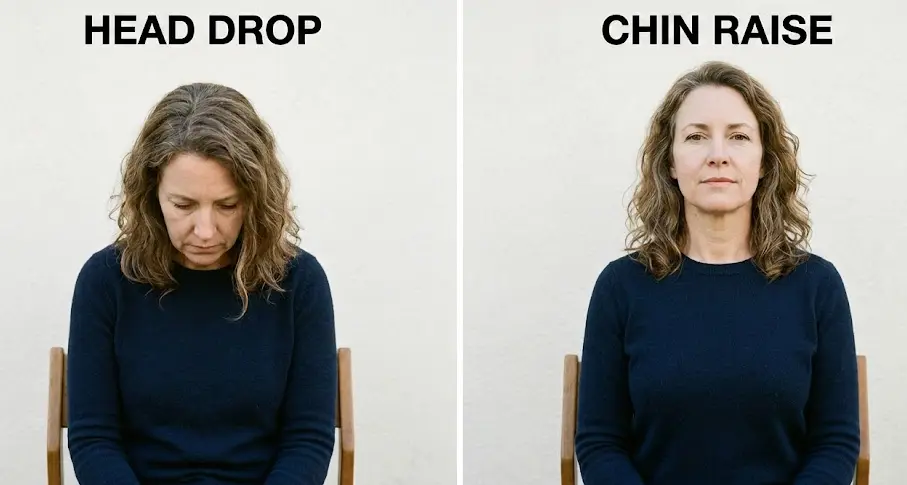
Left: head dropped forward, chin toward chest, gaze down — submission and withdrawal made visible. Right: head level, chin neutral, gaze forward — the posture of someone who is not conceding anything.
The Cluster Matters
Like all body language signals, the head drop is most informative when read alongside the signals that accompany it. A head drop with raised inner brows and a tightened mouth suggests shame or distress. A head drop with closed eyes and slow breathing suggests fatigue or grief. A sudden head drop following direct criticism or a competitive loss, combined with rounded shoulders and reduced eye contact, is a strong submission and defeat cluster.
The chin raise is the direct opposite signal — head held up or back, chin elevated — and often appears in dominance or defiance contexts. Watching for transitions between the two within a single interaction can reveal how a person's internal state is shifting in real time.
Context also determines whether a head drop reflects a transient emotional response or a habitual postural pattern. A person who consistently holds their head low across all situations may be reflecting a chronic low-status self-perception or depression rather than a situational response to a specific trigger. The baseline-plus-change principle applies: a head that drops in response to something specific is far more informative than one that is simply always low. For more tools to sharpen your reading of posture and status signals, explore the resources at the Mind Training Hub and across Cognitive Train.
How Much Body Language Can You Read?
The head drop is one of the clearest submission and shame signals in the human body language repertoire — but reading it accurately means understanding what accompanies it and what context it appears in. The test below covers the full range of expressions, gestures, and postures with detailed explanations after every answer so you learn as you go.