Chin Raise Body Language: Meaning, Psychology & What It Really Signals
Head Signals · Dominance / Status · Confidence family
Think you can read body language? We've included a Body Language Test at the bottom — see how well you read the full range of nonverbal cues. Jump to the test ↓

The chin raise — head back, neck exposed, gaze directed downward from a raised position. A signal that communicates status before a single word is spoken.
The chin raise is one of the most economical status signals the human body produces. A small upward movement of the head — chin lifting, neck exposed, gaze angled slightly downward — communicates a cluster of social information that registers immediately in observers: confidence, high status, lack of concern about threat, and a willingness to be looked at from below. It is a signal that requires almost no muscular effort and yet consistently triggers dominance-related judgments in everyone who witnesses it. Understanding why it works, and when it crosses from confidence into contempt, is what separates accurate reading of this signal from surface-level observation. This page is part of the body language resources available through Cognitive Train and the Mind Training Hub.
What makes the chin raise unusual among dominance signals is its mechanism. Most power displays work by making the body bigger — expanded chest, spread arms, increased height. The chin raise works by making the body more vulnerable. Tilting the head back exposes the neck, which is anatomically one of the most undefended parts of the human body. A signal that deliberately exposes a vulnerable region communicates, at a pre-conscious level, that the person perceives no threat worth protecting against. That fearlessness is what reads as status.
What Does a Chin Raise Signal? The Psychology Behind It
The chin raise communicates dominance through a combination of two mechanisms that operate simultaneously. The first is the vulnerability display: exposing the neck signals that the person does not need to protect it. In primate dominance research, high-ranking animals consistently expose vulnerable body parts during social interactions while lower-ranking individuals orient to protect theirs. The same pattern appears in human nonverbal behavior — confident, high-status individuals are more likely to carry their heads in positions that expose the throat; submissive or anxious individuals tend to lower the chin toward the chest, reducing neck exposure.
The second mechanism is the visual geometry it creates. When the chin rises and the head tilts back, the eyes are now elevated relative to whoever the person is looking at. Even across height differences, a shorter person with chin raised can maintain a downward gaze angle toward a taller person with chin lowered. The perception of "looking down on" someone — which carries a well-established social meaning of higher status — is partly created by this head position rather than by physical height alone. Research on face perception has found that facial postures combining direct eye gaze with an upward head tilt reliably produce dominance attributions in observers, a pattern documented in multiple laboratory studies (PMC2773146).
A landmark series of five studies by Witkower and Tracy (2019), conducted with a combined sample of 1,517 participants, demonstrated that head tilt alone — without any change in facial musculature — is sufficient to shift dominance perceptions significantly. Participants consistently judged neutral faces with altered head angles as more or less dominant purely on the basis of head orientation, with the effect driven by changes in the apparent position of the eyebrows created by the tilt. The finding has since been replicated cross-culturally, including among the Mayangna of Nicaragua — a small-scale traditional society with minimal exposure to Western media — in research published in PMC (2022) — providing evidence that the connection between head position and dominance perception is not a product of cultural learning but a widespread feature of human social cognition.
What Does a Chin Raise Mean in Different Contexts?
Dominance and high status — in social interactions involving hierarchy, status differences, or competition, the chin raise is one of the most reliable indicators of who perceives themselves as higher in the social order. It appears naturally in individuals who feel comfortable with their position — not as a performed display but as a resting orientation the head settles into when the person is not anxious about their standing. In job interviews, negotiations, and social encounters involving perceived status difference, the person whose chin rises tends to be the one who feels they hold the higher position. This is why chin position is often used as a rapid status-assessment cue in professional contexts: it is largely automatic and difficult to maintain artificially under genuine social pressure.
Confidence and self-assurance — the chin raise also appears as a general confidence signal in contexts where there is no explicit dominance dynamic. A person who delivers a presentation, walks into a room, or receives challenging feedback with chin raised is broadcasting that they are not diminished by the situation. The signal is not necessarily directed at anyone — it is an orientation the body adopts when the internal state is one of security rather than threat. In this context, the chin raise is less about social positioning and more about emotional state: the body reflecting that the person does not feel the need to protect or contract.
Contempt and dismissiveness — at higher intensities or in specific interpersonal dynamics, the chin raise transitions from confidence into contempt. When combined with a unilateral lip raise, narrowed eyes, and a slight backward lean, the raised chin becomes part of the contempt cluster — a display that communicates not just higher status but active disdain for the person being looked down at. The key distinction is in the facial expression that accompanies the head position: a neutral or slightly open expression alongside a raised chin signals confidence; a tightened, asymmetrical expression alongside a raised chin signals contempt. The head position is identical in both cases, making the accompanying facial signals essential for accurate reading.
The upward nod greeting — a brief, upward chin movement used as a greeting signal is a specific social use of the chin raise that communicates dominant-style acknowledgment without requiring full interaction. Research on greeting behavior has documented that in two-person interactions, the individual who nods upward (chin rising) tends to be perceived as the more dominant party, while the person who nods downward tends to be perceived as showing deference. The signal is well-established in male peer group interactions in particular and functions as a low-effort way of acknowledging someone while simultaneously signaling social position.
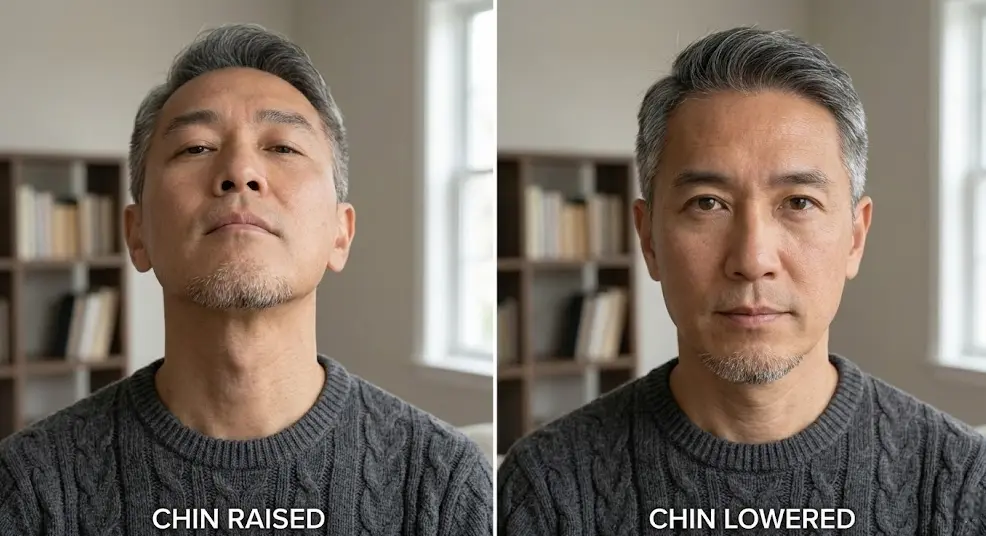
Left: chin raised — neck exposed, gaze directed slightly downward, head elevated, signaling dominance and confidence. Right: chin lowered — neck protected, gaze level, head in neutral position. The same person, different status signals.
The chin raise communicates status before a word is spoken. The Body Language Test below ↓ develops the skill of reading dominance and confidence signals alongside the full range of expressions and postures.
Chin Raise vs Similar Signals
Chin raise vs chin lower — the chin lower is the mirror image signal, communicating submission, deference, or shame. While the raised chin exposes the neck and elevates the gaze, the lowered chin protects the neck and orients the eyes downward — both of which communicate lower status and reduced confidence. Chin lowering also appears as part of the sadness and shame expression clusters, where the head drops as the body reflects the internal state of diminishment. The contrast between the two is one of the clearest status differentials the head can produce: in a group setting, the person whose chin is consistently elevated relative to others is typically the one who holds or perceives themselves to hold higher social standing.
Chin raise vs forward lean — the forward lean and chin raise can appear together but typically signal different states. The forward lean signals engagement and approach motivation — the body moving toward something of interest. The chin raise signals confidence and status without necessarily implying engagement. A person who leans forward with chin raised is both engaged and dominant — approaching from a position of confidence. A person who remains upright or leans slightly back with chin raised is signaling status without particular engagement. The combination of backward lean with raised chin is characteristic of the contempt or dismissiveness cluster — physically distancing from while looking down at.
Chin raise vs brow furrow — the chin raise and brow furrow can appear together as a challenge or threat display. In this combination, the raised chin communicates fearlessness while the furrowed brow signals focused assessment or active displeasure. The cluster reads as confident aggression: a person who is not afraid but is also not pleased. Chin raise without brow furrow tends to read as relaxed dominance or contemptuous dismissal depending on the mouth expression. Reading the two in combination provides considerably more precision than either signal alone.
Chin raise vs widened eyes — widened eyes and a raised chin generally point in opposite directions on the arousal-threat axis. Widened eyes signal alarm and threat detection — the visual system opening to process a potential threat. The chin raise signals absence of threat concern — the posture of someone who does not feel the need to be on guard. When both appear together, the combination is unusual and worth close attention: widened eyes alongside a raised chin can appear in very high-confidence individuals who have been genuinely surprised but are not alarmed, or in exaggerated social expressions combining theatrical surprise with performed status. In genuine alarm, the chin tends to lower as part of the defensive orientation; its remaining elevated while the eyes widen is a signal that the arousal response has not triggered the protective component.
How to Spot a Chin Raise Accurately
The most important calibration for reading chin position is establishing the individual's resting baseline. Some people naturally carry their heads at a slightly elevated angle due to posture habits, anatomy, or physical structure rather than emotional state or status signaling. What matters diagnostically is deviation from the individual's own resting position in response to specific social stimuli — not the absolute angle of the head in isolation. A person whose chin rises when they speak to one person and drops when they speak to another is revealing their perceived status hierarchy through head position, regardless of what their resting orientation is.
Context and the accompanying expression are essential for distinguishing confidence from contempt. The same head position carries very different social meanings depending on what the face is doing alongside it. A relaxed jaw, neutral or slightly open mouth, and steady eye contact alongside a raised chin signal confident ease. A tight jaw, slightly raised upper lip, narrowed eyes, and slight backward lean alongside a raised chin signal contempt or dismissal. Both involve an elevated chin; the difference lies entirely in the accompanying facial signals and body orientation. Cluster reading — tracking multiple signals simultaneously rather than isolating a single cue — is what allows this distinction to be made accurately.
The upward versus downward nod provides a quick real-time read of perceived status in dyadic interactions. In a first meeting or greeting, watch the direction of each person's initial head acknowledgment: the upward nod (chin rises briefly) and the downward nod (chin dips briefly) typically sort according to perceived relative status, with the person who feels higher in the hierarchy producing the upward movement. The pattern is often not conscious on either side — it emerges from the same automatic social cognition system that governs most dominance-related nonverbal behavior.
How Much Body Language Can You Read?
The chin raise is among the most automatic status signals the face and head produce — but reading it accurately means distinguishing confidence from contempt, understanding what the accompanying expression changes, and knowing what other signals appear alongside it. The test below covers the complete range of expressions, gestures, and postures with detailed explanations after every answer.