Inner Brow Raise Body Language: Meaning, Psychology & What It Really Signals
Brow Signals · Sadness / Distress · Authenticity marker
Think you can read body language? We've included a Body Language Test at the bottom — see how well you read the full range of nonverbal cues. Jump to the test ↓
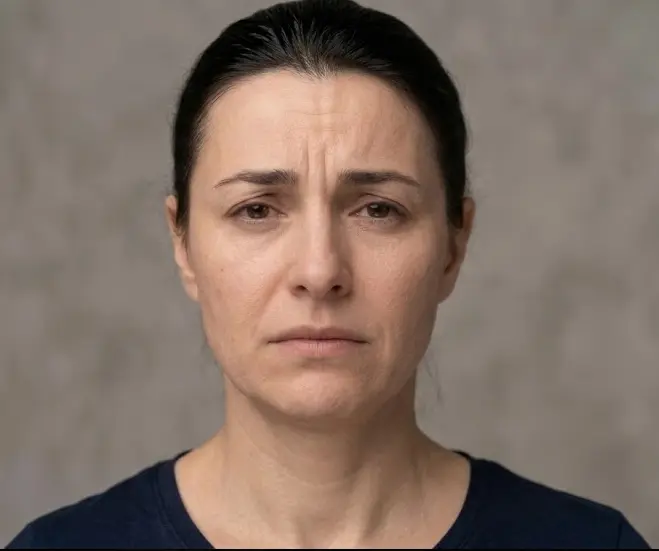
The inner brow raise — inner corners of the eyebrows pulled upward, oblique brow shape, vertical crease between them, slight central forehead wrinkling. Mouth controlled but the upper face revealing what the lower face is suppressing.
The inner brow raise is among the most diagnostically significant signals the face produces — not because it is dramatic, but because it is so difficult to fake. When only the inner corners of the eyebrows rise while the outer portions remain lower, the face takes on the characteristic oblique brow shape associated with sadness, distress, and grief. Most people cannot produce this movement voluntarily on demand. The muscle responsible — the frontalis pars medialis — is innervated differently from the muscles that control the rest of the face, making it resistant to deliberate control in a way that most facial muscles are not. This involuntary quality is precisely what makes the inner brow raise one of the most reliable indicators of genuine emotional distress in human nonverbal communication. This page is part of the body language resources available through Cognitive Train and the Mind Training Hub.
In the Facial Action Coding System (FACS), this movement is designated Action Unit 1 (AU1). It is the defining upper-face signal of sadness — present in genuine expressions of grief, distress, and empathic pain, and conspicuously absent in performed or deceptive displays of the same emotions. Learning to identify it accurately is one of the most valuable skills in body language reading, because it provides a direct window into whether the emotional display being observed is genuine or manufactured.
What Does the Inner Brow Raise Signal? The Psychology Behind It
Research by Gunderson, Baker, Pence and ten Brinke (2023), published across studies with a combined sample of 1,300 participants, provides direct evidence of the inner brow raise's role as an authenticity marker for sadness. The research found that untrained observers gave significantly less sympathy and offered less help to deceptive versus genuine expressers of sadness — and that this difference was driven specifically by the presence or absence of the AU1+4 combination (inner brow raise combined with brow lowerer) in the upper face. The lower face muscles, including the lip corner depressor, were also associated with sadness but did not drive observers' sympathy responses in the same way. The researchers identified the neural basis of this asymmetry: the muscles producing AU1+4 are innervated by the ipsilateral motor cortex rather than the contralateral motor cortex that controls most facial muscles, placing them under considerably less voluntary control. Deceptive expressers consistently failed to produce the upper-face component of genuine sadness, and observers — without knowing why — responded to its absence by withholding sympathy.
This finding aligns with the broader neuroscience literature on sadness. A comprehensive review by Kragel and LaBar (2020) in Neuroscience and Biobehavioral Reviews identified the raised inner eyebrows as one of the characteristic markers of sadness alongside lowered mouth corners, reduced walking speed, and slumped posture — a cluster that spans both the face and the body and reflects the coordinated way in which genuine sadness manifests across multiple expression channels simultaneously.
What Does the Inner Brow Raise Mean in Different Contexts?
Sadness and grief — the primary and most diagnostically important context for the inner brow raise is genuine sadness. When the inner corners of the brows rise and draw slightly together while the outer brow remains lower or neutral, the face produces the characteristic oblique brow shape that signals emotional pain. This expression frequently appears before tears, alongside lip compression as the person suppresses an emotional response, or in the aftermath of distressing news when the person is attempting to maintain composure. Because the movement cannot be reliably produced voluntarily, its presence is a strong indicator that the sadness being expressed is felt rather than performed. Its absence in someone claiming distress is equally informative — the face's upper region often reveals what the lower face attempts to conceal.
Distress and emotional pleading — the inner brow raise also appears in expressions of distress and appeal — situations where a person is communicating vulnerability, need, or a request for help or sympathy. In these contexts, the expression functions socially as well as emotionally: the oblique brow shape is one of the most reliably sympathy-eliciting configurations the face can produce, and its involuntary nature is precisely why it elicits genuine rather than calculated empathic responses in observers. A person whose inner brows rise while making an appeal is producing a signal that observers are neurologically prepared to respond to with care — provided the signal is genuine.
Fear and concern — the inner brow raise also appears as part of the fear expression, where it combines with the outer brow raise to create the full brow-raising of the fear cluster. In fear, both the inner and outer portions of the brow rise, creating high, raised, and slightly rounded brows with horizontal forehead creases. In sadness, by contrast, only the inner corners rise while the outer brow stays lower, producing the oblique or angled shape that distinguishes sadness from fear. This distinction matters: a person with fully raised brows is showing alarm or fear; a person with only the inner corners raised is showing sadness, distress, or grief. Misreading the two is one of the most common errors in body language interpretation, and the outer brow position is the key to distinguishing them.
Empathic pain — the inner brow raise appears not only when a person feels their own distress but also when they are experiencing empathic pain in response to someone else's suffering. Observers watching someone in pain, receiving bad news, or describing a loss will frequently produce a brief inner brow raise as part of the facial mirroring response that underlies empathy. This empathic version tends to be brief and lower in intensity than the full expression produced by direct emotional experience, but it is produced by the same muscle movement and carries the same structural signature. Noticing an inner brow raise in your audience while you speak tells you something about where emotional resonance is being felt in the room.

Left: inner brow raise — inner corners of the brows elevated, oblique brow shape, vertical crease between them, mouth slightly downturned, expression conveying genuine sadness or distress. Right: neutral brow — flat, even brow position, no oblique angle, expression baseline. The same person, different states of the emotional system.
The inner brow raise reveals what most faces cannot hide. The Body Language Test below ↓ trains you to read brow signals alongside the full range of facial expressions and postures.
Inner Brow Raise vs Similar Signals
Inner brow raise vs brow furrow — the inner brow raise and the brow furrow involve overlapping muscles and frequently appear together, but they carry different information and can appear independently. The brow furrow (AU4) pulls the brows down and together, signaling active cognitive processing, anger, or concentration. The inner brow raise (AU1) pulls the inner corners upward, signaling sadness or distress. When both appear simultaneously — the AU1+4 combination — the inner brows are drawn both upward and together, producing the distinctive oblique shape with a vertical crease between the brows that is the most recognizable upper-face signal of genuine sadness. The combination is harder to produce voluntarily than either component alone, which is why it serves as such a reliable authenticity marker. The brow furrow alone without inner brow raise signals concentration or anger; the inner brow raise alone without furrow signals milder distress or empathic concern; together they signal genuine grief or emotional pain.
Inner brow raise vs outer brow raise — the outer brow raise (AU2) lifts the outer corners and arches of the brows, which is the movement associated with surprise and the full surprise/fear expression. The inner brow raise (AU1) lifts only the inner corners. The two can appear together (producing fully raised, arched brows) or independently. When both are present, the face shows the rounded, high brow of surprise or fear. When only the inner portion rises with the outer remaining lower, the face shows the oblique brow of sadness. This structural difference is the single most reliable way to distinguish sadness from fear in the upper face: the angle and symmetry of the brow shape tells you which emotional family is active.
Inner brow raise vs widened eyes — inner brow raise and widened eyes can appear together in fear and distress expressions but serve different functions. The inner brow raise signals the emotional quality of the experience — grief, pain, or vulnerability. Widened eyes signal the threat-detection component — the visual system opening to take in more information about a potential danger. In pure sadness, the eyes tend not to widen; they may lower or become moist as the emotional state deepens. When both inner brow raise and widened eyes appear simultaneously, the expression is typically fear or acute distress rather than grief — the combination signals both emotional pain and active threat monitoring.
Inner brow raise vs unilateral brow raise — the unilateral brow raise involves one full brow rising while the other remains level, and signals skepticism, quizzical evaluation, or social questioning. The inner brow raise is bilateral — both inner corners rise symmetrically — and signals emotional distress rather than intellectual evaluation. Asymmetry is the key distinction: a brow movement that affects one side of the face differently from the other is in the skepticism or questioning family; a symmetric inner corner elevation is in the sadness and distress family. Both affect the brow region, but their different structure and symmetry put them in entirely separate communicative categories.
How to Spot the Inner Brow Raise Accurately
The key to identifying the inner brow raise is knowing exactly what to look for structurally. The movement involves only the inner corners of the brows — the portions closest to the nose — rising while the rest of the brow stays level or lower. This creates an oblique or angled brow shape where the inner end of the brow is higher than the outer end. In combination with AU4, a short vertical crease or furrow appears between the brows as both the raising and the pulling-together occur simultaneously. The forehead may show slight wrinkling in the central region above the inner brow corners rather than the horizontal creases across the full forehead that appear with a full brow raise.
The most common misidentification error is confusing the inner brow raise with the full brow raise of surprise. The structural test is straightforward: check the outer brow. If the outer corners are also elevated and the brow has a rounded, arched, high shape across its full length, the expression is surprise or alarm. If the outer corners remain relatively lower while only the inner portion rises — producing an angled rather than arched shape — the expression is sadness or distress. This distinction holds across cultures and is one of the most consistent structural differences in cross-cultural facial expression research.
Because most people cannot produce the inner brow raise voluntarily, its presence is almost always diagnostic of a genuine emotional state. Its absence in a person who is claiming sadness, distress, or grief is equally informative. A person who describes a loss with a flat, even brow — no oblique angle, no inner corner elevation — may be describing the event without currently experiencing the emotional state associated with it, or may be managing a performance of distress without the neurological activation that produces the expression involuntarily. The test below develops the specific skill of identifying this signal accurately alongside the full range of facial and body signals.
How Much Body Language Can You Read?
The inner brow raise is among the most informative authenticity signals the face produces — but reading it accurately means distinguishing it from the full brow raise of surprise, understanding the AU1+4 combination, and knowing what the surrounding signals confirm or complicate. The test below covers the complete range of expressions, gestures, and postures with detailed explanations after every answer.