Collapsed Posture Body Language: Defeat, Shame & What Making Yourself Small Really Signals
Signal · Posture & Space · Submission / Defeat family
Think you can read body language? We've included a Body Language Test at the bottom — see how well you read the full range of nonverbal cues. Jump to the test ↓
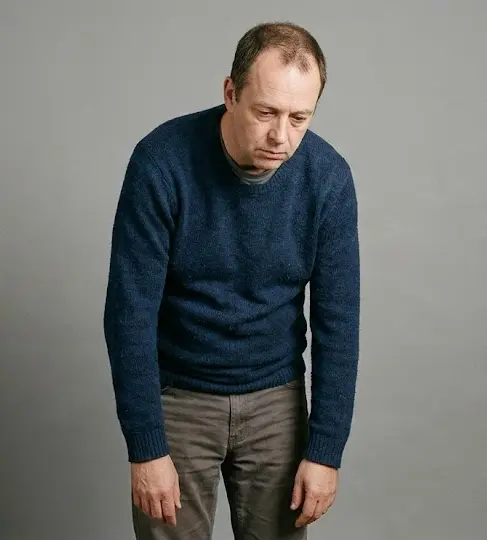
When the body collapses inward — shoulders rounding forward, chest caving, spine curving, head dropping — the signal is immediate and universal. You do not need training to read it. Collapsed posture is one of the oldest and most reliably decoded signals in human nonverbal communication, and it operates across every culture that has been studied.
Most people read it as sadness, defeat, or low confidence — and they are often right. But collapsed posture carries a more specific and nuanced range of meanings depending on what triggered it, how complete the collapse is, and what other signals appear alongside it.
What Does Collapsed Posture Mean in Body Language?
Collapsed posture is the physical opposite of expanded posture. Where expansion claims space and projects dominance, collapse surrenders it. The body turns inward, reduces its visible surface area, and withdraws the chest — the most vulnerable part of the torso — from exposure.
This contraction is deeply instinctive. Across social mammals, making the body small is a universal submission and defeat signal. It communicates that the individual is not a threat, is acknowledging a loss of status, or is experiencing a state — grief, shame, exhaustion — that has temporarily stripped them of the capacity or will to engage.
The collapsed posture is not a single signal but a spectrum. A slight forward rounding of the shoulders is a mild version. A complete cave — head down, arms pulled in, spine bent, legs drawn together — is a severe one. The degree of collapse tends to track the intensity of the underlying state.
The Psychology Behind It
Research by Jessica Tracy and David Matsumoto, who studied athletes at the Olympic and Paralympic Games, found that collapsed posture appears spontaneously after defeat across cultures — including in congenitally blind athletes who have never seen the posture modeled. This cross-cultural and cross-sensory consistency is strong evidence that the posture is biologically wired rather than learned.
The posture and the emotional state are bidirectionally linked. Feeling defeated causes collapse. But research on embodied cognition also shows that adopting a collapsed posture, even without a triggering event, produces measurable increases in feelings of helplessness, sadness, and low self-worth. The body is not merely expressing the state — it is participating in creating and maintaining it.
This is why posture interventions — deliberately correcting collapse by lifting the chest and pulling the shoulders back — have consistent effects on mood and cognitive performance in experimental studies. The posture change does not eliminate the underlying cause, but it does interrupt the feedback loop that sustains the collapsed emotional state.
What Collapsed Posture Can Signal
Defeat — the most direct reading. After a loss, a failure, or the end of a conflict in which the person came off worse, the body expresses the outcome through collapse. This is the posture of someone who has just received bad news, lost a competition, or had their position overruled. It is involuntary and immediate, appearing before the person has consciously processed what has happened.
Shame — a specific and intense version of collapse. Shame posture tends to be more complete than general defeat — the head drops particularly low, eye contact is avoided or cut entirely, and the body may turn slightly away as well as cave inward. Shame is experienced as a threat to the self, and the body responds by trying to disappear. Research on shame expression by June Price Tangney and colleagues has consistently found that shame — unlike guilt — produces a full-body withdrawal rather than a focused facial or gestural response.
Sadness and grief — sustained collapse that does not resolve after a few moments suggests a deeper emotional state. Grief and chronic sadness produce ongoing postural changes — the body seems to carry a weight that it cannot put down. The collapse is less reactive and more settled, and it tends to appear in all contexts rather than being triggered by a specific event.
Exhaustion — physical tiredness produces a superficially similar collapse, but it is typically more symmetrical and accompanied by reduced alertness rather than emotional withdrawal. An exhausted person will often make eye contact and engage when prompted; a defeated or shamed person may not.
Submission in hierarchy — in group settings, low-status individuals frequently adopt mild but persistent collapsed posture in the presence of higher-status members. This is often unconscious, functioning as a continuous social signal that the person is not challenging or competing. The Body Language Hub covers the full dominance-submission spectrum in the states section.
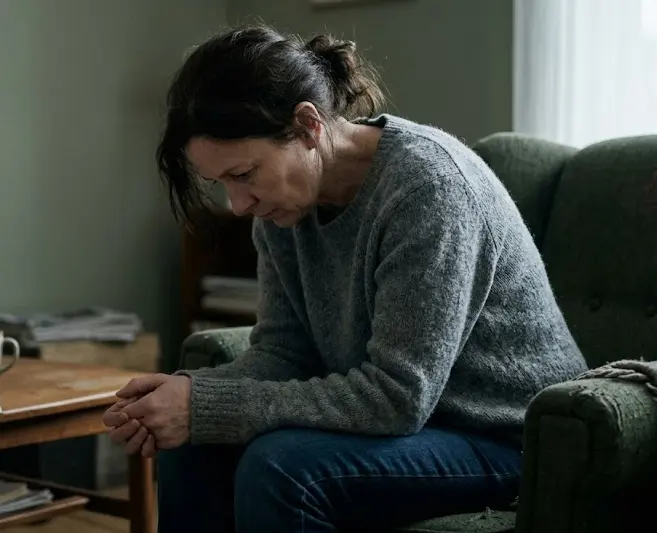
Collapsed Posture Across Contexts
In professional settings, collapsed posture is one of the clearest indicators that something has gone wrong for a person — internally or situationally. A person who enters a meeting already collapsed is carrying something in with them. A person who collapses during a meeting is responding to something in the room. The distinction matters enormously for reading the signal accurately.
In interpersonal conflict, collapse after an exchange signals concession or emotional overwhelm. When one person collapses while another remains expanded or adopts hands on hips, the hierarchy between them has been visually established. Whether or not either party is consciously aware of it, observers will read the status differential automatically.
In therapeutic and clinical contexts, posture is one of the primary nonverbal indicators that practitioners track. Persistent collapsed posture across multiple sessions is associated with depression, social anxiety, and trauma responses. The posture both reflects and maintains these states — which is why somatic and body-based therapeutic approaches frequently begin with postural work before addressing cognitive content.
Distinguishing Collapsed Posture from Similar Signals
Collapsed posture vs relaxed posture — a relaxed person may lean back, soften their spine, and release muscular tension — but the chest remains relatively open and the head stays level or slightly raised. Collapse pulls the chest inward and drops the head forward. The distinction is between release (relaxed) and withdrawal (collapsed).
Collapsed posture vs crossed arms — crossed arms creates a barrier while keeping the posture otherwise upright. Collapsed posture surrenders the upright position entirely. A person can cross their arms defensively without collapsing; a person who has fully collapsed is beyond the defensive stage — they are in withdrawal.
Collapsed posture vs contemplative stillness — someone deep in thought may hunch slightly over a desk or lower their head — but this tends to be forward-focused rather than inward-collapsing, and the shoulders remain relatively back. True collapse is inward and downward rather than forward and focused.
How to Read Collapsed Posture Accurately
The most important question is whether the collapse is reactive or chronic. A reactive collapse — appearing suddenly in response to a specific event — tells you something happened that moment. A chronic collapse — present across contexts and interactions — tells you something is sustained in that person's life or psychology.
The head position is the most informative detail. A head dropped forward with eyes down signals shame specifically. A head dropped to the side or resting in the hand signals exhaustion or sadness. A head pulled back while the chest is collapsed — a rare mixed signal — can indicate someone suppressing an emotional reaction while their body is already reacting to it.
Watch for the trajectory. Is the collapse deepening, stable, or beginning to resolve? A person who starts collapsed and gradually lifts — shoulders back, chest opening, gaze rising — is recovering. A person who is progressively collapsing over the course of an interaction is deteriorating emotionally. The direction of change is often more informative than the position at any single moment.
Reading clusters is the core skill in body language. The Body Language Test below ↓ is built around exactly this — interpreting signals in context, not in isolation.
See also: Body Language Hub · Body Language Test · Expanded Posture · Hands on Hips · Crossed Arms · Social Cognition · Emotion Recognition Test
How Much Body Language Can You Read?
Collapsed posture is one signal in a much larger system. How accurately can you read the rest? The test below covers expressions, gestures, and postures across multiple contexts — with detailed explanations after every answer so you learn as you go.