Zöllner Illusion
The long lines are perfectly parallel, but the short diagonal strokes make them appear to lean in opposite directions.
Look at the four long lines below. Do they seem to spread apart at one end and move closer together at the other? Some may appear tilted clockwise, while their neighbors seem to tilt the opposite way.
Despite that appearance, all four long lines run in exactly the same direction. They never converge or diverge. The only changing feature is the direction of the short strokes crossing them.
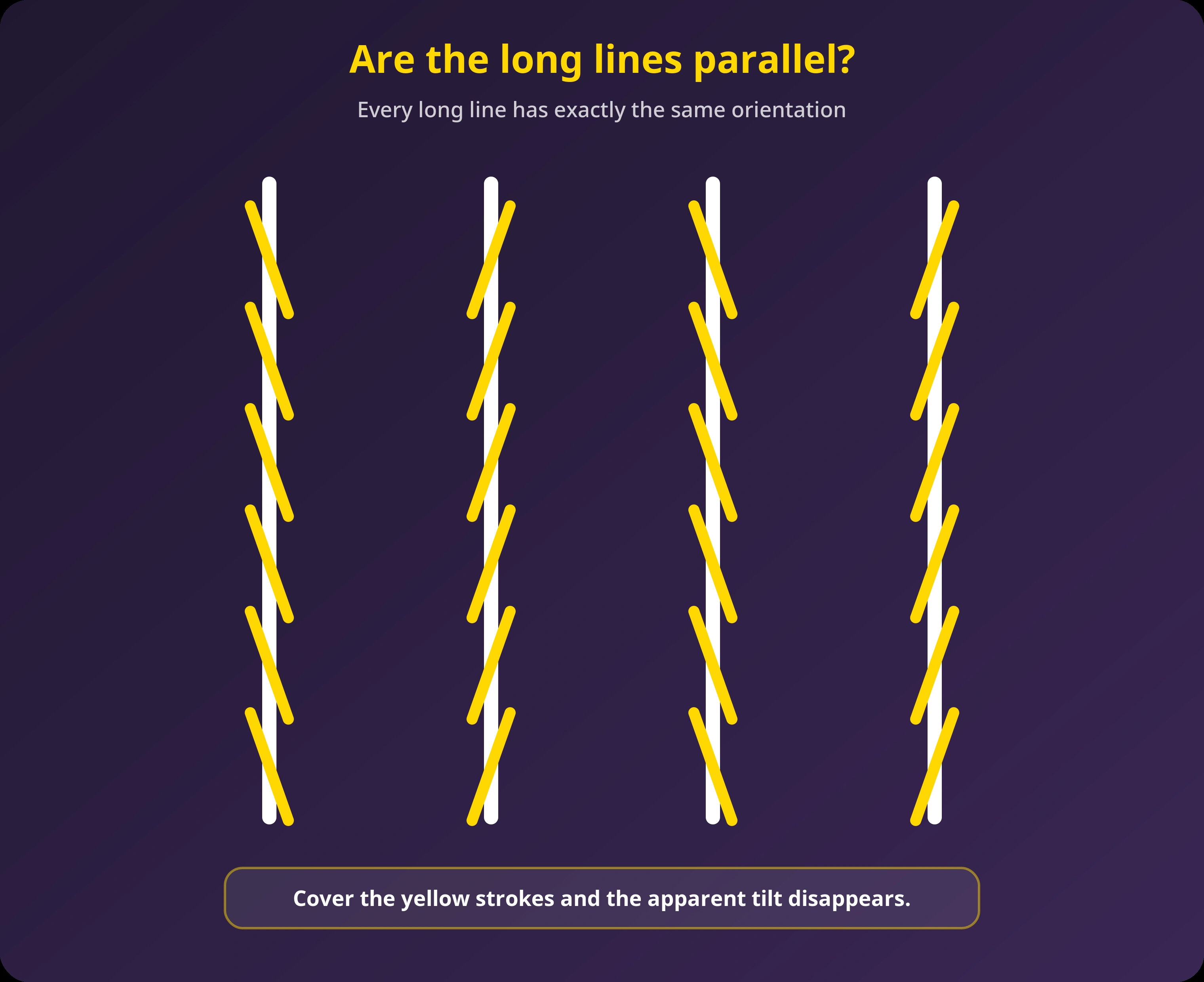
This is the Zöllner illusion, a geometric illusion in which surrounding orientation cues distort the apparent direction of straight, parallel lines.
The long lines do not look randomly crooked. Their apparent tilts alternate systematically with the short crossing strokes, creating a repeated pattern of convergence and divergence.
Why the Parallel Lines Look Tilted
The illusion begins at the intersections between the long lines and the shorter diagonal strokes. Each crossing creates acute and obtuse angles that your visual system must estimate.
Nearby orientations influence one another. When a long vertical line is surrounded by strokes tilted slightly away from vertical, the difference between the two orientations can appear exaggerated. The long line is then perceived as leaning away from the short strokes.
Reverse the diagonal strokes and the apparent tilt reverses too. Because neighboring long lines carry opposite sets of strokes, they seem to rotate in opposite directions even though their physical orientation is identical.
The distortion is small at each crossing. Repeating the same relationship several times along each line makes the combined effect much easier to see.
How to Prove the Lines Are Parallel
Cover the short diagonal strokes with narrow strips of paper while leaving the long lines visible. Without the surrounding orientation cues, the lines look much more obviously parallel.
You can also place the edge of a ruler against two of the long lines. The gap between them stays constant from top to bottom.
A third method is to compare their endpoints. Every line begins and ends at the same horizontal position, with no sideways movement anywhere along its length.
The illusion usually returns as soon as the diagonal strokes are uncovered. Knowing the geometry is correct does not stop the nearby angles from influencing perception.
Recognizing orientation accurately is also important when comparing rotated or partially hidden figures. Cognitive Train’s free spatial test asks you to decide whether shapes remain the same after turning:
Where the Zöllner Illusion Came From
The illusion is named after German astrophysicist Johann Karl Friedrich Zöllner, who reported it in 1860.
Zöllner presented a pattern of parallel lines crossed by alternating diagonal marks. The main lines appeared to converge and diverge, although their physical spacing remained constant.
While examining Zöllner’s figures, physicist and journal editor Johann Christian Poggendorff noticed a separate apparent misalignment involving interrupted diagonal lines. That observation later became known as the Poggendorff illusion.
The two effects are now treated as distinct geometric illusions, but both demonstrate that nearby angles and contours can change perceived direction and alignment.
The Angle of the Short Strokes Matters
The Zöllner illusion is not equally strong at every crossing angle.
In an experiment by Gordon Wallace, the angle between the long lines and the background strokes was systematically varied. The distortion was strongest at an intersecting angle of about 20 degrees and became weaker at angles above or below that range.
Research by Takao Oyama likewise found that the most effective angle varied with the exact stimulus, generally falling between about 15 and 30 degrees.
If the short strokes run almost parallel to the long lines, the orientation difference may be too small to create a strong effect. If they approach a right angle, the pattern also becomes less effective because the relevant acute-angle relationship weakens.
Length, Spacing, and Position Also Change the Effect
The short strokes must be prominent enough to influence the main lines. Oyama found that increasing their length strengthened the illusion until further length produced little additional change.
The effect also weakened when a gap was introduced between the diagonal strokes and the long lines. Once the elements were sufficiently separated, the apparent distortion approached zero.
That result is important because it shows that the illusion depends strongly on local interaction. The inducers do not merely create a general impression of disorder across the page. Their influence is greatest when they sit close to the lines whose orientation is being judged.
Background density matters as well. Too few crossings provide only a weak signal, while repeated inducers make the alternating tilts more coherent across the display.
Is Angle Expansion the Whole Explanation?
A traditional explanation says that acute angles are perceptually expanded. If the small angle between a long line and its crossing strokes looks wider than it is, the long line must appear rotated to accommodate that change.
This account explains the direction of the classic illusion, but researchers have found that different arrangements can produce more complicated results.
In experiments by Akiyoshi Kitaoka and Isao Ishihara, certain combinations of long inducing strokes and wider intersection angles produced an apparent contraction rather than the usual expansion of acute angles.
The authors concluded that several local distortions can contribute to the complete Zöllner figure. The familiar effect is therefore better understood as the combined outcome of multiple orientation and angle relationships, not one universal rule operating identically in every version.
A Real-World Version: The Bookshelf Illusion
Zöllner-like effects can occur outside carefully drawn diagrams.
Researchers described a straight upright lamp positioned in front of a bookshelf filled with books leaning in alternating directions. The lamp appeared subtly bent where the differently oriented rows of books passed behind it.
The alternating book edges acted much like the short strokes in a Zöllner pattern, changing the apparent direction of the straight vertical contour. The effect was documented in research on the bookshelf illusion.
This example shows that the illusion is not tied to a particular set of black lines. Similar orientation interactions can arise whenever a straight edge is viewed against a repeated background of alternating slants.
How It Differs From the Café Wall Illusion
Both the Zöllner and Café Wall illusion make parallel lines appear tilted, but their patterns create that distortion differently.
In the Zöllner illusion, short diagonal strokes cross or closely approach the long lines. Their orientations directly influence the apparent directions of those lines.
In the Café Wall illusion, straight mortar lines sit between offset rows of black-and-white tiles. Local brightness transitions along the tile boundaries create small slanted components that combine into an apparent wedge.
The Zöllner figure is primarily an orientation-and-angle display. The Café Wall pattern depends more strongly on the interaction of staggered edges, contrast, and mortar brightness.
Why Knowing the Answer Does Not Remove the Tilt
You can measure the long lines, trace them, and confirm that they are parallel. They may still appear to lean.
The reason is that conscious knowledge and automatic visual processing are not the same thing. Your reasoning accepts the measurement, but the orientation relationships at each intersection continue to affect how the lines look.
The same separation appears in the Jastrow Illusion, where two identical shapes continue to look different in size even after their equality has been demonstrated.
What It All Comes Down To
The Zöllner illusion takes a set of parallel lines and surrounds them with alternating diagonal strokes. Those nearby angles bias perceived orientation, making neighboring lines appear to rotate in opposite directions.
The effect is strongest only under certain conditions. Inducer angle, length, spacing, and repetition all affect how much distortion you see.
For more examples of misleading lines, invented contours, changing brightness, and impossible geometry, browse the full Optical Illusions guide. Cognitive Train’s brain tests explore perception, attention, and reasoning, while its free cognitive training tools offer more ways to challenge visual processing.