Café Wall Illusion
The horizontal lines are perfectly straight and parallel, yet they seem to slope in alternating directions.
Look at the gray lines separating the rows of tiles below. Some appear to rise toward the right. Others seem to fall. The rows may even look as though they form long wedges that widen and narrow across the image.
Now follow one mortar line from edge to edge. It never changes height. Every horizontal divider is straight, level, and parallel to all the others.
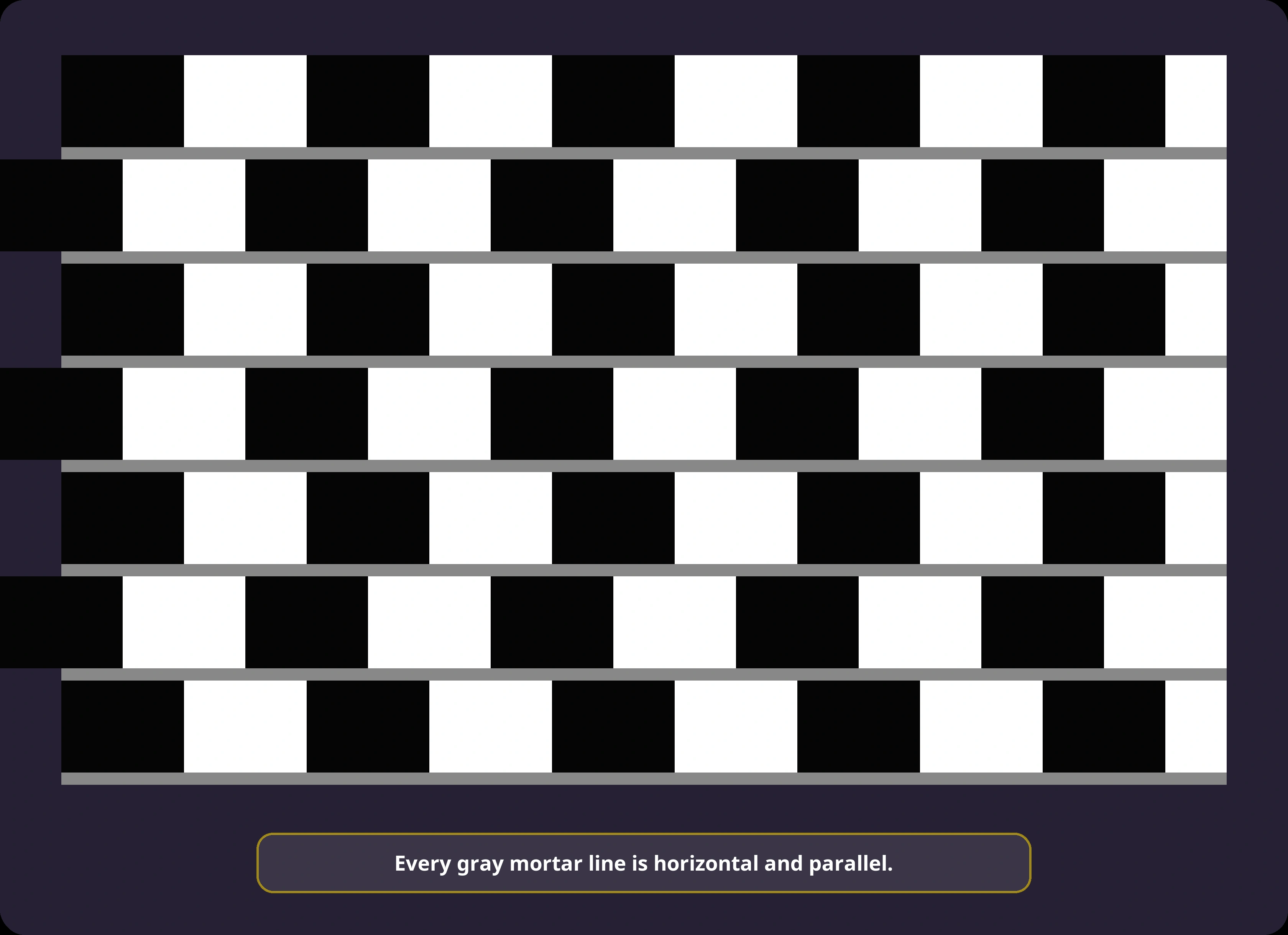
This is the Café Wall illusion, a geometric illusion in which staggered rows of contrasting tiles distort the apparent orientation of the straight lines between them.
The lines are not merely mistaken for slightly crooked ones. Across a large pattern, the local tilts combine into alternating bands that seem to converge, diverge, or form a zigzagging wall.
Why the Lines Look Slanted
The illusion depends on the boundaries where bright and dark tiles meet the medium-gray mortar.
Each row is shifted sideways relative to the row above it. A black tile in one row may sit partly above a white tile in the next. At the edge of the mortar, those mismatched light-dark transitions create small diagonal-looking fragments.
Your visual system detects those local fragments before it settles on the orientation of the complete mortar line. The fragments seem to twist in opposite directions along different parts of the row.
When the brain combines them across the pattern, the straight horizontal divider inherits an apparent tilt. Alternating rows produce opposite local signals, so one line seems to slope upward while the next appears to slope downward.
The result is a global distortion assembled from many small edge interactions.
What the Gray Mortar Contributes
The mortar cannot be just any brightness. The classic illusion is usually strongest when its luminance falls somewhere between the black and white tiles.
If the mortar becomes nearly as dark as the black tiles, its boundary with them weakens. If it becomes nearly as bright as the white tiles, the opposite boundary weakens. The balanced sequence of dark-to-gray and gray-to-light transitions begins to collapse.
Richard Gregory and Priscilla Heard systematically changed the width and brightness of the mortar in their original study of the Café Wall illusion. They found that the apparent wedge distortion depended strongly on tile contrast, mortar width, and mortar luminance.
The illusion also disappears when the tiles lose their light-dark contrast. Without strong luminance boundaries, the visual system has much less conflicting edge information to organize.
Why It Is Called the Café Wall Illusion
The pattern existed in earlier forms and was sometimes known as the Münsterberg illusion. Its modern name came from a real tiled wall in Bristol, England.
In the 1970s, a member of Richard Gregory’s laboratory noticed that the rows of dark and light tiles outside a café appeared visibly crooked even though the mortar lines were level. Gregory and Heard photographed and studied the pattern, publishing their analysis in 1979.
The name stuck because the effect was not invented as an abstract laboratory puzzle. An ordinary building pattern accidentally produced a powerful distortion in full view of anyone walking past.
Can You Prove the Lines Are Parallel?
One method is to place a ruler or straight edge along any mortar line. Its apparent angle will not match the physical edge beneath it.
You can also cover the tile rows with two sheets of paper, leaving only a narrow strip of mortar visible. Once the neighboring black-and-white boundaries disappear, the line looks much straighter.
A third method is to compare the left and right endpoints. Each mortar line begins and ends at exactly the same vertical position.
The illusion survives knowledge surprisingly well. Even after confirming the geometry, uncovering the complete pattern usually restores the apparent slopes.
Brightness Induction and the Twisted-Cord Effect
One influential explanation focuses on brightness induction: nearby light and dark regions alter the apparent brightness of sections of the mortar.
Along the gray line, an area beside a black tile may appear slightly lighter, while an area beside a white tile may appear slightly darker. Those alternating changes produce a sequence of short light and dark segments.
The segments resemble a twisted cord running through the mortar. Rather than seeing a perfectly uniform horizontal band, the visual system detects small diagonal components whose directions depend on the staggered tile arrangement.
Experiments manipulating brightness within the mortar found that researchers could strengthen or weaken the apparent wedge distortion by adding luminance changes that reinforced or cancelled these induced segments.
This supports the idea that the slant is built partly from local brightness relationships rather than from the overall brick pattern alone.
Try a Related Contrast Challenge
The Café Wall illusion depends on the visual system detecting and comparing boundaries of different brightness. Contrast sensitivity measures how faint a light-dark difference can become before its shape disappears into the background.
Cognitive Train’s test gradually reduces the contrast of a large symbol to find how subtle a boundary you can still detect:
Why Viewing Distance Changes the Effect
The illusion can strengthen, weaken, or change character as you move closer to or farther from the pattern.
From nearby, individual tile edges are easy to inspect. At a greater distance, fine details blur together and the local diagonal components become more influential than the exact outline of each tile.
This suggests that the illusion depends on spatial scale. Different visual mechanisms respond best to features of different sizes. A pattern that strongly activates orientation signals at one viewing distance may produce a weaker response at another.
Research examining eccentricity and adaptation found that estimated orientation depended on the spatial-frequency tuning of the mechanisms used to encode the pattern.
The effect may also look stronger away from the exact point you are staring at. Peripheral vision represents fine detail less precisely, allowing the local edge signals to blend into a more obvious global slant.
What Makes the Illusion Stronger or Weaker?
Strong tile contrast helps. Black and white tiles generally create a clearer distortion than similar shades.
Medium-brightness mortar helps. Gray lines preserve visible boundaries against both dark and light tiles.
Narrow mortar usually works best. Extremely wide separators reduce the close interaction between the two tile rows.
Alternating offsets are essential. If every row lines up vertically, the competing diagonal fragments largely disappear.
Viewing scale matters. Changing image size or viewing distance can strengthen or weaken the apparent tilt.
More rows reveal the global pattern. A small fragment may show local twisted-cord effects, while a larger wall makes the alternating wedges easier to see.
How It Differs From Other Line Illusions
In the Zöllner Illusion, short diagonal strokes make longer parallel lines appear to diverge. The Hering illusion places straight lines over radiating spokes, making them seem bowed.
The Café Wall illusion creates its tilt without crossing the mortar lines directly. The misleading orientation signals emerge from the staggered black-and-white boundaries on either side.
It also differs from the Hermann Grid Illusion. Both use repeated black-and-white geometry, but the Hermann Grid creates phantom gray patches at intersections. The Café Wall changes the apparent direction of real, physically straight lines.
Why Knowing the Trick Does Not Straighten the Wall
Once you know every mortar line is parallel, you can give the correct answer immediately. Yet the lines continue to look tilted.
Your belief has changed, but the local contrast signals remain. The visual system still detects alternating brightness transitions and combines them into slanted components.
This persistence shows why visual illusions are not simply failures of knowledge. They arise from processing that continues automatically even after conscious reasoning has identified the mistake.
What It All Comes Down To
The Café Wall illusion turns level mortar into a field of apparent wedges by staggering high-contrast tiles on either side.
Small brightness and orientation signals develop along the tile boundaries. The brain combines them across each row, and a perfectly straight horizontal line seems to slope.
For more examples of distorted lines, impossible depth, invented contours, and changing brightness, browse the full Optical Illusions guide. Cognitive Train’s brain tests explore perception and reasoning, while its free cognitive training tools offer more ways to challenge visual processing.