Jastrow Illusion
Two curved pieces are exactly identical, yet the lower one looks unmistakably larger.
Look at shapes A and B below. Which one is longer? Most people choose B, the lower shape. Its right edge reaches farther across the page, and its curved body seems to contain more material.
But A and B are exact copies. They have the same height, width, curvature, and area. The lower shape only appears larger because of how the two pieces are positioned.

This is the Jastrow illusion, also called the Wundt-Jastrow illusion. Unlike a perspective drawing that makes one object appear farther away, this effect arises from a direct comparison between neighboring curves.
Your visual system does not measure each piece in isolation. It compares the edges placed closest together, and those edges are deliberately mismatched.
Why the Lower Shape Looks Larger
Each piece has a long outer curve and a shorter inner curve. When the shapes are stacked, the long outer edge of the lower piece sits close to the short inner edge of the upper piece.
That nearby comparison is unfair. Your brain notices that the lower curve extends farther than the upper curve beside it, then treats the difference as evidence that the entire lower object is larger.
The opposite edges are farther apart and less visually dominant, so they do not correct the first impression effectively.
This kind of local comparison is useful in ordinary vision. Nearby edges often belong to objects that genuinely differ in size. The Jastrow arrangement exploits that habit by placing different parts of two identical objects next to each other.
Proving the Shapes Are Identical
The easiest way to break the illusion is to move one piece directly on top of the other. Once their corresponding edges align, the apparent size difference disappears.
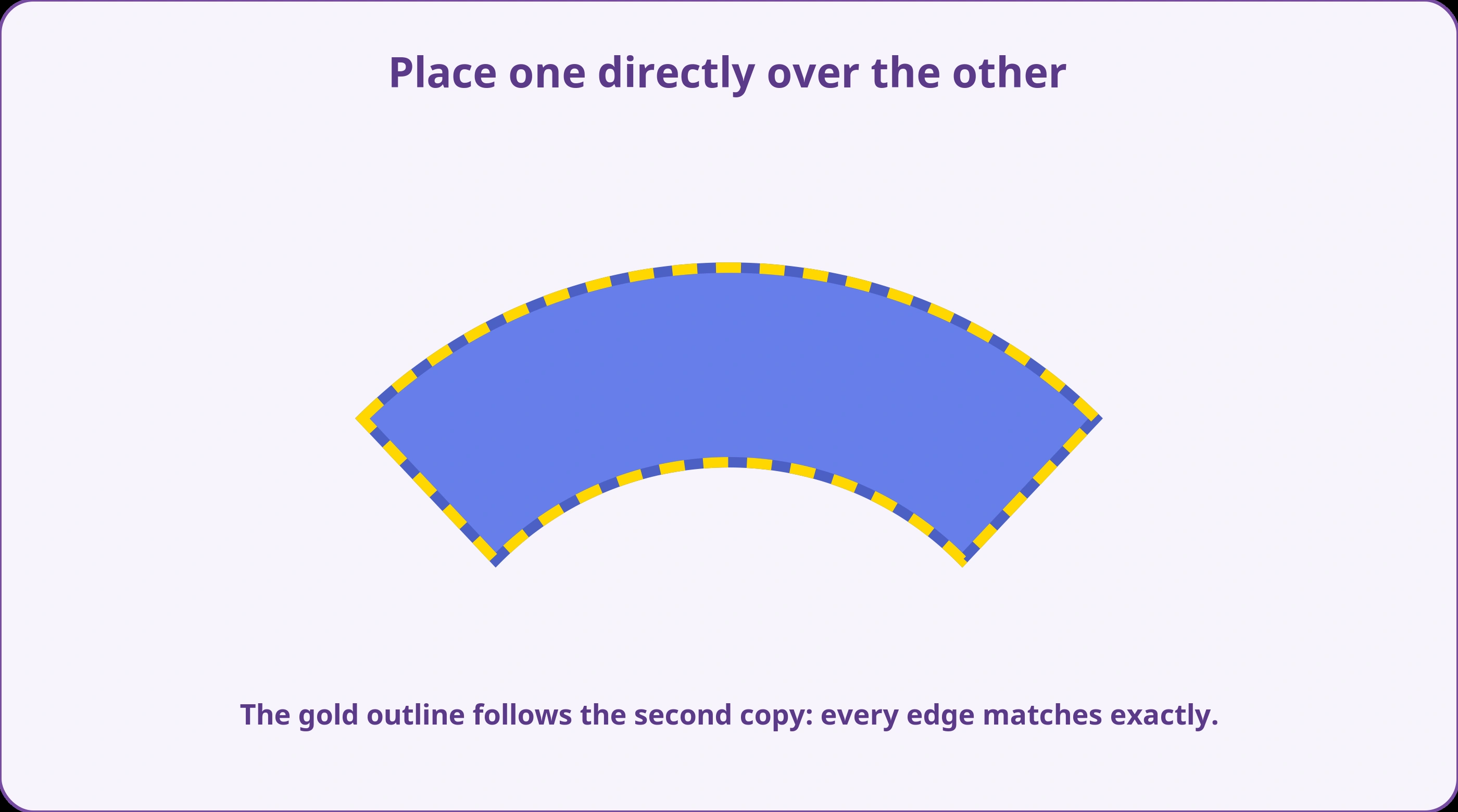
Physical versions of the illusion are especially convincing because you can pick up the supposedly smaller piece and place it over the larger one. Curved wooden train-track pieces, paper cutouts, and slices of cake can all produce the effect.
The illusion depends on rapid visual comparison. Cognitive Train’s Symbol Search Test asks you to scan a target group, compare it with a larger set of symbols, and decide whether a match is present:
Where the Jastrow Illusion Came From
The illusion is associated with Polish-American psychologist Joseph Jastrow, who helped popularize it in the late nineteenth century. Similar curved figures also appeared in the work of German psychologist Wilhelm Wundt, which is why the effect is sometimes called the Wundt-Jastrow illusion.
Jastrow is also associated with the famous duck-rabbit figure, another image that demonstrates how the same visual input can support competing interpretations.
The two illusions work differently. The duck-rabbit switches between two recognizable objects. The Jastrow figure produces one stable judgment: the lower curved piece appears larger, even though both pieces have identical dimensions.
What Research Has Found
The strength of the illusion depends heavily on how the pieces are arranged. In a series of experiments on the Jastrow figure, researchers varied factors including the spacing between the pieces, the direction of their cut ends, and the curvature of the arcs.
The apparent difference became weaker as the distance between the two pieces increased. That supports the idea that close, local comparison between neighboring edges is central to the effect.
More recent comparative research asked whether other primates experience the same illusion. In a 2019 study of humans, rhesus monkeys, and capuchin monkeys, the monkeys successfully detected small real size differences but did not show clear evidence of the Jastrow illusion.
The result suggests that accurate size discrimination alone does not guarantee the same contextual bias. Humans may organize or compare the curved pieces differently, although one experiment cannot establish exactly why the species differed.
Research using the related “fat face” version found a Jastrow-like effect in human observers but not chimpanzees. The authors argued that people may compare the closest neighboring contours rather than evaluating each complete image independently.
Does the Illusion Affect Action Too?
Seeing one piece as larger does not necessarily mean every movement toward it will be distorted by the same amount.
A study using the Wundt-Jastrow illusion in a grasping task compared perceptual judgments with hand movements. Participants showed the expected size illusion when reporting what they saw, while some measurements of their grasping behavior followed a different pattern.
Research on perception and action is method-sensitive, so the finding does not prove that the hand is immune to illusions. It does show that “looks larger” and “is acted on as larger” are not always interchangeable claims.
How to Make the Illusion Stronger
Keep the pieces close together. Increasing the gap weakens the direct comparison between the neighboring curves.
Align the inner and outer edges. The effect depends on placing the lower piece’s longer outer arc next to the upper piece’s shorter inner arc.
Use identical colors and outlines. Extra differences can make viewers suspect that the pieces are not true copies.
Use thick curved shapes. Thin arcs provide less visible area and may make the effect less compelling.
Avoid adding measurement guides too early. Straight reference lines make the equal dimensions easier to verify and weaken the surprise.
How It Differs From Other Size Illusions
The Ebbinghaus Illusion changes the apparent size of a circle by surrounding it with larger or smaller circles. The Ponzo Illusion uses converging lines to suggest depth, making an apparently distant object seem larger.
The Jastrow illusion needs neither surrounding circles nor a simulated distant scene. Its effect comes from placing the long and short edges of identical curved objects into an asymmetric comparison.
All three demonstrate the same broader principle: perceived size is relational. Your brain judges dimensions partly by comparing an object with nearby structures and by interpreting the scene in which it appears.
Why Knowing the Answer Does Not Fully Fix It
Once you know the two pieces are identical, you can state the correct answer immediately. Yet the lower piece may continue to look larger.
That persistence shows the difference between perception and belief. Your deliberate reasoning accepts the measurement, but the visual comparison that produces the illusion remains active.
You can reduce the effect by separating the pieces, aligning them vertically, or overlapping them. Merely knowing the trick usually does less than changing the visual arrangement itself.
What It All Comes Down To
The Jastrow illusion turns two identical pieces into an apparently unequal pair by arranging the wrong edges beside each other. The lower shape’s long outer curve dominates the comparison against the upper shape’s shorter inner curve.
Your brain extends that local difference to the objects as a whole, making one complete piece seem larger even though every measurement matches.
For more examples of context changing apparent size, shape, depth, and brightness, browse the full Optical Illusions guide. Cognitive Train’s brain tests explore perception and reasoning, while its free brain training tools offer more ways to challenge visual processing.