Spotlight Effect — Meaning, Examples & How to Overcome It
Mind · Cognitive Biases · Social & Self-Perception family
Test yourself — can you spot the bias in each scenario? Take the Cognitive Bias Spotter Test. Jump to the test ↓
What Is the Spotlight Effect? Simple Definition
The spotlight effect is the tendency to overestimate how much other people notice and pay attention to your actions, appearance, and mistakes. You feel as though you are standing in a spotlight — highly visible, closely observed, and significantly more salient to those around you than you actually are.
In plain terms: other people are far less aware of what you are doing and how you look than you think they are. The food stain on your shirt, the verbal stumble in your presentation, the awkward comment in the meeting — these loom large in your own awareness but register only faintly, if at all, in the awareness of those around you. Everyone is the star of their own film, but to everyone else they are a minor character.
This page is part of the cognitive biases guide on our brain training and cognitive testing platform, alongside interactive tools covering memory, attention, reaction time, and decision-making.
Spotlight Effect Meaning & Psychology
The spotlight effect was named and formally studied by Gilovich, Medvec & Savitsky (2000) in a series of five experiments at Cornell University. In the most memorable study, participants were asked to wear a T-shirt featuring an embarrassing image — a picture of Barry Manilow — before entering a room of other students. They were then asked to estimate how many of the other students in the room had noticed the image on their shirt. Participants predicted that about half the room would have noticed; in reality, fewer than a quarter had. The same overestimation occurred with flattering images. Participants consistently predicted that their appearance was more salient to others than it actually was.
Further experiments showed the same effect in social conversations: participants overestimated how much their good and bad contributions to a group discussion had been noticed by other participants. The spotlight was not just on appearance — it extended to performance, behaviour, and social presence generally.
Why the brain does this
The spotlight effect is driven by egocentrism in social perception — the tendency to anchor judgments about how you appear to others on your own subjective experience of yourself, and then adjust insufficiently for the fact that others lack access to that experience. You know exactly what you are wearing, what mistake you just made, and what you just said — it is vivid, present, and significant to you. The adjustment required to recognise that others do not share this rich internal experience, and therefore notice far less, is systematically insufficient.
The mechanism is the same anchoring-and-adjustment process that drives the anchoring bias: you start from your own highly salient internal reference point and adjust outward toward others' perspectives, but the adjustment is consistently too small. The result is a persistent overestimation of your salience in others' awareness.
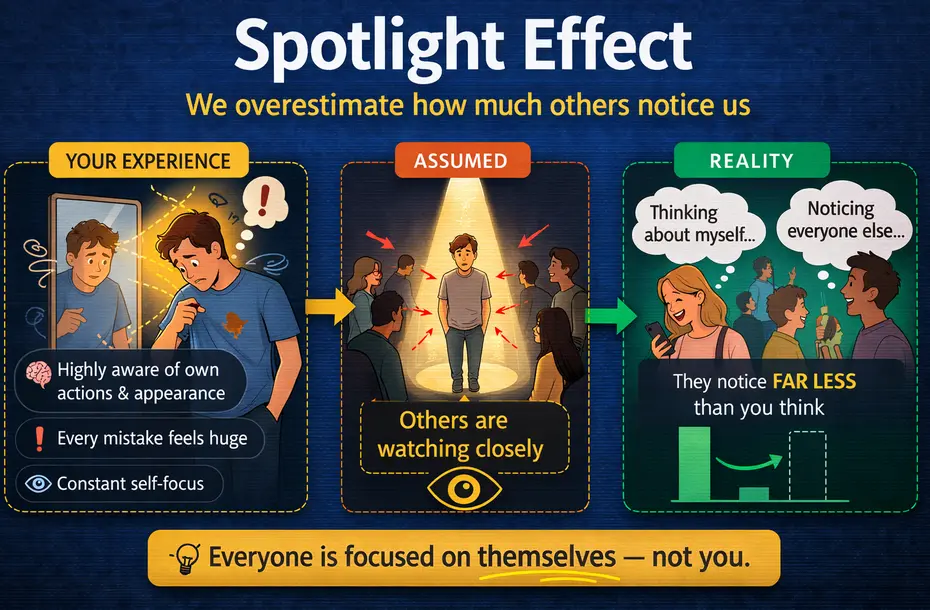
The spotlight effect: every mistake feels huge and you assume others are watching closely — but in reality, everyone is focused on themselves and notices far less than you think.
Spotlight Effect in Real Life — Examples
The spotlight effect is active in virtually every social situation where self-consciousness plays a role. Walking into a room late, tripping on a step, mispronouncing a word in a presentation, having a bad hair day, wearing the wrong outfit to an event — all of these feel catastrophically visible in the moment, but research and experience consistently show that most people in the room notice only a fraction of what you are acutely aware of.
The asymmetry is especially pronounced for mistakes and embarrassments. You remember your own awkward moments vividly because they were emotionally significant to you; other people barely registered them because they were busy managing their own social experience, their own concerns about how they appear, and their own internal monologue. The spotlight you feel is almost entirely a projection of your own heightened self-awareness.
Spotlight Effect and Social Anxiety
The spotlight effect has a direct and well-documented relationship with social anxiety. People who suffer from social anxiety disorder characteristically overestimate the extent to which others are observing and evaluating them — a core feature of the condition that closely parallels the spotlight effect. They believe their anxiety is visible, their mistakes are obvious, and their social performance is being closely scrutinised and negatively judged.
The spotlight effect research provides important context for understanding social anxiety: the feared observation and judgment is substantially a misperception. Others are not, in fact, watching as closely as the socially anxious person believes. This does not fully explain or cure social anxiety — the emotional experience is real regardless of the accuracy of the perception — but it does suggest that the catastrophic visibility that social anxiety predicts is significantly overestimated.
The related illusion of transparency — the tendency to overestimate how much internal states like nervousness, embarrassment, or deception are visible to others — compounds the spotlight effect in social anxiety contexts. People believe that others can read their anxiety in their face, voice, and behaviour to a degree that research consistently shows is not the case.
Spotlight Effect in the Workplace
In professional settings, the spotlight effect shapes how people experience and respond to mistakes, performance evaluations, and public-facing activities. Professionals who make an error in a meeting, stumble in a presentation, or perform below their usual standard tend to believe the failure was far more visible and memorable to colleagues than it actually was. This can lead to disproportionate self-criticism, avoidance of similar situations in the future, and overestimation of the reputational damage caused by a relatively minor incident.
The spotlight effect also shapes how people prepare for public performance. Speakers, presenters, and performers often spend disproportionate effort preparing for and worrying about minor details — a particular slide, a specific phrase, a moment of potential awkwardness — that audiences will not notice. The internal salience of these details does not translate into external salience, but the spotlight effect makes it feel as though it does.
Spotlight Effect in Social Media and Online Behaviour
Social media environments amplify the spotlight effect by creating contexts where actions are in principle visible to large audiences, even when in practice they receive little attention. A post that receives few likes or comments feels like a public failure because it was visible to potentially hundreds of people — yet the majority of those people saw it briefly, if at all, and have no meaningful memory of it. The spotlight effect causes the creator to experience the post as far more salient to the audience than the audience's actual engagement reflects.
Conversely, social media also exploits the spotlight effect in a different direction: users see their own posts as unusually visible and significant, which drives a cycle of posting, monitoring for responses, and experiencing disproportionate emotion about the results. The platform's visible engagement metrics — likes, views, comments — give the illusion of an audience that is watching closely, even when actual engagement is minimal.
How to Avoid and Overcome the Spotlight Effect
Remember that everyone is in their own spotlight
The most effective corrective for the spotlight effect is the recognition that every person in a social situation is experiencing their own version of it. While you are acutely aware of your food stain, your stumbled word, or your awkward comment, the people around you are acutely aware of their own food stains, stumbled words, and awkward comments. Everyone is the centre of their own experiential world, which means no one has significant cognitive bandwidth left to closely monitor yours. This is not a comforting fiction — it is what the research consistently shows.
Ask what you actually remember about others
A useful corrective exercise is to recall, in detail, the specific mistakes, awkward moments, and appearance details of the last several people you interacted with. The answer is usually that you remember very little — general impressions, perhaps a few salient moments, but none of the specific details that you feared were so visible in your own social performances. Your memory of others' minor social moments is a direct model for their memory of yours.
Separate the felt experience from the actual observation
The spotlight effect is driven by the vividness of your own internal experience being projected outward. When a mistake feels catastrophic to you internally, that feeling is real — but it does not translate into equivalent visibility externally. Deliberately separating "this feels very visible to me" from "this is actually visible to others" weakens the automatic projection. The felt experience of being observed is not reliable evidence of actual observation.
The Deeper Point
The spotlight effect reveals a fundamental feature of social cognition: we are not natural perspective-takers. We experience the world from inside our own heads, with privileged access to our own thoughts, feelings, and self-assessments, and we systematically under-adjust for the fact that others have no access to this rich internal experience. The result is a persistent sense of greater visibility and salience than we actually have — a spotlight that exists primarily in our own perception.
This has a liberating implication: most of the social scrutiny you feel is not occurring. The audience evaluating your every word is largely a projection. The people who watched you stumble have already forgotten it. The embarrassment that feels so present and lasting in your own memory is absent or minimal in the memory of others. Understanding the spotlight effect does not eliminate self-consciousness — but it does provide an accurate model of how much attention you are actually receiving, which is almost always considerably less than it feels.
Related biases that interact closely with this one: the false consensus effect, which similarly overestimates the degree to which others share your perspective; self-serving bias, which makes both successes and failures feel more significant and attributable to you personally than they are; and anchoring bias, which drives the insufficient adjustment from your own perspective to others' that produces the spotlight effect.
The Cognitive Bias Spotter Test below puts that understanding to work — see if you can identify the spotlight effect and the other nine biases when they appear in realistic scenarios.