False Consensus Effect — Meaning, Examples & How to Overcome It
Mind · Cognitive Biases · Social & Self-Perception family
Test yourself — can you spot the bias in each scenario? Take the Cognitive Bias Spotter Test. Jump to the test ↓
What Is the False Consensus Effect? Simple Definition
The false consensus effect is the tendency to overestimate how much other people share your own beliefs, opinions, preferences, and behaviours. You assume that your views and choices are more common and more widely held than they actually are — that what seems normal and reasonable to you seems normal and reasonable to most people.
Also known as consensus bias, the effect operates across beliefs, attitudes, behaviours, and even personal quirks. If you prefer a particular diet, political position, or approach to a problem, you are likely to assume that a larger proportion of the general population agrees with you than actually does. The error is not just a matter of being imprecise — it is a systematic bias that tilts estimates consistently in the direction of your own position.
This page is part of the cognitive biases guide on our free brain training and cognitive assessment platform, alongside interactive tools covering memory, attention, reaction time, and decision-making.
False Consensus Effect Meaning & Psychology
The false consensus effect was formally identified and named by Ross, Greene & House (1977) in a series of four studies at Stanford University. In one of the most cited experiments, participants were asked whether they would be willing to walk around a university campus for thirty minutes wearing a sandwich board bearing the message "Eat at Joe's." Those who agreed estimated that approximately 62% of other students would also agree; those who refused estimated that approximately 67% would also refuse. Each group assumed that the majority of others would make the same choice they had — despite the two groups arriving at opposite estimates of the same population. The choice itself, not the objective characteristics of the situation, was driving the estimate of what others would do.
The effect has been replicated across a wide range of domains — political beliefs, dietary habits, moral judgments, risk behaviours, and consumer preferences — with consistent results. People systematically overestimate the proportion of the population that agrees with them, and they simultaneously tend to view those who disagree as unusual, deviant, or in need of explanation in a way that agreement does not require.
Why the brain does this
Several mechanisms contribute to the false consensus effect. The most significant is selective exposure: people tend to spend time with others who share their views, belong to communities defined by shared values, and consume media that reflects their existing beliefs. The social sample available to the mind is therefore not a representative sample of the population — it is a biased sample enriched for people who think similarly. When the mind uses this sample to estimate the prevalence of its own views, it naturally overestimates.
A second mechanism is the availability heuristic: examples of agreement come to mind more easily than examples of disagreement, partly because we actively seek out agreement and partly because disagreement is sometimes suppressed in social settings. The ease with which agreeing examples are recalled leads to overestimates of their frequency.
A third mechanism is motivational: believing that your views are widely shared is psychologically comfortable. It validates your beliefs, supports your sense of normality, and reduces the cognitive effort required to engage with the possibility that you might be wrong.
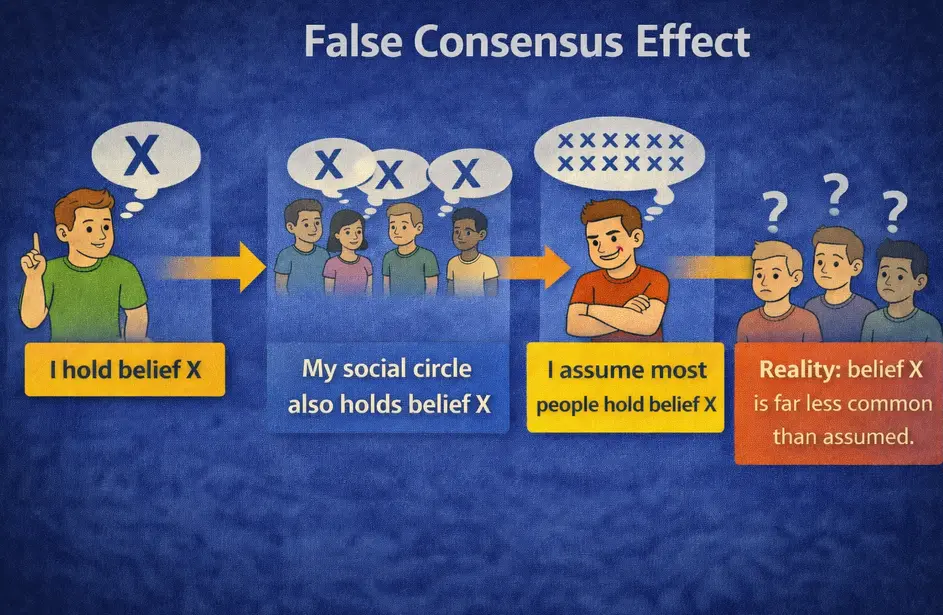
The false consensus effect: because our social circle shares our beliefs, we assume most people do too — but in reality our views are often far less common than we assume.
False Consensus Effect in Real Life — Examples
The false consensus effect operates continuously in everyday social life. People who do not drink alcohol tend to underestimate how much others drink; people who drink heavily tend to underestimate how many others are moderate or non-drinkers. People with strong political views tend to overestimate the proportion of the electorate that holds those views, which is one reason election results consistently surprise people across the political spectrum. People who find a film funny assume most others will find it funny; people who find it boring assume most others will find it boring.
The effect is particularly visible in online environments, where algorithmic content curation reinforces selective exposure and creates what are sometimes called echo chambers — information environments in which the views encountered are heavily biased toward the views already held. Someone whose social media feed is populated predominantly by people who share their political beliefs will encounter consistent apparent agreement, which strengthens the false impression that these views represent something close to a majority position.
False Consensus Effect in the Workplace
In professional settings, the false consensus effect shapes how managers and leaders interpret their teams. A manager who finds a particular working style natural — a preference for detailed written communication, or for unstructured brainstorming, or for working in silence — will tend to assume that this preference is broadly shared. Decisions about team processes, communication norms, and work environments are therefore often made on the basis of what the decision-maker personally finds effective, with an implicit assumption that this matches what others find effective.
In product development, the false consensus effect is a significant source of error. Founders and product teams are rarely representative of their target users, and they tend to overestimate the degree to which user needs, preferences, and behaviours match their own. Features that the team finds valuable or intuitive are assumed to be valuable and intuitive to users; friction that the team does not notice — because they are sophisticated users who have already adapted — is assumed not to exist for less experienced users. This is one reason why user research and testing with actual representative users is essential rather than optional.
False Consensus Effect in Politics and Society
Political polarisation is partly sustained by the false consensus effect. People on opposing sides of a political divide each tend to believe their own position is more mainstream than it is, and each tends to view the opposing position as more extreme and less common than it actually is. This combination — overestimating the prevalence of your own view and underestimating the prevalence of the opposing view — creates a distorted picture of the political landscape that makes compromise and understanding harder to achieve.
The effect also shapes how people respond to social norms. When someone believes that their behaviour — whether it is recycling, voting, or paying taxes honestly — is the majority behaviour, they are more likely to continue it. When they discover that the behaviour is less common than they assumed, the false consensus that previously reinforced it is disrupted. This is why accurate information about actual social norms is sometimes more effective at changing behaviour than moral arguments: correcting the false consensus directly removes one of its sustaining mechanisms. This connects to in-group bias, which similarly leads people to overweight the views and behaviours of their own group when forming impressions of what is normal.
False Consensus Effect in Marketing and Business
Businesses regularly fall prey to the false consensus effect when making product, pricing, and communication decisions based on the preferences of their own team rather than their actual customer base. A pricing decision made by executives who are comfortable with a particular price point assumes that customers share that comfort. A marketing message that resonates with the team assumes it will resonate with the audience. The false consensus effect makes the team's own reactions feel like representative data when they are not.
Consumer research is the direct corrective to this: it replaces the biased internal sample — the team — with an actual representative sample of the target population. The value of this is precisely that it disrupts the false consensus and replaces it with accurate information about what others actually believe and prefer.
How to Avoid and Overcome the False Consensus Effect
Actively seek out disagreement
The most direct counter to the false consensus effect is to deliberately expose yourself to people who hold different views. Because selective exposure is one of the primary drivers of the bias, disrupting it disrupts the bias. This does not mean seeking out conflict — it means making a conscious effort to engage with the best versions of views that differ from your own, to understand why people who have thought carefully about a question arrive at different conclusions, and to revise your estimates of how common disagreement actually is.
Check actual data before assuming consensus
Whenever you find yourself assuming that most people agree with a position you hold, look for actual survey data or research on how common that position is. The gap between assumed and actual prevalence is often substantial, and seeing it concretely is an effective corrective. This is particularly important for product, business, and policy decisions where false assumptions about user or public preferences can have significant consequences.
Treat your own reactions as one data point
In any situation where you are trying to assess what others will think, feel, or prefer — a product feature, a communication, a policy — your own reaction is useful information but not representative information. Explicitly labelling it as one data point among many, and seeking additional data points from people who differ from you, reduces the degree to which your own response anchors estimates of others' responses. The anchoring bias compounds the false consensus effect here: your own view not only inflates your estimate of consensus but also anchors all subsequent adjustments to that estimate.
The Deeper Point
The false consensus effect reflects a fundamental feature of how the mind constructs its model of the social world: it builds that model primarily from the inside out, starting with the self and projecting outward. The self is the most accessible reference point, the social circle is the most available sample, and the result is a picture of the world that is systematically centred on whatever the observer happens to believe and do.
This has consequences that extend beyond individual decisions. At the social level, when large groups each falsely believe that their own position is the majority position, the conditions for productive disagreement and negotiation are undermined. Each side feels they are representing the mainstream against a vocal minority, when in reality both sides are minorities relative to the complexity and diversity of actual public opinion. Accurate perception of genuine diversity of views is a precondition for the kind of social understanding that disagreement, at its best, can produce.
Related biases that interact closely with this one: confirmation bias, which reinforces the false consensus by selectively attending to agreeing voices; in-group bias, which leads people to overweight the views of their own group; and the availability heuristic, which makes easily recalled examples of agreement feel more representative than they are.
The Cognitive Bias Spotter Test below puts that understanding to work — see if you can identify the false consensus effect and the other nine biases when they appear in realistic scenarios.