Overconfidence Effect — Meaning, Examples & How to Overcome It
Mind · Cognitive Biases · Self-Perception family
Test yourself — can you spot the bias in each scenario? Take the Cognitive Bias Spotter Test. Jump to the test ↓
What Is the Overconfidence Effect? Simple Definition
The overconfidence effect is the tendency to be more confident in the accuracy of your knowledge, judgments, and predictions than is actually warranted — to rate your confidence higher than your actual rate of being correct. When you say you are 90% sure about something, you are right less than 90% of the time. When you are certain, you are still wrong with notable frequency.
This is not about arrogance or personality — it is a systematic miscalibration that affects most people across most domains. The gap between felt confidence and actual accuracy is one of the most robust findings in the psychology of judgment, documented across hundreds of studies in diverse populations and tasks.
This page is part of the cognitive biases guide on our brain training and cognitive assessment platform, alongside interactive tools covering memory, attention, reaction time, and decision-making.
Overconfidence Effect Meaning & Psychology
The systematic study of overconfidence was established by Fischhoff, Slovic & Lichtenstein (1977) in a series of five experiments examining the relationship between confidence and accuracy in general-knowledge questions. Participants answered questions with two possible answers — for example, whether absinthe is a liqueur or a precious stone — and then indicated their confidence that their chosen answer was correct, on a scale from 50% (pure guessing) to 100% (certain). The results showed consistent and substantial overconfidence: when participants said they were 100% certain, they were wrong approximately 20% of the time. When they said they were 70% confident, they were correct only about 60% of the time. Across all confidence levels, felt confidence exceeded actual accuracy — a finding that has been replicated in hundreds of subsequent studies.
The overconfidence effect takes three main forms. The first is overestimation — believing you have performed better than you actually have. The second is overplacement — believing you are better than others, related to the better-than-average effect. The third, and the focus of the Fischhoff et al. research, is overprecision — being more certain about the accuracy of your beliefs than your actual error rate justifies. All three are distinct but frequently occur together.
Why the brain does this
Overconfidence arises partly from the same mechanism as confirmation bias: when forming a judgment, the mind selectively retrieves evidence that supports the emerging answer and pays less attention to evidence against it. By the time a conclusion is reached, the supporting evidence feels comprehensive and the case feels strong — even when it is not. The confidence generated by this selective process reflects the strength of the case as constructed in memory, not the actual probability of being correct.
A second mechanism is the difficulty of imagining ways you could be wrong. When a belief feels coherent and well-supported, alternative possibilities are hard to generate or take seriously. The fluency of the reasoning process — the ease with which the answer comes to mind — is mistaken for evidence of its accuracy, when in fact fluency and accuracy are only loosely correlated.
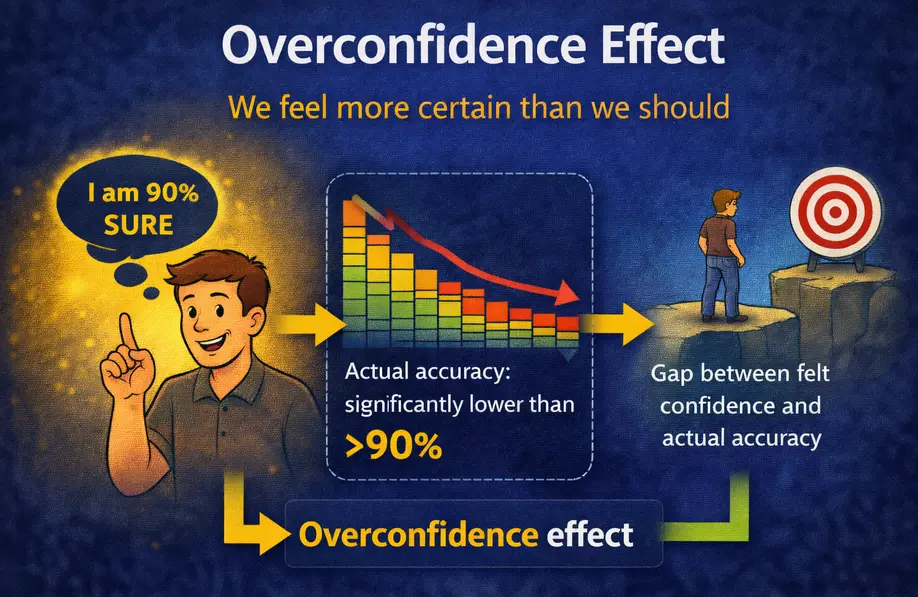
The overconfidence effect: when we say "I am 90% sure," actual accuracy is significantly lower — the gap between felt confidence and actual accuracy is the overconfidence effect.
Overconfidence Effect in Real Life — Examples
Overconfidence is pervasive in everyday judgment. Drivers consistently rate themselves as above-average in safety and skill — a statistical impossibility for the majority. Students who feel confident after an exam consistently score lower than their confidence would predict. People who are certain they remember a past event accurately are frequently shown to be wrong when objective records are checked. In each case, the felt certainty exceeds the actual reliability of the judgment.
The "better-than-average effect" is a specific form of overconfidence in comparative self-assessment. Studies consistently find that the majority of people rate themselves above average on desirable traits — driving ability, intelligence, leadership, ethical behaviour — with majorities often reaching 80–90% of participants claiming above-average standing. Since only half can actually be above average on any normally distributed trait, this represents systematic overconfidence in self-assessment relative to others.
Overconfidence Effect in Investing and Finance
Financial markets are one of the most consequential domains for overconfidence, and also one of the most extensively studied. Overconfident investors trade more frequently than is justified by their actual ability to predict price movements, incurring transaction costs that erode returns. They take on more concentrated positions than a calibrated assessment of their predictive accuracy would justify. They underestimate the variance of future returns — expressing confidence intervals that are too narrow — which leads to inadequate preparation for adverse outcomes.
Research on trading behaviour has found that more active traders — who by definition are expressing the most confidence in their ability to time the market — consistently underperform less active traders and passive index strategies after costs. The overconfidence that motivates the trading is the primary driver of the underperformance. This connects directly to the illusion of control: overconfident investors believe their active involvement is producing returns, when the evidence suggests it is primarily producing costs.
Overconfidence Effect in Medicine and Expert Judgment
Expert overconfidence has been documented across medical specialties, legal judgment, and other domains where professionals make high-stakes predictions. Physicians who express high confidence in diagnoses are wrong significantly more often than their confidence would suggest. Clinical psychologists who express certainty in psychological assessments show similar miscalibration. Importantly, expertise does not reliably reduce overconfidence — in many studies, experts are as poorly calibrated as non-experts, and sometimes more so, because their expertise makes their reasoning feel more compelling.
An important exception exists: domains that provide immediate, clear, and objective feedback on performance tend to produce better-calibrated confidence. Weather forecasters who receive daily feedback on their predictions, professional bridge players, and experienced bookmakers all show much better calibration than groups without this systematic feedback. This suggests that overconfidence is not an immutable feature of human judgment but a consequence of operating in domains where feedback on accuracy is delayed, ambiguous, or absent.
Overconfidence Effect in the Workplace
Organisational decision-making is significantly affected by overconfidence. Business plans consistently overestimate revenues, underestimate costs, and predict faster growth than is actually achieved — a pattern that reflects the same miscalibration documented in laboratory settings. Leaders who are overconfident in their strategic assessments take on risks they would avoid with more accurate confidence levels, commit to plans they would hedge if properly calibrated, and resist updating their views in response to disconfirming evidence because their high confidence makes the evidence feel insufficient to overturn the conclusion.
The planning fallacy — the tendency to underestimate project timelines and costs — is itself partly a product of overconfidence: project teams are too confident that their plans will unfold as expected, and not confident enough that unexpected obstacles will arise. The planning fallacy and the overconfidence effect are deeply intertwined, both reflecting a systematic gap between felt certainty and actual predictive accuracy.
How to Avoid and Overcome the Overconfidence Effect
Consider the opposite actively
The most directly effective debiasing technique for overconfidence is to actively generate reasons why your current judgment might be wrong. Research by Koriat, Lichtenstein & Fischhoff found that generating supporting reasons for a judgment did not reduce overconfidence, but generating opposing reasons did. Simply thinking about why you might be wrong — specifically and concretely, not abstractly — reduces the one-sided processing that drives overconfidence and produces more calibrated confidence levels.
Use confidence intervals instead of point estimates
When making predictions or estimates, providing a range that you are 90% confident contains the true value — rather than a single point estimate — forces explicit acknowledgement of uncertainty. Research consistently shows that people's 90% confidence intervals are far too narrow, containing the true value only 50–60% of the time. Calibration training — practising with feedback on whether true values fall within stated intervals — improves this substantially over time.
Seek out disconfirming evidence
Because overconfidence is partly driven by the selective retrieval of supporting evidence, actively seeking evidence against your current judgment directly counters the mechanism. This is the same corrective recommended for confirmation bias, and for the same reason: both biases are sustained by asymmetric information gathering, and both are reduced by deliberately correcting that asymmetry.
Track your calibration over time
Keeping a record of predictions and their outcomes — noting both the confidence level at time of prediction and whether the prediction was correct — builds a personal calibration dataset that makes the overconfidence effect concrete and measurable. People who track their own accuracy consistently find that they are less accurate than their confidence levels predict, and this empirical record is more persuasive for behaviour change than abstract knowledge of the bias.
The Deeper Point
The overconfidence effect is in many ways the meta-bias — the bias that makes all other biases harder to correct. If you are overconfident in your judgments generally, you will be overconfident that any given judgment of yours is not the product of bias. You will feel certain that your assessment of a situation is accurate when it is distorted by confirmation bias. You will feel sure that your memory is correct when it has been reshaped by hindsight bias. The bias blind spot and the overconfidence effect reinforce each other: you cannot see your own biases partly because you are too confident that your thinking is accurate to look for them.
Calibration — the alignment of confidence with accuracy — is the remedy. Not lower confidence across the board, but appropriately scaled confidence that reflects your actual error rate in each domain. Calibrated judgment is not timid judgment; it is accurate judgment about your own accuracy. The goal is to be as confident as your track record justifies, and no more.
Related biases that interact closely with this one: Dunning-Kruger effect, where limited knowledge produces particularly high overconfidence; planning fallacy, which reflects overconfidence in predictions about project timelines and costs; and illusion of control, where overconfidence in one's influence over outcomes compounds the felt certainty about predictions.
The Cognitive Bias Spotter Test below puts that understanding to work — see if you can identify the overconfidence effect and the other nine biases when they appear in realistic scenarios.