The Dunning-Kruger Effect — Meaning, Examples & How to Overcome It
Mind · Cognitive Biases · Self-perception family
Test yourself — can you spot the bias in each scenario? Take the Cognitive Bias Spotter Test. Jump to the test ↓
What Is the Dunning-Kruger Effect? Simple Definition
The Dunning-Kruger effect is the tendency for people with limited knowledge or skill in a domain to overestimate their own competence — while people with genuine expertise tend to underestimate theirs.
In simple terms: the less you know, the more confident you feel. Beginners often think they understand something far better than they do, because they lack the knowledge to recognise what they are missing. Experts, who can see the full complexity of a problem, are acutely aware of how much they do not know — and often assume others know just as much.
This page is part of the cognitive biases guide on our cognitive training and assessment site, alongside interactive tests and tools covering memory, attention, and decision-making.
Dunning-Kruger Effect Meaning & Psychology
The effect was formally described by psychologists David Dunning and Justin Kruger in a 1999 paper, Unskilled and Unaware of It, published in the Journal of Personality and Social Psychology. Their core finding was that people who performed in the bottom quartile on tests of logical reasoning, grammar, and humour consistently and significantly overestimated their own performance — sometimes placing themselves above average despite scoring near the bottom. Meanwhile, participants who performed in the top quartile tended to underestimate their relative standing, assuming the tasks were easy for everyone.
The mechanism Dunning and Kruger identified is elegant in its simplicity: the same knowledge and skills required to perform well in a domain are also required to accurately evaluate performance in that domain. A person who lacks the skills to solve a problem also lacks the skills to recognise that their solution is wrong. Incompetence, in this sense, is self-concealing.
What the effect is not
The Dunning-Kruger effect is frequently misrepresented in popular culture as a simple claim that "stupid people think they are smart." This misses the original finding substantially. The effect is about metacognitive limitation — the inability to accurately assess one's own competence in a specific domain — not about general intelligence. A highly intelligent person who is a novice in a new field will typically show the same pattern as any other novice: initial overconfidence followed by a sharp reassessment as genuine learning begins. The effect is domain-specific, not a fixed trait of any individual.
The expert underconfidence side
The less-discussed half of the Dunning-Kruger finding is that genuine experts tend to underestimate their own relative competence. Because experts find the tasks in their domain manageable, they assume others find them manageable too — a form of the curse of knowledge. This produces systematic underestimation of how far above average their skills actually are, and contributes to the phenomenon of highly competent people experiencing significant self-doubt — sometimes called impostor syndrome.
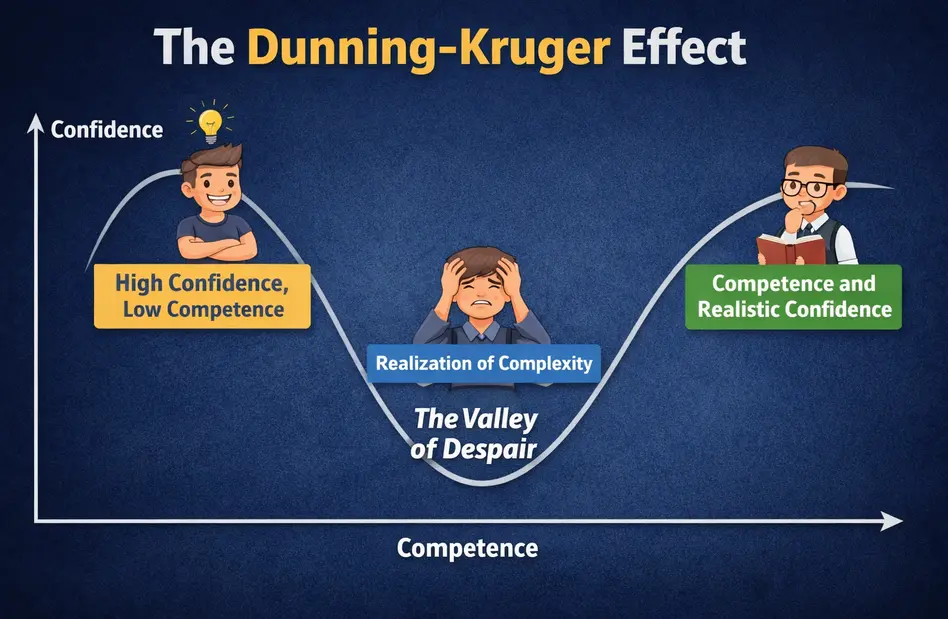
The Dunning-Kruger curve — confidence peaks early when competence is lowest, collapses into the Valley of Despair as complexity becomes visible, then stabilises at a realistic level as genuine skill develops.
Dunning-Kruger Effect in Real Life — Examples
The Dunning-Kruger effect appears wherever people evaluate their own abilities without sufficient external feedback. A person who has read a few articles about investing begins confidently trading individual stocks, certain they have identified what professional fund managers have missed. Someone who has watched a few hours of online cooking videos believes they are ready to cater a dinner party. A first-year medical student, having just learned a handful of diagnoses, feels briefly more certain about clinical medicine than they will ever feel again — because they do not yet know what they do not know.
In online debate, the effect produces a recognisable pattern: the most confident, assertive voices in a discussion are often those with the least depth of knowledge, while people with genuine expertise hedge their claims, acknowledge uncertainty, and are frequently perceived as less authoritative as a result. The confident novice dominates the conversation; the cautious expert qualifies every statement.
Dunning-Kruger Effect in the Workplace
The Dunning-Kruger effect has direct consequences in professional environments, where self-assessment feeds into hiring decisions, promotion, task allocation, and team dynamics.
In hiring, candidates who overestimate their competence tend to present with high confidence, which interviewers often read as a genuine signal of ability — particularly when combined with the halo effect. A candidate who speaks confidently about a domain they understand only superficially may outperform a genuinely skilled but self-effacing candidate in an unstructured interview, precisely because the skilled candidate's hedging and qualification reads as uncertainty rather than accuracy. Structured interviews with domain-specific technical assessments reduce this effect by providing objective evidence that overrides self-presentation.
In team environments, employees with limited expertise in a domain often volunteer most readily for tasks in that domain, take on responsibilities beyond their actual capability, and resist feedback that challenges their self-assessment. Employees with genuine expertise, by contrast, are more likely to flag uncertainty, seek input, and escalate problems early — behaviours that are more valuable but sometimes read as less confident. Managers who are not aware of the Dunning-Kruger dynamic can systematically misallocate tasks as a result.
The effect also shapes how employees receive training and development. Novices who are overconfident tend to disengage from training earlier than their actual competence warrants, because they feel they already understand the material. The critical phase of learning — where genuine skill is being built — requires tolerating a period of reduced confidence as complexity becomes visible. Employees who have not been told to expect this dip often interpret it as evidence that they are not suited to the domain, rather than as a sign that genuine learning is occurring.
Dunning-Kruger Effect in Politics and Public Discourse
The Dunning-Kruger effect is particularly visible in public debate about complex policy domains — economics, public health, climate science, foreign policy — where the gap between the knowledge required to form a well-grounded view and the knowledge most people actually have is enormous. People with a surface familiarity with a topic feel equipped to reach firm conclusions about questions that specialists spend careers studying. The complexity that experts see — the caveats, the competing models, the contradictory evidence — is simply invisible to those without the background to recognise it.
This dynamic is exploited deliberately in political communication: simplified, confident assertions outperform nuanced, qualified ones in reach and persuasiveness, because audiences often interpret confidence as competence and hedging as weakness. The result is an information environment that systematically rewards Dunning-Kruger-style overconfidence and penalises the kind of calibrated uncertainty that actual expertise produces.
Dunning-Kruger Effect in Psychology — Research and Debates
The original Dunning-Kruger findings have been extensively replicated, but also subjected to serious methodological scrutiny. A significant statistical critique argues that much of the observed pattern may be a mathematical artefact: when you ask low scorers to estimate their score, regression to the mean alone predicts they will overestimate, and high scorers will underestimate — independently of any metacognitive bias. This critique, advanced most prominently by Gignac and Zajenkowski (2020), does not eliminate the Dunning-Kruger effect but suggests the magnitude reported in some studies may be inflated by statistical artifacts.
What is not disputed is the core finding that people are often poorly calibrated in self-assessment, and that novices in a domain systematically lack the metacognitive tools to accurately evaluate their own performance. The debate is about the size and mechanism of the effect, not its existence.
Dunning-Kruger Effect vs Impostor Syndrome
The Dunning-Kruger effect and impostor syndrome are in some ways mirror images of each other. The Dunning-Kruger effect describes the novice who does not know enough to recognise their own limitations; impostor syndrome describes the expert who does not give themselves enough credit for what they genuinely know. Both involve miscalibrated self-assessment, but in opposite directions and at opposite ends of the competence spectrum.
They can coexist in the same person across different domains: someone might be overconfident in a domain where they are a novice and underconfident in a domain where they are an expert. This is one reason that awareness of the Dunning-Kruger effect should include both directions — asking not only "where am I overconfident?" but also "where am I dismissing genuine competence I actually have?"
How to Avoid and Overcome the Dunning-Kruger Effect
Seek specific, expert feedback
The most direct antidote to overconfidence in a domain is accurate external feedback from someone with genuine expertise in that domain. Not general encouragement or vague criticism, but specific evaluation of your actual performance against the standards of the field. This is uncomfortable — it makes visible exactly the gap that overconfidence conceals — but it is the fastest route to accurate self-assessment. The key is that the feedback source must have genuine domain expertise; feedback from fellow novices tends to reinforce overconfidence rather than correct it.
Study the edges of what you know
Overconfidence in a domain typically collapses when you encounter the questions you cannot answer. Deliberately seeking out the hardest problems, the most contested questions, and the areas of greatest disagreement within a field exposes the limits of your current understanding in a way that reviewing familiar material does not. Experts maintain calibrated self-assessment partly because they regularly encounter the edges of their knowledge — novices who stay within comfortable territory never do.
Track your predictions
One of the most reliable ways to recalibrate overconfidence is to make explicit predictions and then check whether they come true. If you believe you understand a domain well, make specific, falsifiable predictions about outcomes in that domain and record them. The gap between predicted and actual accuracy is a direct measure of calibration — and seeing it in writing is more difficult to dismiss than the vague sense that you understand something. This is the same mechanism used in forecasting training, which has been shown to substantially improve calibration over time.
Normalise "I don't know"
In environments — professional or social — where admitting uncertainty is treated as weakness, overconfidence is incentivised. Building a personal habit of distinguishing between what you know, what you believe, and what you are uncertain about — and communicating those distinctions clearly — counteracts the social pressure that sustains Dunning-Kruger overconfidence. The goal is not to perform uncertainty but to accurately represent your actual epistemic state.
The Deeper Point
The Dunning-Kruger effect is not primarily a story about ignorance — it is a story about the relationship between knowledge and self-knowledge. The skills required to accurately assess your own competence in a domain are largely the same skills required to perform well in that domain. This means that the early stages of learning any new subject involve a period of false confidence that can only be corrected by learning enough to see its own limits.
Understanding this changes how you approach new domains, how you interpret confident claims from others, and how you design feedback systems in professional environments. The goal is not to distrust all confidence — experts who are confident in their domain are often accurately calibrated. It is to ask, for any given confident claim, whether the person making it has the background to know what they do not know.
Related biases that interact closely with this one: the halo effect, which causes confident self-presentation to be read as genuine competence; confirmation bias, which prevents novices from encountering the disconfirming evidence that would correct their overconfidence; and the overconfidence effect, which is the broader pattern of which the Dunning-Kruger effect is a specific instance.
The Cognitive Bias Spotter Test below puts that understanding to work — see if you can catch the Dunning-Kruger effect and the other nine biases when they appear in realistic scenarios.