Planning Fallacy — Meaning, Examples & How to Overcome It
Mind · Cognitive Biases · Decision & Action family
Test yourself — can you spot the bias in each scenario? Take the Cognitive Bias Spotter Test. Jump to the test ↓
What Is the Planning Fallacy? Simple Definition
The planning fallacy is the tendency to underestimate how long a task will take, how much it will cost, and how many obstacles will arise — while overestimating the benefits — even when you have direct experience of similar tasks running over time and over budget in the past. The error is not ignorance; it is the systematic failure to apply what you already know about past performance to your predictions for a current project.
In plain terms: you know your last five projects ran late. You know projects generally run late. And yet when you estimate this project, you confidently predict it will be done on time. This is the planning fallacy — not a failure to know the base rate, but a failure to use it.
This page is part of the cognitive biases guide on our free cognitive training and testing platform, alongside interactive tools covering memory, attention, reaction time, and decision-making.
Planning Fallacy Meaning & Psychology
The planning fallacy was first identified by Daniel Kahneman and Amos Tversky in 1979, who proposed that it arises from a fundamental asymmetry in how people approach planning. When estimating how long a task will take, people adopt what Kahneman and Tversky called the inside view: they focus on the specific task at hand, imagine the steps they will take to complete it, and construct a best-case scenario of how the work will unfold. This inside view naturally generates optimistic estimates because it focuses on plans rather than on the historical record of how plans actually perform.
The empirical foundation of the planning fallacy was established by Buehler, Griffin & Ross (1994) in a study that followed psychology students through the completion of their senior theses. Students predicted on average that they would finish in 33.9 days. Their most pessimistic estimate — "if everything went as poorly as possible" — was 48.6 days. The actual average completion time was 55.5 days. Only 30% of students finished within the time they had predicted. The students were not uninformed about their own tendencies: when asked how long similar projects had taken them in the past, they gave significantly longer estimates. They simply did not use that information when predicting the current project.
Inside view vs outside view
The core mechanism of the planning fallacy is the privileging of the inside view over the outside view. The inside view focuses on the specifics of the current task — its unique features, the steps involved, the plans in place. The outside view asks: how long do tasks like this actually take, across all the similar cases that have been attempted? The inside view feels more relevant and informative because this project is specific and known; the outside view feels statistical and abstract. But the outside view is almost always a better predictor of how the project will actually go, because it incorporates the base rate of how plans perform across the full distribution of similar attempts — including all the unexpected delays, obstacles, and complications that the inside view systematically ignores.
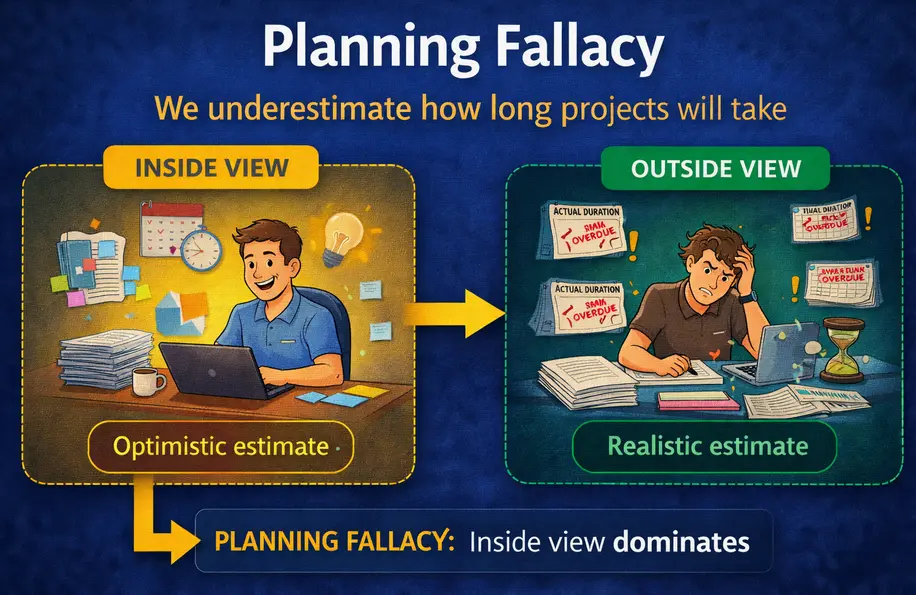
The planning fallacy: the inside view generates an optimistic estimate while the outside view — reflecting actual past overruns — generates a realistic one. The planning fallacy is that the inside view dominates.
Planning Fallacy in Real Life — Examples
The planning fallacy is one of the most thoroughly documented patterns in applied psychology precisely because it operates at every scale, from individual tasks to civilisation-scale infrastructure projects. Students consistently underestimate how long essays and dissertations will take to complete. Home renovations reliably run over time and over budget. Software projects are legendarily late — the software industry has been producing research on this for decades, with studies consistently finding that projects take two to three times longer than initial estimates.
At the largest scale, major public infrastructure projects provide the most dramatic illustrations. The Sydney Opera House was originally budgeted at AUD $7 million and scheduled for completion in 1963; it was completed in 1973 at a cost of AUD $102 million. The Channel Tunnel between England and France cost approximately 80% more than projected. Studies of major transport infrastructure projects by economist Bent Flyvbjerg across 20 countries found that 86% of projects run over budget, with average cost overruns of around 28%. These are not isolated failures of particularly incompetent planners — they are the reliable output of a cognitive bias that operates universally.
Planning Fallacy in Business and Organisations
In business, the planning fallacy produces a consistent pattern of product launches that miss deadlines, budgets that are exceeded, and business plans that overestimate revenue and underestimate costs. New product development projects, marketing campaigns, and organisational change initiatives all systematically underestimate the time and resources required — not because planners are careless or uninformed, but because the inside-view focus on the specific project suppresses the outside-view recognition of how similar projects actually perform.
This interacts with the optimism bias, which inflates expected benefits alongside the planning fallacy's suppression of expected costs. The result is a systematic misalignment between plan and reality that is predictable in direction if not in magnitude. Kahneman and Lovallo, in a later expansion of the concept, described this as the combination of the planning fallacy producing cost and time underestimates while optimism bias produces benefit overestimates — creating what they called a "double whammy" of miscalibration at both ends of the cost-benefit calculation.
Planning Fallacy in Software Development
Software development is one of the domains most frequently cited as an illustration of the planning fallacy in professional practice. Project overruns — in both time and cost — are widely documented as common across the industry, and the pattern has been noted for decades. The underlying reason is consistent with the planning fallacy mechanism: development teams focus on the inside view of their specific project, imagining the steps required under normal conditions, while systematically underweighting the likelihood of unexpected technical problems, changing requirements, and integration delays that the outside-view base rate of similar projects would predict. The fact that this pattern has persisted despite widespread industry awareness of it is itself evidence that awareness alone is insufficient to correct the bias.
Planning Fallacy vs Hofstadter's Law
The planning fallacy is captured wittily in Hofstadter's Law, formulated by cognitive scientist Douglas Hofstadter: "It always takes longer than you expect, even when you take into account Hofstadter's Law." This self-referential formulation captures something real — the planning fallacy is recursive. Even when you know about the planning fallacy and consciously try to add a buffer to your estimates, the adjusted estimate is still typically too optimistic, because the buffer is added to an already optimistic inside-view estimate rather than replacing it with an outside-view estimate.
How to Avoid and Overcome the Planning Fallacy
Use reference class forecasting
The most empirically supported corrective for the planning fallacy is reference class forecasting: anchoring your estimate in the actual distribution of outcomes for a relevant class of similar projects, rather than in your inside-view assessment of the current project. To do this, identify the class of projects most similar to yours, find the actual distribution of completion times and costs for that class, and use that distribution as your baseline estimate. Adjust from the baseline based on specific features of your project — but always start from the outside view, not the inside view. This is the same approach recommended for countering the optimism bias more generally, and it is the most effective known corrective for planning fallacy errors in large projects.
Pre-mortem analysis
Before finalising a plan, conduct a pre-mortem: imagine that the project has failed to meet its timeline and budget, and work backwards to identify what caused the failure. This exercise surfaces the specific obstacles and delays that the inside view naturally suppresses — because the inside view focuses on what will go right, while the pre-mortem forces attention onto what will go wrong. Teams that conduct pre-mortems consistently produce more realistic estimates and better-prepared contingency plans than those that do not.
Break projects into smaller tasks and estimate each
Research has found that people are better at estimating the time required for specific, concrete sub-tasks than for the overall project. Breaking a project into its component tasks and estimating each individually — then summing the estimates and adding a buffer — produces more accurate total estimates than estimating the project as a whole. The overall project tends to feel like a single, manageable entity; the sub-tasks, when enumerated, surface the true scope of what is involved.
Track your prediction accuracy over time
Keeping a record of how long tasks actually take, compared to how long you predicted they would take, builds a personal empirical database that can calibrate future estimates. Most people who track their planning predictions over time find a consistent pattern of underestimation — and the concrete evidence of this pattern, specific to their own projects, is more persuasive and more useful for calibration than abstract knowledge of the planning fallacy. This is the same practice recommended for optimism bias and hindsight bias debiasing.
The Deeper Point
The planning fallacy is unusual among cognitive biases in that it is both extraordinarily well documented and extraordinarily resistant to correction through awareness alone. You can know about the planning fallacy in detail, have direct personal experience of your own projects running over time, be aware that you are making an inside-view estimate right now — and still produce an optimistic estimate. The bias is not primarily a failure of knowledge; it is a failure of the cognitive process through which we construct predictions about the future.
The inside view is cognitively compelling because it is specific, concrete, and emotionally engaging. The outside view is abstract, statistical, and emotionally flat. The mind naturally gravitates to what is vivid and specific — which is the current project — rather than what is statistically representative, which is the distribution of past outcomes. Overcoming the planning fallacy therefore requires not just knowing the outside view but actively forcing the planning process to be anchored there, through pre-mortems, reference class data, and deliberate attention to past performance.
Related biases that interact closely with this one: optimism bias, which inflates expected benefits alongside the planning fallacy's suppression of expected costs; illusion of control, which produces overconfidence in the ability to manage the project to the planned timeline; and availability heuristic, which makes the vivid inside-view scenario more cognitively accessible than the statistical outside view.
The Cognitive Bias Spotter Test below puts that understanding to work — see if you can identify the planning fallacy and the other nine biases when they appear in realistic scenarios.