Representativeness Heuristic — Meaning, Examples & How to Overcome It
Mind · Cognitive Biases · Probability & Judgment family
Test yourself — can you spot the bias in each scenario? Take the Cognitive Bias Spotter Test. Jump to the test ↓
What Is the Representativeness Heuristic? Simple Definition
The representativeness heuristic is the tendency to judge the probability of an event or the likelihood of a category membership by how closely something resembles a typical example — a prototype or stereotype — rather than by actual statistical probability. When assessing whether a person, object, or event belongs to a particular category, the mind asks "how similar is this to the typical member of that category?" and uses the answer as a substitute for probability.
In plain terms: if something looks like the prototype, it is judged as likely to belong to the category, regardless of how common or rare that category actually is. The resemblance does the work that probability should do — and the two are often in direct conflict.
This page is part of the cognitive biases guide on our cognitive training and assessment platform, alongside interactive tools covering memory, attention, reaction time, and decision-making.
Representativeness Heuristic Meaning & Psychology
The representativeness heuristic was identified and named by Tversky & Kahneman (1974) as one of three fundamental heuristics — mental shortcuts — that people use when making judgments under uncertainty. They demonstrated that people judge the probability of an event by assessing how representative it is of a known class or process: how similar it is in essential characteristics to the parent category, and how much it reflects the expected features of the process that generated it.
The heuristic is useful as a general guide — things that resemble a category often do belong to it — but it leads to systematic errors when resemblance and probability diverge. The most consequential of these errors are base rate neglect, the conjunction fallacy, and insensitivity to sample size.
Base rate neglect
When a description of a person or event closely matches a stereotype, people tend to judge category membership primarily by the match and ignore the base rate — the actual frequency of that category in the population. In the classic demonstration, participants were told that a panel of psychologists had interviewed 100 people, of whom 70 were engineers and 30 were lawyers. They were then given personality descriptions and asked to judge the probability that each described person was an engineer or a lawyer. When the description matched the stereotype of a lawyer, participants judged the person to be a lawyer — even when the base rates strongly favoured engineers. The resemblance overrode the statistics.
The conjunction fallacy
The representativeness heuristic also produces the conjunction fallacy — the error of judging a conjunction of two events to be more probable than one of its components alone. In the famous Linda problem, participants are told that Linda is 31, single, outspoken, and very bright, and that as a student she was deeply concerned with issues of discrimination and social justice. They are then asked whether it is more probable that (a) Linda is a bank teller, or (b) Linda is a bank teller and is active in the feminist movement. The correct answer is (a): the probability of two events occurring together can never exceed the probability of either alone. Yet the majority of participants choose (b), because the description is more representative of a feminist bank teller than of a bank teller. Representativeness overrides logic.
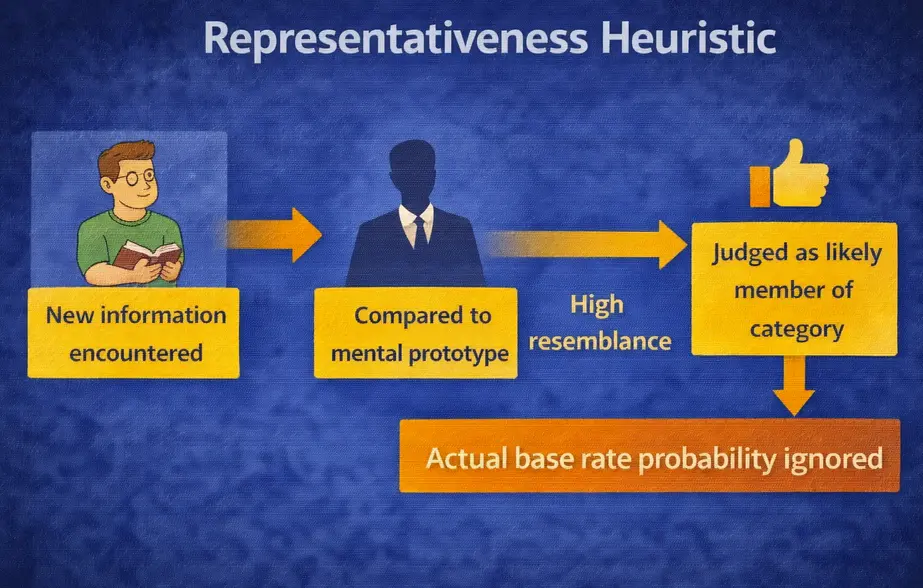
The representativeness heuristic: new information is compared to a mental prototype, and high resemblance leads to a confident category judgment — while the actual base rate probability is ignored.
Representativeness Heuristic in Real Life — Examples
The representativeness heuristic operates continuously in social judgment. When meeting someone who is quiet, detail-oriented, and passionate about data, people tend to assume they are more likely to be a scientist or accountant than a salesperson — even if salespeople are far more common in the population being considered. The description matches the prototype of the scientist or accountant, so the heuristic assigns high probability of that category membership regardless of base rates.
In medical diagnosis, the representativeness heuristic leads clinicians to judge the probability of a diagnosis by how well the patient's presentation matches the classic picture of the disease. A patient who presents with the textbook symptoms of a dramatic but rare condition may receive that diagnosis at the expense of a more common condition with overlapping symptoms — the dramatic match to the prototype overrides the base rate probability that the common condition is responsible.
In everyday social life, the heuristic underlies much of what is called stereotyping: the tendency to judge an individual's characteristics, abilities, or intentions by how closely they resemble the prototype of a social group. The error is not in using category information at all — categories carry real statistical information — but in applying it without appropriate weighting by base rates, individual variation, and the reliability of the resemblance itself.
Representativeness Heuristic in Investing and Finance
Financial decision-making is significantly shaped by the representativeness heuristic. Investors often judge a company's future performance by how closely it resembles the prototype of a successful company — strong brand, charismatic leadership, exciting product narrative — rather than by the base rate performance of similar companies in similar situations. This produces systematic overvaluation of companies that look like winners and undervaluation of companies that do not match the growth-company prototype, regardless of the underlying fundamentals.
The heuristic also drives the tendency to treat recent short-term performance as representative of long-term quality. A fund manager who has produced strong returns for two or three years is judged as a skilled manager rather than as a random winner in a large population of managers — the recent performance matches the prototype of skilled management and is treated as evidence of that quality, with insufficient weight given to the base rate probability of producing such a run by chance. This connects directly to the clustering illusion, where short-run streaks are perceived as non-random patterns.
Representativeness Heuristic in the Workplace
Hiring decisions are a major domain for representativeness heuristic errors. Interviewers often assess candidates by comparing them to a mental prototype of the ideal candidate — in terms of appearance, manner, background, or communication style — and use this resemblance as a proxy for actual job performance probability. The base rate relationship between the prototype-matching features and actual job success is rarely considered explicitly, and the prototype is frequently shaped by irrelevant features of past successful employees rather than by the causal drivers of job performance.
Leadership assessment suffers from the same problem. Research consistently shows that people judge leadership potential substantially by physical appearance, vocal characteristics, and the degree to which a person resembles the culturally dominant prototype of a leader. These prototype-matching features are used as a proxy for leadership ability, with base rates — what fraction of people with these features actually perform well as leaders — largely ignored.
Representativeness Heuristic vs Other Biases
The representativeness heuristic is the cognitive mechanism underlying several other biases covered in this series. The gambler's fallacy is driven by representativeness: a short random sequence "should" look representative of the long-run distribution, so a streak of heads triggers the expectation of tails. The clustering illusion is similarly representativeness-driven: random data "should" look evenly distributed, so natural clusters appear non-random. The availability heuristic is a distinct but related shortcut — it uses ease of retrieval rather than resemblance as a proxy for probability, and the two heuristics often operate together.
How to Avoid and Overcome the Representativeness Heuristic
Always ask about base rates
The most direct counter to the representativeness heuristic is to actively seek out and apply base rate information before or alongside any resemblance-based judgment. When assessing the probability that someone belongs to a category, or that an event reflects a particular cause, ask: how common is this category in the relevant population? How often does this cause produce this kind of event? The base rate should anchor your judgment, with resemblance providing an update rather than the entire assessment.
Separate description from probability
The representativeness heuristic is most powerful when a vivid, detailed description closely matches a prototype. Deliberately separating the question "does this resemble X?" from the question "how probable is X?" weakens the automatic substitution of resemblance for probability. The Linda problem works because the description makes feminist bank teller feel more probable — until you separate the questions and recognise that probability cannot increase by adding detail.
Consider the population, not just the case
When making any probabilistic judgment about an individual case, it helps to explicitly consider the population of similar cases. Rather than asking "does this person look like a scientist?", ask "what fraction of people with this description are actually scientists?" The shift from the individual case to the population forces base rate information into the judgment in a way that the representativeness heuristic naturally suppresses. This is the same principle recommended for countering the availability heuristic — replace the vivid individual case with the statistical distribution it comes from.
The Deeper Point
The representativeness heuristic is one of the most fundamental and pervasive shortcuts in human judgment, precisely because resemblance is genuinely useful information. Categories do have prototypes. Descriptions that match a prototype often do indicate category membership. The heuristic is not irrational — it is a reasonable approximation that works well in many contexts. The problem is that it works so automatically and feels so compelling that it overrides explicit probability information even when that information is directly available and clearly relevant.
The practical implication is not to stop using resemblance as a cue — that would be both impossible and inadvisable. It is to recognise that resemblance is a noisy, biased proxy for probability, and to supplement it systematically with base rate information, statistical thinking, and explicit consideration of the population from which individual cases are drawn. The goal is to use the heuristic where it is appropriate and override it where it leads systematically astray.
Related biases that are directly driven by this heuristic: the gambler's fallacy and clustering illusion, both of which arise from applying representativeness to random sequences; and the halo effect, which generalises from a few representative features to an overall judgment of a person's quality.
The Cognitive Bias Spotter Test below puts that understanding to work — see if you can identify the representativeness heuristic and the other nine biases when they appear in realistic scenarios.