Shepard Tables Illusion
The two tabletops look radically different, but one is simply a rotated copy of the other.
Look at the two tables below. The left tabletop probably appears long and narrow, while the right one seems shorter and much broader.
But the tops are exactly the same shape and size. The right tabletop is a precise 90-degree rotation of the left one.
The legs, perspective, and orientation make the identical parallelograms look like two differently proportioned pieces of furniture.
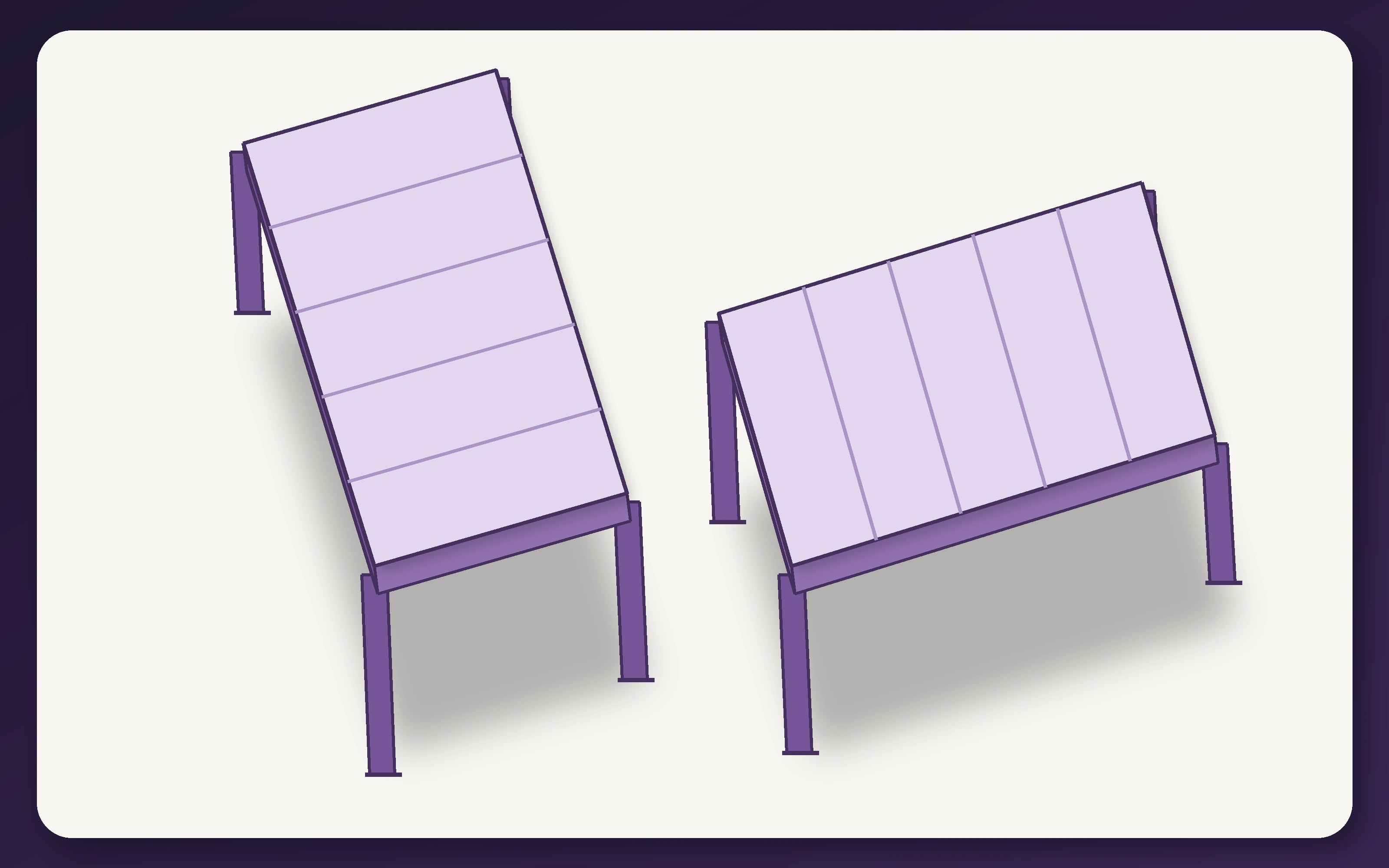
This is the Shepard Tables illusion, also called the Shepard tabletop illusion.
It shows how strongly the visual system interprets flat shapes as surfaces in three-dimensional space rather than simply measuring their geometry on the page.
What Is Actually Identical?
Ignore the legs for a moment and focus only on the pale-purple tabletops.
Each top has four matching sides, the same angles, and the same area. The second is not wider, shorter, stretched, or compressed. It is simply rotated.
The proof image isolates the two shapes and then places one over the other after rotation. Their corners and edges coincide exactly.
Why does the equality remain hard to believe in the complete picture?
The tabletop is not normally perceived as a flat parallelogram on a screen. It is seen as a rectangular surface tilted away from the viewer.
The Proof: Rotate One Top
The top portion of the proof image shows the same two isolated parallelograms. They may already look more similar after the table legs are removed, although their orientations can still influence their apparent proportions.
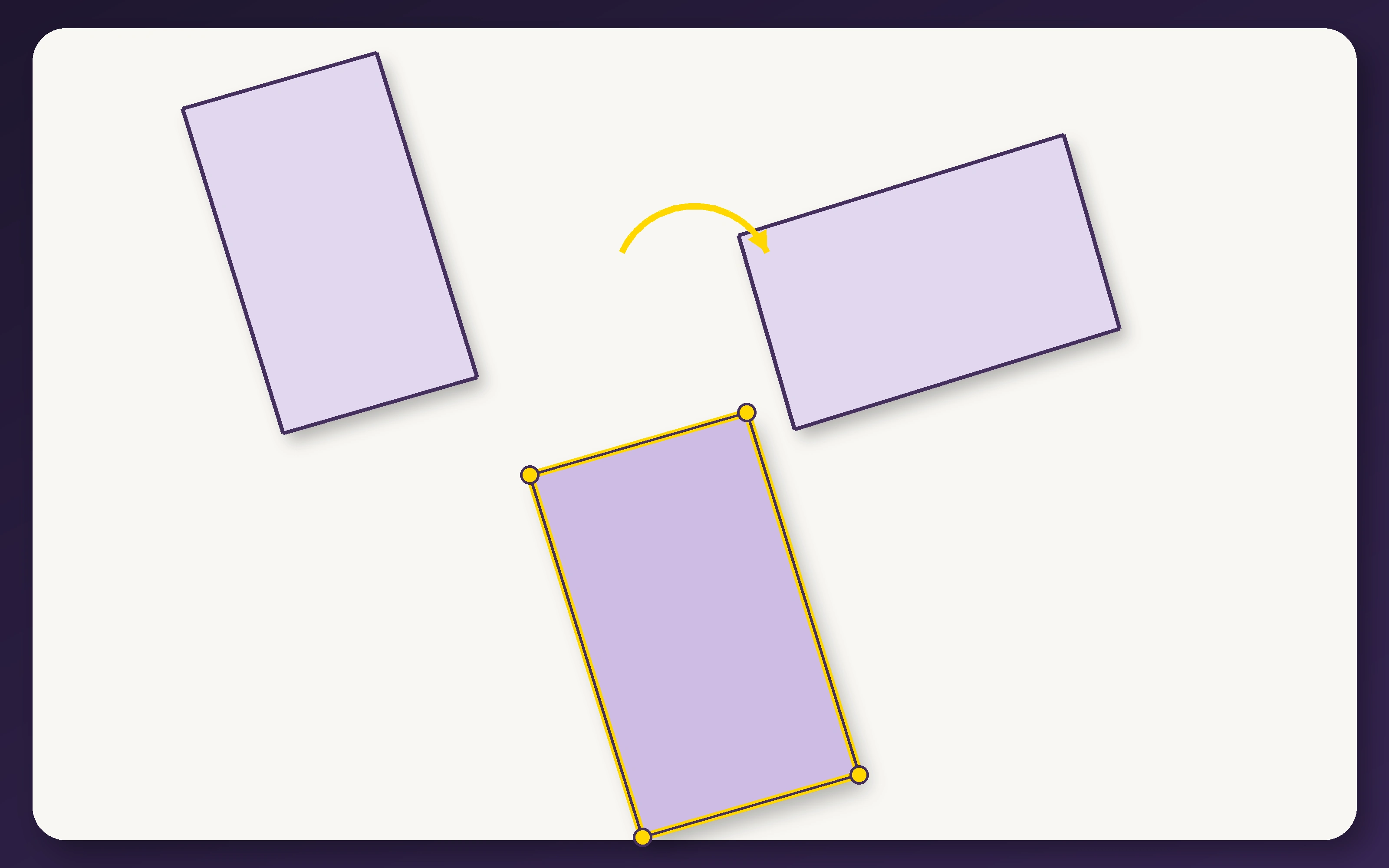
At the bottom, one shape has been rotated and aligned with the other. The gold boundary follows the same outline.
The overlay demonstrates that this is not a comparison between approximately similar drawings. The tabletops are exact copies.
Why One Table Looks Longer
A surface that recedes into depth produces a shortened image on the retina. This is called foreshortening.
The visual system normally compensates for that shortening. A rectangular table viewed at an angle should not suddenly seem to become a narrow trapezoid. Instead, perception estimates the stable shape that could have produced the angled image.
In the more upright table, the long direction appears to extend strongly into depth. The brain expands that receding dimension perceptually, making the top look especially long and narrow.
The other table is interpreted with a different slant and orientation. Its apparent depth is distributed differently, so it looks shorter and broader.
This is commonly linked to shape constancy, the tendency to perceive an object as retaining its shape despite changes in viewpoint. The illusion occurs because a useful correction for ordinary scenes is applied to carefully arranged flat drawings.
The Table Legs Are Not Decoration
Without the legs, the figures are plainly two rotated parallelograms. Adding legs encourages a three-dimensional interpretation.
The edges become the boundaries of solid tabletops rather than abstract lines. The legs establish which corners are near, which are far, and how each surface is tilted.
A 2026 study of the Shepard Tables illusion tested versions with different combinations of depth cues and surface textures.
Additional depth cues generally strengthened the illusion, supporting the importance of three-dimensional interpretation.
However, the full effect could not be explained by depth cues alone. Wood-like texture reduced the illusion in some configurations, and illusion strength was related to mental-rotation performance rather than measured shape-constancy ability.
The results suggest that surface interpretation, low-level image features, spatial transformation, and individual differences can all contribute.
The Paradox Is Deeper Than Different Lengths
Christopher Tyler analyzed several unusual features of the Shepard Tables illusion in a 2011 paper.
The tabletops are usually understood as horizontal surfaces, yet their drawn edges do not specify fully consistent slants. The tables can also appear less deep than the perspective explanation seems to require.
Even the rear legs create a puzzle. Legs drawn with comparable lengths can be perceived differently because they belong to differently interpreted surfaces.
These contradictions show why “the brain corrects for perspective” is helpful but incomplete. The image supports several spatial interpretations that do not fit together perfectly.
Try a Related Spatial Reasoning Test
The proof requires mentally rotating one tabletop and recognizing that its proportions remain unchanged.
Cognitive Train’s Spatial Reasoning Test measures mental rotation, cube-net folding, and mirror-image recognition in one assessment:
The Mental Rotation Test provides more focused practice with deciding whether shapes are identical under rotation or have been reflected. More spatial tools are available in the Spatial Reasoning hub.
Where the Illusion Came From
The illusion was created by cognitive scientist Roger N. Shepard.
An earlier version appeared in his 1981 writing on psychological complementarity. The best-known table drawing, titled Turning the Tables, appeared in his 1990 book Mind Sights.
Shepard deliberately placed identical image-plane shapes into different object-space interpretations. The drawing demonstrates that seeing is not the same as measuring.
Michael Bach’s interactive Shepard Tables demonstration lets viewers move and rotate one top over the other, making the equality visible while the complete tables continue to look different.
How It Differs From the Ponzo Illusion
The Ponzo Illusion makes two equal lines look different in length because converging lines suggest depth. A line interpreted as farther away appears larger after the visual system compensates for distance.
Shepard Tables also uses pictorial depth, but the targets are complete surfaces rather than simple horizontal lines.
The illusion changes the apparent aspect ratio of each top. One dimension seems lengthened relative to the other, so the whole shape appears different.
How It Relates to the Ames Room
The Ames Room Illusion uses a distorted physical room viewed from one fixed position.
Perspective makes the room look rectangular and causes people standing in different corners to appear dramatically different in size.
Shepard Tables works entirely within a flat drawing, but the principle is related. Familiar three-dimensional interpretations override the literal geometry of the image.
The Penrose Staircase Illusion takes pictorial interpretation in another direction. Its local depth cues create plausible stair flights that cannot form one globally possible object.
Why Measuring Does Not Remove the Effect
You can trace the outlines, rotate the proof shape, or measure every side. The complete tables may still look mismatched afterward.
Your conscious judgment now knows the two tops are equal. Visual perception continues treating them as differently oriented surfaces in depth.
That persistence is part of what makes the illusion so effective. The brain’s automatic spatial interpretation is not easily replaced by a factual instruction.
What It All Comes Down To
The Shepard Tables illusion uses two identical parallelograms rotated into different orientations and surrounded by table-like depth cues.
One top appears long and narrow, while the other seems short and broad. Rotate either outline and the shapes match exactly.
The effect shows that the visual system does not report flat geometry in isolation. It estimates the three-dimensional surfaces that the image might represent, and that useful interpretation can dramatically reshape what identical forms look like.
For more impossible objects, size distortions, false motion, and ambiguous figures, browse the full Optical Illusions guide. Cognitive Train’s brain tests explore perception, attention, speed, and reasoning, while its free brain training tools offer more ways to challenge visual thinking.