Fraser Spiral Illusion
The pattern appears to wind inward like a spiral, but every twisted cord forms a complete circle.
Look at the image below. Your eyes may follow one black-and-white cord inward toward the center, as though it belongs to a continuous spiral.
Try choosing one apparent loop and tracing it carefully. Instead of moving steadily inward, the path eventually returns to where it started.
There is no spiral in the image. Every cord is centered on the same point and follows a mathematically exact circle.
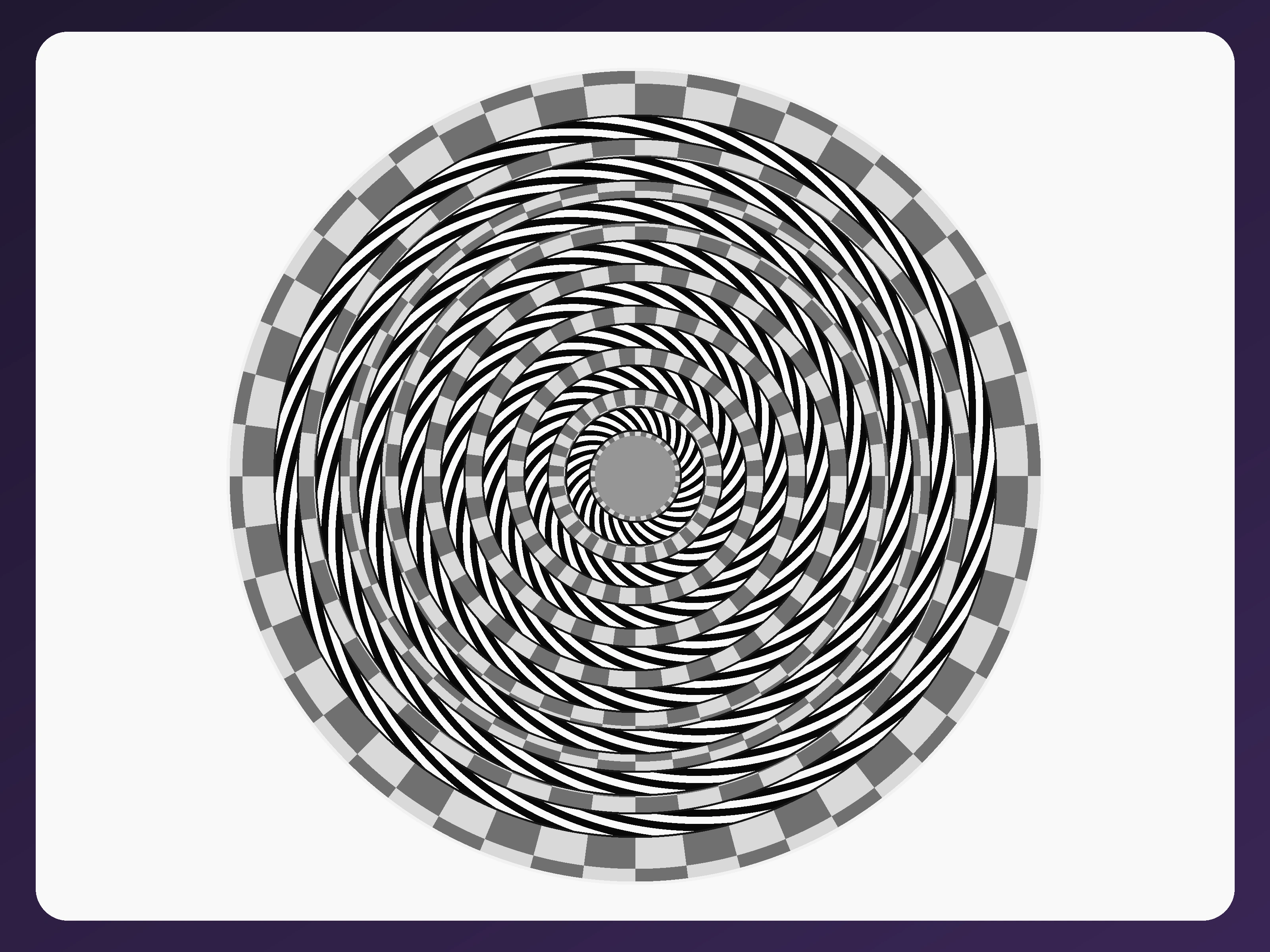
This is the Fraser Spiral illusion, also called the false spiral or twisted-cord illusion.
The display combines true circular structure with small tilted elements. Those local tilts push perception away from the physical direction of the circles, and the errors accumulate into the impression of one winding path.
What Is Actually Drawn?
The image contains several circles of increasing diameter. Each one remains at a constant distance from the center for its entire route.
The circles are difficult to recognize because they are not drawn as clean, uninterrupted outlines. Instead, each circular band contains alternating black-and-white pieces that lean across the true path.
A patchwork of light and dark regions surrounds the cords. This background adds more changing edges and makes it harder to isolate the actual circular boundaries.
The proof image traces the center of every cord with a colored circle:
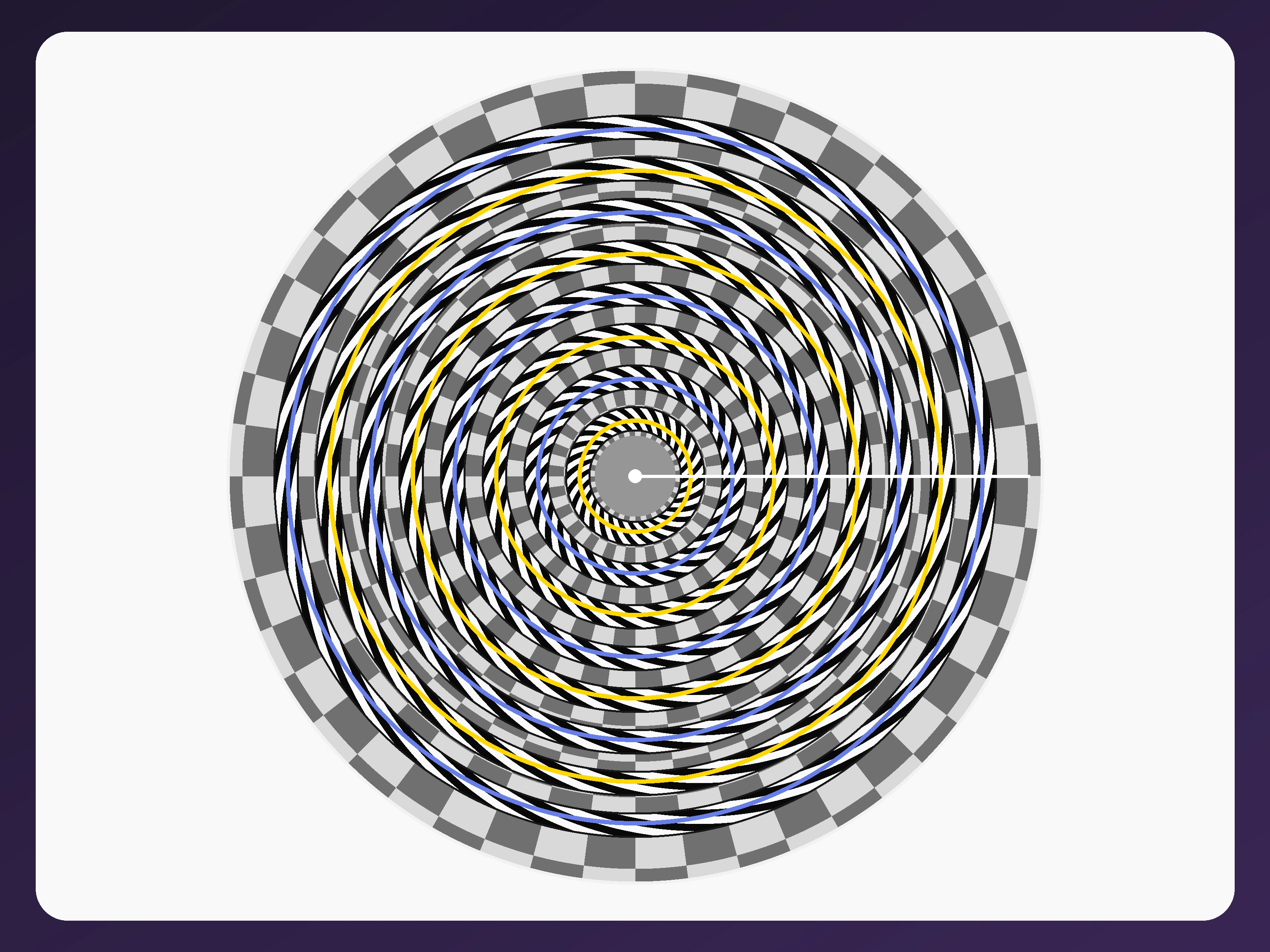
Once the guides are visible, the circular construction becomes much easier to follow. Remove them, and the apparent spiral returns.
Why the Twisted Cords Create a Spiral
The edge of each cord follows a circle, but its internal elements are tilted relative to that circular path.
When many short elements lean consistently in one direction, the complete row can appear tilted in that direction too. This is known as the Fraser effect.
In a straight version of the pattern, a horizontal row made from oblique pieces can appear to slope. Wrapping that row around a center converts the apparent tilt into an inward or outward drift.
Your visual system combines the small local directions into a larger global contour. Instead of seeing independent tilted pieces arranged around separate circles, it interprets them as sections of a continuous spiral.
The physical circular edges remain present, but the repeated orientation signal is strong enough to pull the perceived path away from them.
Does the Background Cause the Illusion?
The gray patchwork strengthens the effect, but it is not the only cause.
Research on more complex Fraser figures has found that background elements can increase illusion strength. They make the true borders harder to isolate and contribute additional local orientation relationships.
However, twisted cords can produce apparent tilt even without the full patchwork. The crucial feature is the conflict between the physical direction of the contour and the orientation suggested by its smaller components.
The background therefore acts more like an amplifier than a complete explanation.
Can the Effect Occur Without Obvious Tilted Lines?
Yes. The local signal does not always need to look like a set of clearly slanted strokes.
In a study by Ariella Popple and Dov Sagi, researchers constructed contours from Gabor patches, small striped elements contained within soft-edged windows.
Changes in the internal phase of the stripes influenced the apparent orientation of the complete contour even though the positions of the surrounding windows remained aligned.
The result showed that perceived direction can depend on how local visual information is combined across a larger contour. The effect is not limited to one traditional drawing made from obvious diagonal line segments.
Try a Related Visual Scanning Test
The Fraser Spiral makes it difficult to follow a true contour when smaller elements suggest a conflicting direction. Cognitive Train’s Symbol Search Test asks you to scan a group of symbols and decide whether any target symbol is present among the distractors:
Where the Fraser Spiral Came From
The illusion was described by British psychologist James Fraser in 1908 in a paper titled A New Visual Illusion of Direction.
Fraser referred to the underlying effect as a twisted-cord illusion. Rows built from angled black-and-white elements appeared to deviate from their true orientation.
Arranging those rows as concentric circles produced the dramatic false spiral that now carries his name.
A historical reference, interactive demonstration, and source list are available through Michael Bach’s visual-illusion archive.
Is the Fraser Pattern the Only Way to Create a False Spiral?
No. A false spiral can emerge from several kinds of orientation illusion.
In research by Akiyoshi Kitaoka, Baingio Pinna, and Gavin Brelstaff, the authors transformed patterns related to the Café Wall illusion, striped cords, shifted edges, and other tilt effects into circular arrangements.
Many of those physically concentric patterns also appeared spiral-shaped.
The researchers proposed a general principle: if a pattern produces a coherent apparent tilt in a straight arrangement, wrapping it into concentric circles can convert that tilt into an apparent spiral.
They also discussed the possibility that higher visual areas contain mechanisms sensitive to spiral-like global structure. Local orientation errors could feed into those mechanisms and produce one unified spiral percept.
That proposal remains an interpretation rather than proof of one dedicated “spiral detector,” but it explains why many separate local biases can combine into a strong global shape.
What EEG Research Found
A 2015 exploratory EEG study compared four Fraser-like displays.
The researchers varied both the physical structure, circles or a true spiral, and the internal cord pattern, parallel or twisted.
Twisted cords produced two opposite errors. Concentric circles could appear spiral-shaped, while a real spiral could sometimes appear more circular.
The EEG results showed an early posterior effect associated mainly with the physical stimulus between about 220 and 280 milliseconds. A later anterior effect between about 350 and 450 milliseconds was associated more strongly with perceptual interpretation, particularly the condition in which circles were experienced as a spiral.
The authors cautioned that stimulus and percept were not separated completely. The study was exploratory, but it showed that the illusion involves more than one stage of visual processing.
How It Differs From Related Illusions
The Café Wall illusion makes straight horizontal lines appear tilted through staggered black-and-white tiles.
The Zöllner illusion uses short diagonal strokes to make parallel lines appear to diverge.
The Hering illusion uses radiating spokes to make straight lines appear curved.
The Fraser Spiral applies a related conflict between local and global orientation to closed circular paths. Instead of producing a small tilt or bow, it changes the apparent category of the whole figure from circles to a spiral.
How to See the Circles
Start at one point on a black-and-white cord and trace it slowly with a finger or cursor. Do not jump to the neighboring cord when the pattern seems to lead inward.
You will eventually return to the starting position.
You can also cover most of the image and expose only a short arc at a time. The isolated section becomes easier to interpret as part of a circle because the larger spiral organization is weakened.
The proof image works for the same reason. It supplies an unambiguous circular guide that competes with the misleading tilted elements.
What It All Comes Down To
The Fraser Spiral contains no physical spiral.
Its concentric circles are filled with small elements that suggest a consistent directional shift. The visual system combines those local tilts across the full display and constructs one winding global path.
The result is a powerful conflict between geometry and perception. You can trace every circle, verify the shared center, and still see the pattern curling inward.
For more examples of distorted lines, false movement, impossible geometry, and changing size, browse the full Optical Illusions guide. Cognitive Train’s brain tests explore perception, attention, processing speed, and reasoning, while its free brain training tools offer more ways to challenge visual judgment.