Poggendorff Illusion
One line is the exact continuation of the black segment, but the wrong answer may look more convincingly aligned.
Imagine that the black line continues behind the purple rectangle. Which right-hand line does it meet: A or B?
Many viewers feel that B forms the smoother continuation. Its position seems to match the path suggested by the black segment.
But A is mathematically correct. If the black line continued in one perfectly straight path behind the rectangle, it would emerge exactly where A begins.
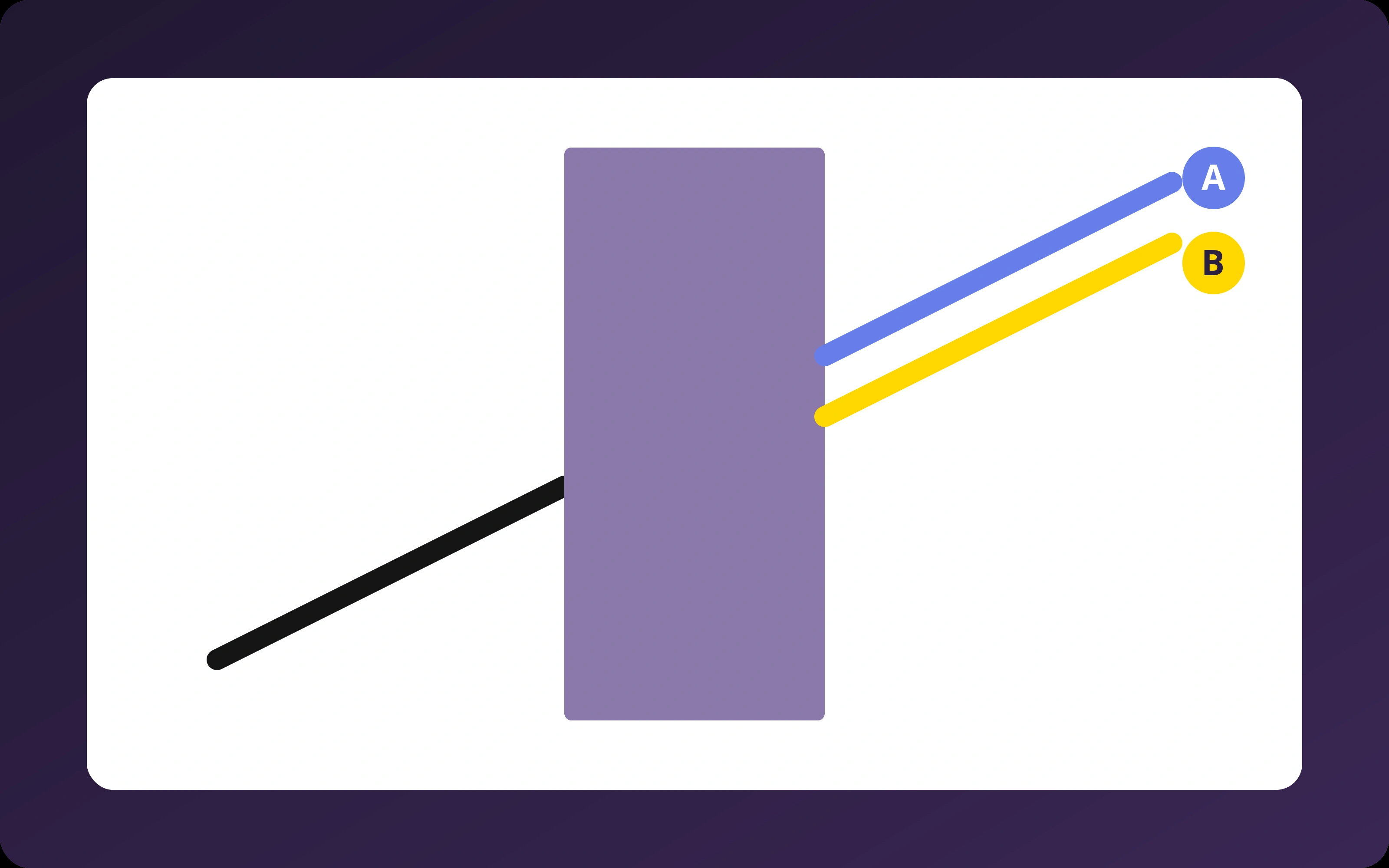
This is the Poggendorff illusion, a geometric illusion in which an interruption makes two collinear line segments appear offset.
The visible pieces point in compatible directions, but the visual system misjudges where an invisible continuation would cross the space between them.
What Is Actually Aligned?
The black line and A lie on one continuous mathematical line. They have the same angle and would meet if the purple rectangle became transparent.
B has the same general slope, but it is shifted downward. It only appears to provide a more natural continuation.
The proof image below removes the uncertainty. The black line is extended through the rectangle, and the hidden section is highlighted with a dashed gold path.
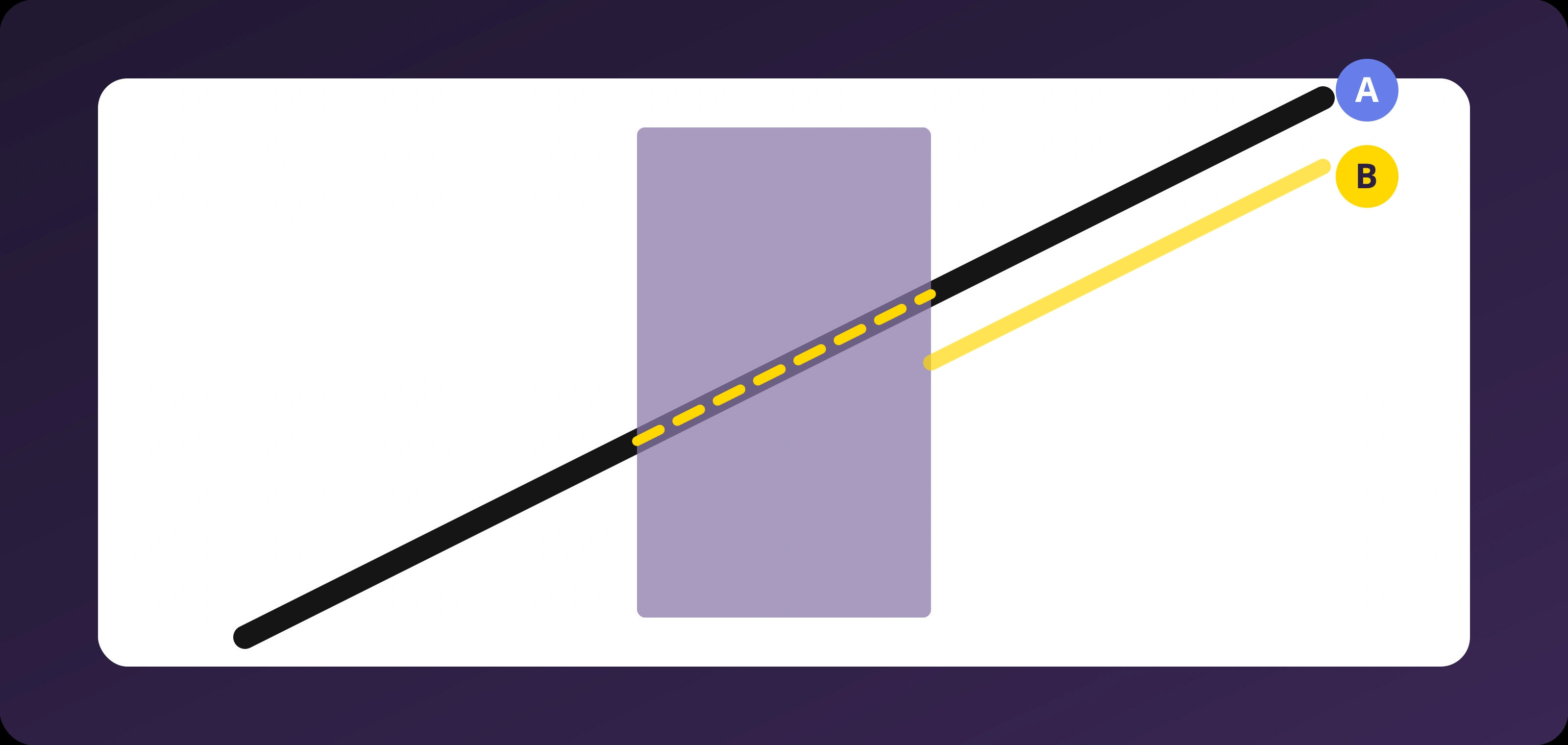
The error is not caused by poor eyesight or an unclear picture. The coordinates are exact, and the effect can remain visible even after the correct answer has been demonstrated.
Why the Interruption Creates an Error
When a continuous line is visible from end to end, judging its direction is easy. You can follow the edge without reconstructing anything.
The purple rectangle removes the middle section. Your brain must estimate where the line would travel across the hidden space and where it should reappear on the other side.
That estimate is influenced by the angles formed where the diagonal segments meet the rectangle’s vertical edges.
The visual system may slightly distort those local angle relationships. A small error near each boundary becomes a larger positional error after the imagined line is projected across the full width of the rectangle.
The result is a line that is physically straight but perceptually broken.
The Angle of the Diagonal Matters
The Poggendorff illusion is usually stronger when the interrupted line crosses the vertical edges at a relatively shallow angle.
A shallow diagonal has farther to travel vertically while crossing the hidden width. A small orientation error therefore produces a larger displacement at the opposite edge.
As the diagonal approaches a horizontal line, the classic effect can weaken. It also changes when the entire figure is rotated, showing that both local angles and the line’s orientation relative to the viewer matter.
The central rectangle matters too. Increasing the distance between its two sides forces the visual system to project the missing line across a larger gap, often increasing the apparent misalignment.
Local Orientation Can Influence the Whole Line
One influential explanation focuses on how the visual system estimates orientation near the points where the line disappears.
In a study by Michael Morgan, tiny bends were introduced close to the occluding boundary. The bends were subtle enough to be difficult to notice directly.
Even so, their direction changed the strength and direction of the illusion as though the complete line had taken on the altered orientation.
This suggests that the visual system may give substantial weight to the local direction immediately beside the occluder when estimating the invisible continuation.
The illusion is therefore not necessarily produced by one large conscious mistake. It may begin with a very small orientation bias that becomes amplified across the missing space.
Try a Related Spatial Challenge
The Poggendorff illusion tests whether you can mentally continue a line through an interruption. A related spatial skill is determining how a shape will look after it has been rotated.
Does Attention Remove the Illusion?
Paying closer attention can help you reason through the geometry, but it does not necessarily eliminate the perceptual bias.
In a 2023 dual-task study, participants judged Poggendorff alignment while also reading either an analogue or digital clock.
The extra tasks did not significantly change the magnitude of the illusion. The analogue-clock condition did increase uncertainty and produced more clock-reading errors, but the apparent misalignment itself remained similar.
The researchers concluded that placing additional demands on line-orientation processing did not weaken the illusion in the way their hypothesis predicted.
This does not prove that orientation processing is irrelevant. It shows that the illusion is robust and may involve several interacting mechanisms rather than one limited attentional resource.
Is the Rectangle Interpreted as an Occluder?
The central rectangle naturally looks like a foreground surface covering the middle of one diagonal line.
That apparent depth relationship has led to theories that the visual system treats the line as receding behind an object and applies assumptions learned from three-dimensional scenes.
Research has produced mixed support for this explanation.
In a 2022 study of pictorial depth cues, researchers added brick textures and corridor-like perspective information to Poggendorff displays.
The added depth cues did not increase the illusion as predicted. In some conditions, they reduced it. The physical size of the central rectangle still affected the strength of the apparent misalignment.
The authors concluded that the illusion may involve both lower-level visual mechanisms and higher-level interpretations, rather than being fully explained by misapplied depth constancy.
Where the Poggendorff Illusion Came From
The illusion is named after German physicist and journal editor Johann Christian Poggendorff.
In 1860, astronomer Johann Karl Friedrich Zöllner submitted a description of the pattern now called the Zöllner illusion. While examining Zöllner’s figures, Poggendorff noticed a different distortion: diagonal segments separated by parallel lines appeared displaced from one another.
That second effect became known as the Poggendorff illusion.
A historical overview and interactive version are available through Michael Bach’s visual-illusion archive.
How It Differs From Related Line Illusions
The Poggendorff illusion concerns alignment across a gap. The visible segments have the same orientation, but their positions appear inconsistent.
In the Zöllner illusion, short diagonal strokes make long parallel lines appear to tilt in alternating directions.
In the Hering illusion, radiating spokes make straight parallel lines appear curved.
The Café Wall illusion makes horizontal mortar lines appear slanted through staggered tile boundaries.
All four effects demonstrate contextual distortion, but they alter different judgments: alignment, tilt, curvature, and apparent slope.
Why Knowing the Answer Does Not Fix the Appearance
After seeing the proof, you can confidently state that A is correct. B may still feel more naturally connected to the black line.
Your conscious reasoning now has the measurement, but the automatic processes estimating angles and continuation remain active.
Cover the rectangle or replace it with a transparent overlay, and the correct line becomes obvious. Restore the opaque interruption, and the bias returns.
This shows that the difficulty is not understanding what collinearity means. It is perceiving collinearity when the most important section of the line is hidden.
What It All Comes Down To
The Poggendorff illusion interrupts one straight line with a vertical object.
Your visual system estimates the missing path from the visible orientations and the angles at the occluding edges. A small bias in that estimate shifts the expected reappearance point, making the true continuation look wrong and a displaced alternative look more convincing.
For more examples of distorted lines, misleading depth, changing size, and impossible geometry, browse the full Optical Illusions guide. Cognitive Train’s brain tests explore perception, attention, processing speed, and reasoning, while its free brain training tools offer more ways to challenge visual judgment.