Ambiguity Effect — Meaning, Examples & How to Overcome It
Mind · Cognitive Biases · Judgment & Decision-Making family
Test yourself — can you spot the bias in each scenario? Take the Cognitive Bias Spotter Test. Jump to the test ↓
What Is the Ambiguity Effect? Simple Definition
The ambiguity effect is the tendency to avoid options whose probabilities are unknown, and to prefer options with known probabilities — even when the unknown option might well be better. When you know the odds, you can weigh them. When you do not know the odds, most people avoid the option altogether, regardless of whether the unknown probability is actually worse than the known one. Uncertainty itself feels aversive, independent of what the uncertain outcome might turn out to be.
The practical consequence is that people systematically favour the familiar and the measurable over the unknown and the unmeasurable — not because familiar options are better, but simply because their probabilities are known. This leads to predictable patterns of under-exploration, over-reliance on familiar choices, and avoidance of genuinely promising options that happen to come with less certain odds.
This page is part of the cognitive biases guide on our free brain training and cognitive testing platform, alongside interactive tools covering memory, attention, reaction time, and decision-making.
Ambiguity Effect Meaning & Psychology
The ambiguity effect was first demonstrated formally by economist Daniel Ellsberg in a now-classic thought experiment. Ellsberg (1961) presented participants with two urns. The first contained exactly 50 red balls and 50 black balls — the probability of drawing either colour was known precisely. The second contained 100 balls of red and black in some unknown proportion — the probabilities were completely ambiguous. Participants were asked to bet on drawing a red ball, or a black ball, from either urn. The unknown urn was not shown to be worse — it could contain any proportion of red and black, including 50-50 — yet the overwhelming majority of participants chose to bet on the known urn. Despite this, the overwhelming majority of participants chose to bet on the known urn. They were willing to accept lower expected value, or equivalent expected value with greater discomfort, simply to avoid the ambiguity of the unknown urn. This has since become known as the Ellsberg paradox — a direct contradiction of the rational choice model, which predicts that people should be indifferent between options with the same expected value.
Subsequent research by Fox & Tversky (1995) refined understanding of when and why ambiguity aversion is strongest. They found that ambiguity aversion is primarily driven by comparison — when people evaluate an ambiguous option alongside a clearly defined one, the contrast makes the ambiguity feel more threatening. When the ambiguous option is evaluated in isolation, without a clear alternative for comparison, ambiguity aversion is substantially weaker. The discomfort of not knowing the odds is amplified by the awareness that someone else — or some other option — offers better information.
Ambiguity versus risk
The ambiguity effect draws on an important distinction in decision-making between risk and ambiguity. Risk refers to situations where the probabilities of different outcomes are known — you know you have a one-in-six chance of rolling a six. Ambiguity refers to situations where the probabilities themselves are unknown — you do not know what the odds are. Classical economic theory treats these as equivalent: what matters is the expected value of the outcome. In reality, people respond very differently to the two. Known risks are manageable and can be reasoned about; ambiguous situations trigger a deeper discomfort that leads people to avoid them disproportionately, even when the ambiguity could resolve in their favour.
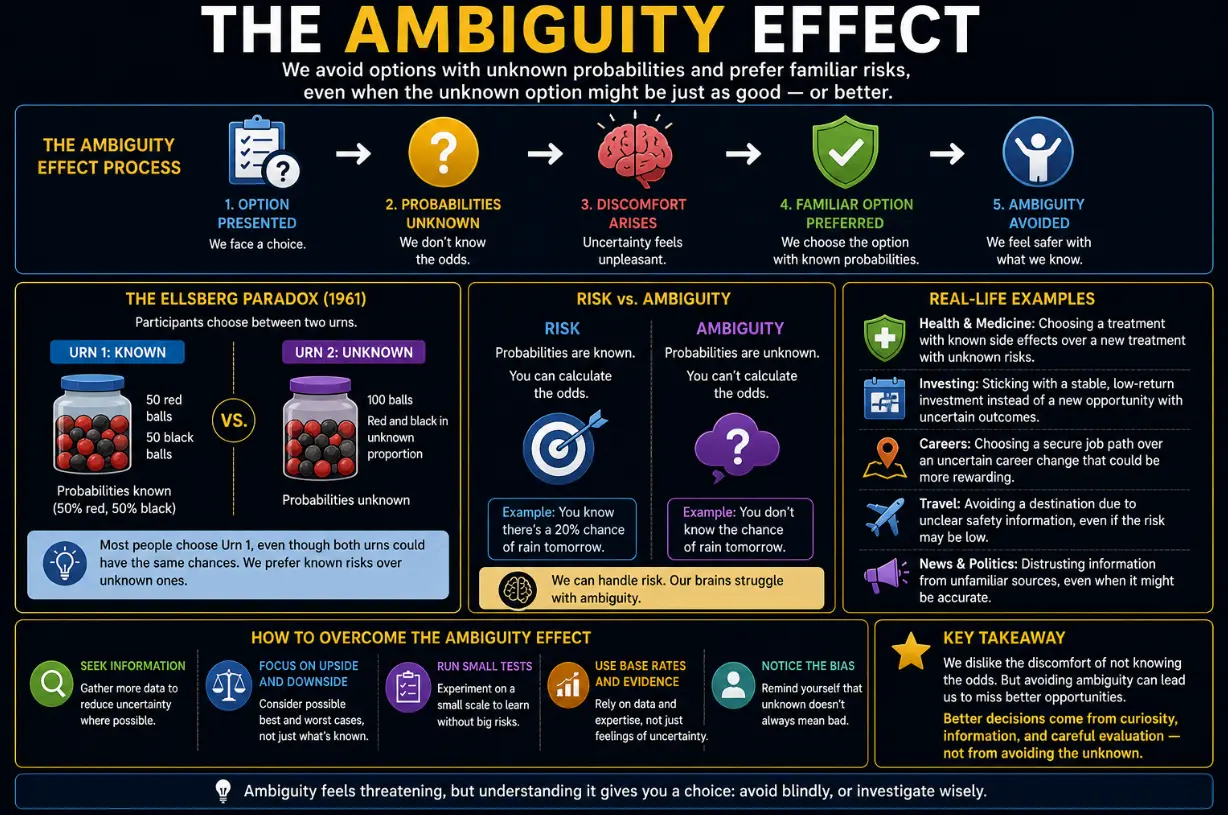
The ambiguity effect: we dislike not knowing the odds, so we avoid ambiguous options and prefer familiar risks — even when the unknown option might be just as good or better. Ambiguity feels threatening, but avoiding it can lead us to miss better opportunities.
Ambiguity Effect in Real Life — Examples
In job and career decisions, the ambiguity effect produces a strong pull toward familiar, established paths over novel ones. A job at a well-known company with a clear salary and defined role feels more attractive than an equivalent opportunity at an early-stage company with variable compensation and an uncertain trajectory — even when the expected financial and career outcome of the second is genuinely comparable or better. The unknown probabilities of the startup trigger ambiguity aversion; the known structure of the established employer does not. The result is that genuinely promising opportunities are systematically undervalued because their outcomes are harder to quantify.
In investment, the ambiguity effect produces a preference for assets and markets that investors know well over those they know less about, independent of the actual risk-return profile. Investors tend to overweight domestic stocks relative to foreign ones, familiar companies relative to unfamiliar ones, and established asset classes relative to newer ones — a pattern that cannot be fully explained by rational risk management and is consistent with ambiguity aversion. The unknown probability of an unfamiliar market triggers avoidance; the known volatility of a familiar one does not, even when the familiar market is objectively riskier.
In healthcare, patients and clinicians both show ambiguity aversion in treatment decisions. A treatment with a known success rate — even a modest one — tends to be preferred over a newer treatment with less established efficacy data, even when the available evidence on the newer treatment is promising. The ambiguity of the less-studied option triggers avoidance that is independent of the actual clinical evidence. This is not always irrational — caution about unproven treatments can be appropriate — but the ambiguity effect means the avoidance is driven by the unknown probabilities rather than by a balanced assessment of the evidence.
Ambiguity Effect in Business and Innovation
In organisational decision-making, the ambiguity effect is one of the reasons why genuinely novel ideas face a higher bar than incremental ones. A proposal with clearly quantifiable expected returns is easier to approve than one whose upside is real but harder to estimate — even when the latter has higher potential value. The ambiguity of unknown outcomes triggers caution that is calibrated to the degree of uncertainty rather than to the degree of actual risk. This means organisations systematically under-invest in high-ambiguity, high-potential opportunities relative to lower-ambiguity, lower-potential ones — a pattern that favours incremental improvement over genuine innovation.
The ambiguity effect also shapes how businesses respond to new markets, new technologies, and new competitive threats. A threat or opportunity with well-established precedent and quantifiable probabilities is more likely to prompt action than one that is genuinely novel, even when the novel threat or opportunity is more significant. The difficulty of attaching probabilities to unprecedented situations produces the same avoidance and inaction that the Ellsberg urn demonstrates in the laboratory.
Ambiguity Effect and the Status Quo
The ambiguity effect is a significant driver of status quo bias — the preference for keeping things as they are rather than changing them. The current situation, whatever its merits, has the advantage of known probabilities: you have experienced it, you understand it, and its outcomes are at least somewhat predictable. Any alternative involves some degree of ambiguity about how it will turn out. The ambiguity effect adds an extra weight against change beyond the loss aversion that drives status quo bias, making the pull toward inaction even stronger in situations where alternatives are genuinely unfamiliar.
This interaction also connects to the affect heuristic: familiar options feel safer not only because their probabilities are known but because familiarity itself generates positive affect, which reduces perceived risk. The ambiguity effect and the affect heuristic compound each other — unfamiliar options are both probabilistically unknown and affectively less comfortable, producing a double disadvantage relative to familiar alternatives.
How to Overcome the Ambiguity Effect
Distinguish between unknown and bad
The most important reframe for countering the ambiguity effect is to recognise that unknown probabilities are not the same as bad probabilities. An option with unknown odds could resolve anywhere across the range of possible outcomes, including outcomes better than the known alternative. Asking explicitly "what is the range of plausible outcomes here, and how does that range compare to the known option?" converts ambiguity from a reason to avoid into a question to investigate. The goal is not to eliminate uncertainty but to assess it rather than simply react to it.
Seek information to reduce ambiguity before deciding
Because the ambiguity effect is strongest when probabilities are completely unknown, even partial information about an ambiguous option substantially reduces avoidance. In investment, career, and business decisions, actively seeking information about the ambiguous option — talking to people with relevant experience, researching comparable situations, running small experiments — converts ambiguity into something closer to risk, which is easier to evaluate rationally. The effort to reduce ambiguity is often worthwhile precisely because most people avoid ambiguous options, meaning they are frequently undervalued relative to their actual prospects.
Evaluate options separately before comparing them
Because Fox and Tversky showed that ambiguity aversion is strongest in comparative contexts — when an ambiguous option is evaluated alongside a clear one — evaluating options separately before comparing them reduces the contrast effect that amplifies aversion. Asking "would I consider this option worthwhile if it were the only one available?" before placing it beside a known alternative gives the ambiguous option a fairer evaluation on its own terms. This connects to the corrective for the contrast effect more broadly — the context of comparison shapes evaluation in ways that independent assessment can partially correct.
The Deeper Point
The ambiguity effect reveals that what people avoid is not just bad outcomes but uncertainty itself — the absence of a clear probability estimate triggers aversion that is independent of what the unknown probability might actually be. This produces a systematic bias toward the familiar, the measurable, and the known at the expense of the novel, the uncertain, and the potentially better.
In a world where many of the most significant opportunities — new careers, new technologies, new markets — come with genuine uncertainty about their probabilities, the ambiguity effect is a bias with substantial real-world costs. Understanding it does not mean embracing uncertainty recklessly; it means developing the capacity to investigate ambiguous options rather than simply avoiding them, and to evaluate unknown probabilities on their merits rather than treating their unknownness as a reason to reject them outright.
Related biases worth exploring alongside this one: status quo bias, which is amplified by ambiguity aversion whenever alternatives to the current situation involve unknown probabilities; affect heuristic, which compounds the ambiguity effect by making unfamiliar options feel worse as well as less certain; and neglect of probability, which is in some respects the mirror image — where the ambiguity effect overweights the absence of known probabilities, neglect of probability underweights known probabilities in favour of other features of the decision.
The Cognitive Bias Spotter Test below puts that understanding to work — see if you can identify the ambiguity effect and the other nine biases when they appear in realistic scenarios.