Affect Heuristic — Meaning, Examples & How to Overcome It
Mind · Cognitive Biases · Judgment & Decision-Making family
Test yourself — can you spot the bias in each scenario? Take the Cognitive Bias Spotter Test. Jump to the test ↓
What Is the Affect Heuristic? Simple Definition
The affect heuristic is the tendency to use how you feel about something as a shortcut for judging it. If something feels good, you assume it is safe, beneficial, and worth doing. If something feels bad or frightening, you assume it is risky, harmful, and best avoided. Your emotional reaction to a person, place, technology, or idea substitutes for a careful weighing of the actual evidence — and the result is that your feelings shape your assessments of risk and benefit in ways you often do not notice.
The key feature of the affect heuristic is the inverse relationship it creates between perceived risk and perceived benefit. When you like something, you tend to judge it as both low risk and high benefit. When you dislike something, you judge it as both high risk and low benefit. In reality, risk and benefit are largely independent — a thing can be risky and beneficial, or safe and useless. The affect heuristic collapses this independence, making your overall emotional response do the work that evidence-based reasoning should be doing.
This page is part of the cognitive biases guide on our free brain training and cognitive assessment platform, alongside interactive tools covering memory, attention, reaction time, and decision-making.
Affect Heuristic Meaning & Psychology
The affect heuristic was named and systematically investigated by Paul Slovic and colleagues, who proposed that people maintain an "affect pool" — a store of positive and negative feelings associated with the objects, activities, and ideas they encounter — and that they consult this pool rapidly and automatically when making judgments. In their foundational 2002 book chapter, and in the subsequent peer-reviewed journal elaboration by Slovic, Finucane, Peters & MacGregor (2007), they demonstrated that affective responses occur quickly and without deliberate effort — note how immediately you sense the feeling associated with the word "treasure" versus the word "poison" — and that these rapid responses guide judgment and choice before slower, more deliberate analysis has a chance to operate.
A key experimental demonstration of the heuristic came from studies by Finucane and colleagues, who manipulated the affect associated with technologies — nuclear power, natural gas, food preservatives — by providing information that either increased or decreased their perceived benefit. When the perceived benefit of a technology was increased, perceived risk automatically decreased, even though no risk-relevant information had been provided. The benefit information had changed how participants felt about the technology, and that changed feeling had updated both their benefit and risk assessments simultaneously. Risk and benefit judgments were not independent — they moved together in response to affective information, not risk information.
Fast feelings, slow facts
The affect heuristic is part of a broader picture of two modes of thinking — one fast, automatic, and feeling-based; the other slow, deliberate, and evidence-based. The fast system is efficient and often reliable: feelings built up from experience can be genuinely informative, and the ability to make rapid evaluations without exhaustive analysis is frequently useful. The problem arises when the fast, feeling-based assessment overrides the slow, deliberate one in situations where the emotional signal is not a reliable guide to actual risk and benefit — where feelings are driven by familiarity, exposure, vivid imagery, or prior associations rather than by the actual properties of the thing being judged.
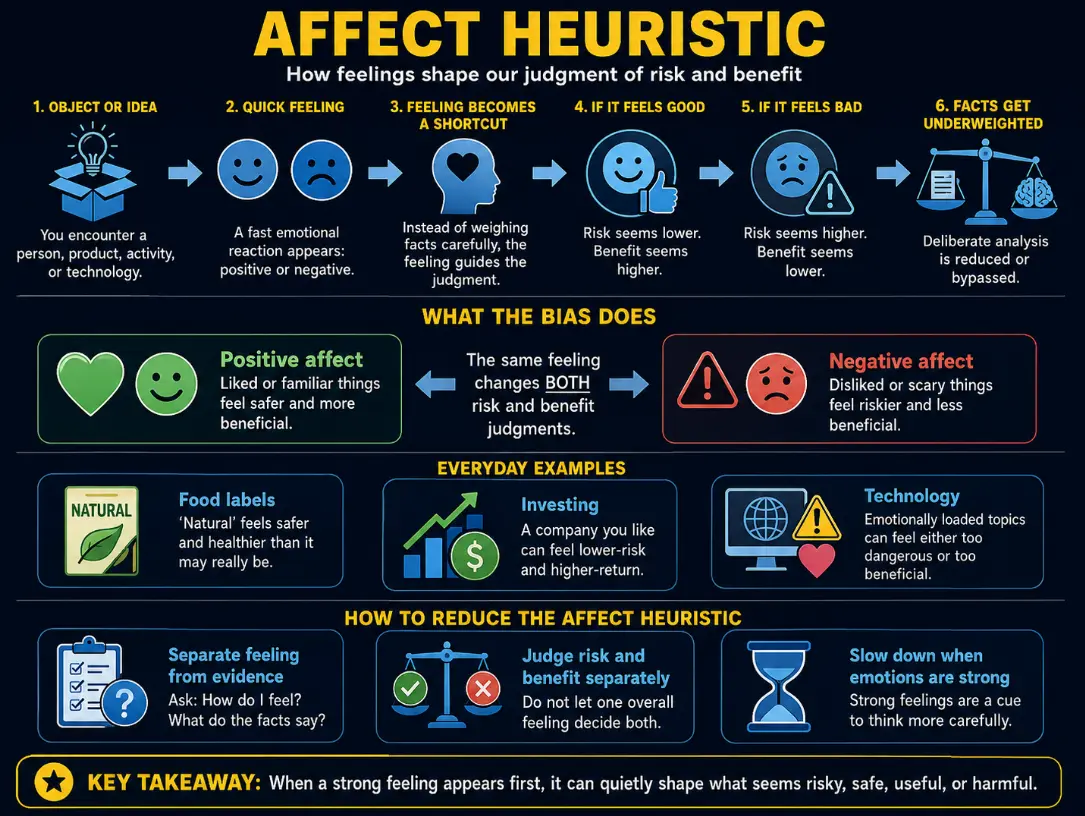
The affect heuristic: when a strong feeling appears first, it quietly shapes what seems risky, safe, useful, or harmful — the same feeling changes both risk and benefit judgments simultaneously, with deliberate analysis reduced or bypassed.
Affect Heuristic in Real Life — Examples
In risk perception, the affect heuristic produces systematic distortions between how dangerous something feels and how dangerous it actually is. Activities and technologies that trigger strong negative associations — nuclear power, flying, shark attacks — are perceived as far riskier than their actual statistical frequency warrants. Activities with positive associations — driving, eating processed food, sunbathing — are perceived as far safer than the data supports. The affect associated with vivid, dramatic, or emotionally loaded risks drives perception upward; the affect associated with familiar, mundane risks keeps perception low. This interacts directly with the availability heuristic — dramatic events are both more emotionally charged and more available in memory, compounding the distortion.
In investment and financial decisions, the affect heuristic produces a well-documented pattern in which investors rate stocks and companies they feel positively about as both higher return and lower risk than those they feel neutral or negative about — despite the fact that return and risk are generally positively correlated in financial markets. Familiar companies, well-loved brands, and firms associated with positive personal experiences are judged more favourably on both dimensions simultaneously, a pattern that cannot be explained by the underlying financial data and is consistent with affect-driven judgment.
In food and health decisions, the affect heuristic shapes evaluations of foods, supplements, and treatments. Foods labelled as "natural" trigger positive affect, which reduces perceived risk and increases perceived benefit — regardless of whether the natural label has any bearing on the actual nutritional or safety profile. "Chemical" and "artificial" labels trigger negative affect, increasing perceived risk and decreasing perceived benefit, again independent of actual properties. The feeling generated by the label does the evaluative work that the nutritional content should be doing.
Affect Heuristic and Political Judgment
In political and social judgment, the affect heuristic produces strong distortions in how people evaluate policies, candidates, and groups. When a candidate or party is liked, their policies are judged as more beneficial and their risks as smaller; when disliked, the opposite. This means that political evaluation is substantially driven by overall emotional response to a figure or party, with policy analysis following and rationalising the feeling rather than determining it. The same policy proposal receives systematically different risk and benefit assessments depending on whether it is attributed to a liked or disliked political figure — a direct demonstration of the affect heuristic operating in a high-stakes domain.
This overlaps with confirmation bias: once a positive or negative feeling about a political figure or position is established, the affect heuristic reduces perceived risk in the case of positive affect and increases it in the case of negative affect, while confirmation bias selectively processes information that supports the initial emotional assessment. The two biases reinforce each other, producing evaluations that are largely insulated from disconfirming evidence.
Affect Heuristic in Technology and Environmental Decisions
Attitudes toward new technologies are heavily shaped by the affect heuristic. Nuclear power, genetic modification, artificial intelligence, and chemical treatments all tend to trigger strong affective responses — positive or negative — that drive risk and benefit assessments more powerfully than factual information does. People who feel positively about a technology tend to see its benefits as large and its risks as manageable; those who feel negatively tend to see the reverse, often simultaneously overestimating risk and underestimating benefit in ways that are symmetrically opposite to the assessments of those with positive affect.
This creates a significant challenge for public communication about new technologies and environmental risks: presenting accurate risk and benefit data to people whose affect toward the technology is already strongly formed often fails to shift assessments, because the affect heuristic processes the new information through the existing emotional lens rather than updating independently. Information that is inconsistent with the prior feeling tends to be discounted; information consistent with it is accepted — a pattern that combines the affect heuristic with confirmation bias to produce particularly stable, evidence-resistant evaluations.
How to Overcome the Affect Heuristic
Separate your feelings from the evidence
The most direct counter to the affect heuristic is to deliberately separate the question "how do I feel about this?" from the question "what does the evidence say about the risks and benefits of this?" The two questions can have very different answers, and the affect heuristic operates by collapsing them into one. Making the distinction explicit — noting that your feeling is one input to the judgment rather than the judgment itself — creates space for deliberate analysis to operate alongside the affective response rather than being pre-empted by it.
Check risk and benefit assessments independently
Because the affect heuristic produces an inverse relationship between perceived risk and perceived benefit, a practical check is to evaluate risk and benefit separately rather than allowing an overall impression to determine both. Ask: what is the actual evidence on the risk of this, independent of how beneficial I think it is? What is the actual evidence on the benefit, independent of how risky I think it is? If your risk and benefit assessments are both high or both low — which should be uncommon for most real-world decisions — that is a signal that affect may be driving both rather than evidence. This applies directly in investment contexts, where the overconfidence effect often amplifies affect-driven assessments of favoured positions.
Slow down when feelings are strong
The affect heuristic is most powerful when emotional responses are strong and when time pressure or cognitive load prevents deliberate analysis from engaging. Deliberately slowing down decisions involving strong positive or negative feelings — allowing time for the slower, evidence-based assessment to run — reduces the degree to which the affective shortcut determines the outcome. This is particularly important in high-stakes decisions about health, finance, and technology, where the gap between how something feels and what the evidence shows can be substantial and consequential.
The Deeper Point
The affect heuristic reveals that emotional responses are not merely accompaniments to judgment — they are active inputs that shape what people believe about the world. How risky something seems, how beneficial, how trustworthy, how worth pursuing — all of these assessments are influenced by the rapid, automatic feelings that objects and ideas generate, often before deliberate reasoning has had a chance to engage. This is not always a problem: affect built from genuine experience can be a reliable guide. The problem arises when affect is generated by familiarity, imagery, labelling, or prior association rather than by actual properties — and when that affect-driven judgment is mistaken for an evidence-based one.
Understanding the affect heuristic does not mean distrusting all emotional responses or insisting on purely analytical decision-making. It means recognising that strong feelings about a topic are a cue to examine whether those feelings are tracking actual evidence or simply reflecting prior associations — and being willing to update the assessment when the evidence diverges from the feeling.
Related biases worth exploring alongside this one: availability heuristic, which similarly distorts risk perception by substituting memory salience for statistical frequency; confirmation bias, which selectively processes information in ways that preserve the affect-driven initial assessment; and framing effect, which shapes the affective response to information — and therefore the affect heuristic's downstream influence on judgment — through the way information is presented rather than through its content.
The Cognitive Bias Spotter Test below puts that understanding to work — see if you can identify the affect heuristic and the other nine biases when they appear in realistic scenarios.