Neglect of Probability — Meaning, Examples & How to Overcome It
Mind · Cognitive Biases · Probability & Randomness family
Test yourself — can you spot the bias in each scenario? Take the Cognitive Bias Spotter Test. Jump to the test ↓
What Is Neglect of Probability? Simple Definition
Neglect of probability is the tendency to disregard the actual likelihood of an outcome when making decisions under uncertainty — focusing instead on the vividness, severity, or emotional impact of the outcome itself. When the possibility of something frightening or exciting is presented, the mind responds to what could happen rather than to how likely it is to happen.
Small risks are either ignored entirely or massively overrated, with little meaningful difference in the emotional response to a one-in-a-thousand chance and a one-in-a-million chance. The continuum of probability between these extremes collapses: once a risk feels real enough to trigger an emotional response, its exact probability becomes almost irrelevant to how much it is feared or desired.
This page is part of the cognitive biases guide on our cognitive assessment and brain training site, alongside interactive tools covering memory, attention, reaction time, and decision-making.
Neglect of Probability Meaning & Psychology
The term probability neglect was coined by legal scholar and behavioural economist Cass Sunstein, who demonstrated through experimental and real-world evidence that when strong emotions are triggered by a risk, people focus overwhelmingly on the severity of the potential outcome rather than on its probability. Sunstein (2003) showed this pattern most clearly in the context of terrorism: the fear generated by a low-probability catastrophic threat consistently exceeded the expected harm calculated by multiplying the probability by the severity — because the probability was being discounted or ignored while the severity was fully weighted.
The psychological mechanism is the affect heuristic: the emotional response to an outcome — fear, disgust, excitement, hope — drives the assessment of risk independently of the probability. Once an emotional response has been triggered, the question "how likely is this?" is answered by the emotion, not by the statistics. A vivid, imaginable worst case produces strong fear whether its probability is 1% or 0.001%, and the difference between those probabilities barely registers in the emotional calculus.
How it differs from related biases
Neglect of probability is distinct from the gambler's fallacy, which involves incorrectly using probability. Neglect of probability involves not using it at all — the actual odds are available but are simply not weighted appropriately against the emotional salience of the outcome. It is also related to but distinct from the availability heuristic, which distorts probability estimates based on how easily examples come to mind. Neglect of probability operates even when the probability is explicitly stated: people are told the odds and still respond primarily to the outcome.
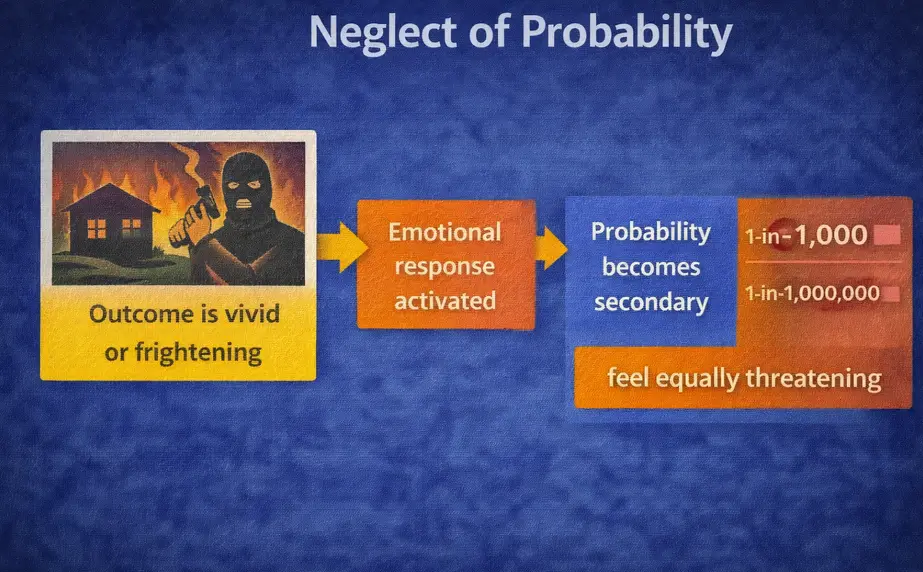
Neglect of probability: when an outcome is vivid or frightening, the emotional response takes over, probability becomes secondary, and a 1-in-1,000 chance feels no less threatening than a 1-in-1,000,000 chance.
Neglect of Probability in Real Life — Examples
Neglect of probability is one of the most pervasive distortions in everyday risk perception. People who fear flying but drive without anxiety are implicitly treating the vividness and catastrophic nature of a plane crash as more relevant than the actual comparative statistics, which consistently show driving to be the more dangerous activity per mile travelled. The fear is not proportional to the risk — it is proportional to the imaginability and emotional weight of the worst case.
Lottery tickets are the mirror image of this: people buy them not because the expected value is favourable — it almost never is — but because the vividness of the jackpot outcome overwhelms the negligible probability. The possibility of winning, however remote, produces a genuine emotional response that the actual probability — typically one in several million — cannot counteract. The outcome is imagined; the odds are not.
Shark attacks, rare diseases that receive significant media coverage, and terrorist incidents all produce fear responses that substantially exceed what their actual statistical frequency would justify. Meanwhile, statistically far larger risks — cardiovascular disease, road accidents, falls — receive far less attention and fear, because they lack the vivid, dramatic, single-event quality that activates probability neglect.
Neglect of Probability in Health Decisions
Medical decision-making is significantly distorted by neglect of probability. Patients who are told about potential side effects of a treatment often respond primarily to the severity of those side effects rather than to their stated probability. A side effect described as "rare but serious" triggers more concern than one described as "common but mild," even when the expected harm — probability multiplied by severity — is greater for the common mild side effect. The word "serious" activates the affect heuristic; the word "rare" does not adequately counteract it.
This has direct consequences for treatment decisions. Patients may refuse beneficial treatments because of vivid but very low-probability risks, while accepting riskier alternatives whose risks are less salient. It also shapes vaccination decisions: the possibility of a rare adverse reaction to a vaccine is given disproportionate weight relative to the much higher probability of harm from the disease the vaccine prevents, because the adverse reaction — if it occurs — is directly attributable to the vaccine in a way that feels different from a naturally occurring disease.
Neglect of Probability in Policy and Law
At the policy level, neglect of probability shapes regulatory responses to risk in ways that are frequently disproportionate to actual expected harm. Sunstein documented how the US government enacted major environmental and safety legislation in response to highly publicised low-probability risks — abandoned hazardous waste sites, pesticide residues, anthrax — without systematic analysis of the actual probability that harm would occur. The emotional salience of the worst-case scenario drove the regulatory response regardless of whether the probability justified it.
This creates a systematic misallocation of regulatory resources: high-salience low-probability risks attract large expenditures and tight regulation, while high-probability moderate risks receive less attention because they lack the catastrophic imagery that activates probability neglect. The result is a risk management landscape shaped more by emotional salience than by expected harm.
Neglect of Probability in Investing and Finance
In financial markets, neglect of probability distorts both fear and greed. On the fear side, investors give excessive weight to the possibility of dramatic crashes — scenarios that are vivid and frightening — relative to their actual probability, leading to excessive caution and missed opportunities during periods when low-probability tail risks dominate the narrative. On the greed side, the same mechanism leads investors to overweight the possibility of spectacular gains in speculative assets, driven by the vividness of the potential upside rather than by a realistic assessment of the odds.
This connects directly to the availability heuristic: recent dramatic market events — a crash, a bubble — make catastrophic outcomes more easily imagined and therefore more heavily weighted in risk assessment, regardless of whether the underlying probability has actually changed. Neglect of probability and the availability heuristic compound each other to produce systematic over-reaction to salient recent events.
How to Avoid and Overcome Neglect of Probability
Always state probabilities explicitly and compare them
The most direct counter to neglect of probability is to make the actual odds explicit and to compare them to reference probabilities that have concrete meaning. Saying that a risk has a one-in-a-million annual probability means little in isolation; saying that it is ten times less likely than being struck by lightning, or a hundred times less likely than dying in a road accident, gives the probability genuine comparative weight. Concrete comparisons counteract the tendency to respond to the vividness of the outcome rather than the magnitude of the probability.
Separate the outcome assessment from the probability assessment
When evaluating any risk, deliberately separating the question "how bad would this be?" from the question "how likely is this?" forces both components into the analysis rather than allowing the emotional response to the outcome to absorb the probability assessment. Writing down an explicit probability estimate before evaluating the severity of the outcome — or vice versa — reduces the degree to which one contaminates the other.
Focus on expected value, not worst-case scenarios
Rational risk assessment requires weighting outcomes by their probability to produce an expected value. A 0.001% chance of losing £10,000 has the same expected value as a 100% chance of losing £10 — but the emotional responses to these two framings are completely different. Training yourself to calculate and focus on expected value — rather than on the vivid best or worst case — directly counters the mechanism that drives probability neglect.
Be especially sceptical of emotionally charged risk framings
The emotional charge attached to a risk presentation is itself a signal that neglect of probability may be operating. When a risk is described in vivid, concrete terms — with named victims, graphic descriptions, or worst-case scenarios — this is precisely the condition under which probability is most likely to be underweighted. Treating the emotional intensity of a risk framing as a reason for more careful probability assessment, rather than less, directly inverts the direction of the bias.
The Deeper Point
Neglect of probability reflects a deep feature of how the emotional system processes risk. The emotional system evolved to respond to threats as present or absent — something is dangerous or it is not — rather than to gradations of probability. A predator that might be there is treated with the same urgency as a predator that definitely is there, because the cost of under-reacting to a real threat is much higher than the cost of over-reacting to a false one. This asymmetry made sense in an environment where threats were immediate and physical. In a modern environment where the relevant risks are statistical, distributed, and long-term, the same mechanism produces systematic distortions.
The result is a risk landscape that is felt rather than calculated — shaped by vividness, narrative, and emotional resonance rather than by expected harm. Resources, attention, and fear are allocated to the risks that are most imaginable rather than to those that are most probable. Correcting for this requires not just knowing the odds, but actively insisting that the odds matter even when the emotional response says otherwise.
Related biases that interact closely with this one: the availability heuristic, which inflates the perceived probability of easily imagined events; the gambler's fallacy, which misuses probability rather than neglecting it; and confirmation bias, which selectively attends to evidence that supports already-held fears or hopes about a risk.
The Cognitive Bias Spotter Test below puts that understanding to work — see if you can identify neglect of probability and the other nine biases when they appear in realistic scenarios.