IKEA Effect — Meaning, Examples & How to Overcome It
Mind · Cognitive Biases · Judgment & Decision-Making family
Test yourself — can you spot the bias in each scenario? Take the Cognitive Bias Spotter Test. Jump to the test ↓
What Is the IKEA Effect? Simple Definition
The IKEA effect is the tendency to place a disproportionately high value on things you helped create, simply because you put effort into making them. A flat-pack bookcase you assembled yourself feels more valuable than an identical pre-assembled one. A business plan you developed feels more promising than an equivalent one presented to you by someone else. A dish you cooked from scratch tastes better than the same dish prepared by another person. The labour invested in something inflates its perceived worth — not because the labour improves the object, but because the effort creates psychological ownership and a sense of competence that attaches to the finished product.
The effect is named after IKEA, the Swedish furniture retailer whose business model is built around customer assembly — a model that, it turns out, is not merely a cost-saving measure but a mechanism for increasing product attachment and perceived value.
This page is part of the cognitive biases guide on our free brain training and cognitive testing platform, alongside interactive tools covering memory, attention, reaction time, and decision-making.
IKEA Effect Meaning & Psychology
The IKEA effect was named and formally investigated by Norton, Mochon & Ariely (2012), who conducted four studies in which participants assembled IKEA storage boxes, folded origami figures, and built Lego sets. Across all studies, participants who assembled products themselves valued their creations significantly more highly than participants who evaluated identical pre-assembled products made by others. Critically, the self-assemblers rated their amateurish creations as roughly comparable in value to expert-made versions of the same objects — a striking inflation of perceived quality that could not be justified by the objective standard of the work produced.
The study also identified an important boundary condition: the IKEA effect depends on successful completion. When participants built products and then had them immediately dismantled, or when they failed to complete the assembly, the effect disappeared. The valuation inflation was tied specifically to the experience of having successfully finished something — not to the effort expended, the time invested, or the difficulty of the task. It is completion, not labour alone, that generates the attachment.
The underlying mechanism was examined by Mochon, Norton & Ariely (2012), who showed that the IKEA effect is driven by the feelings of competence associated with successful self-creation. Creating something that works fulfils a psychological need to demonstrate competence — to oneself and to others — and that sense of demonstrated competence attaches to the product, inflating its perceived value. When people's sense of competence was threatened, they showed greater motivation to self-create; when it was affirmed, the IKEA effect was reduced. The product becomes a token of the self's capacity, and this makes it more valuable than its material properties alone would warrant.
Effort justification as a related mechanism
A complementary explanation draws on effort justification — the cognitive dissonance-based tendency to rate outcomes as more valuable when they required greater effort to achieve. If you worked hard to make something, rating it as mediocre creates cognitive inconsistency: why would you have worked so hard for something not worth having? The resolution is to rate the outcome upward, bringing the evaluation into alignment with the effort invested. This mechanism is related to but distinct from the competence account — effort justification operates through dissonance reduction, while the competence account operates through self-signal enhancement. Both produce the same outcome: inflated valuation of self-made products.
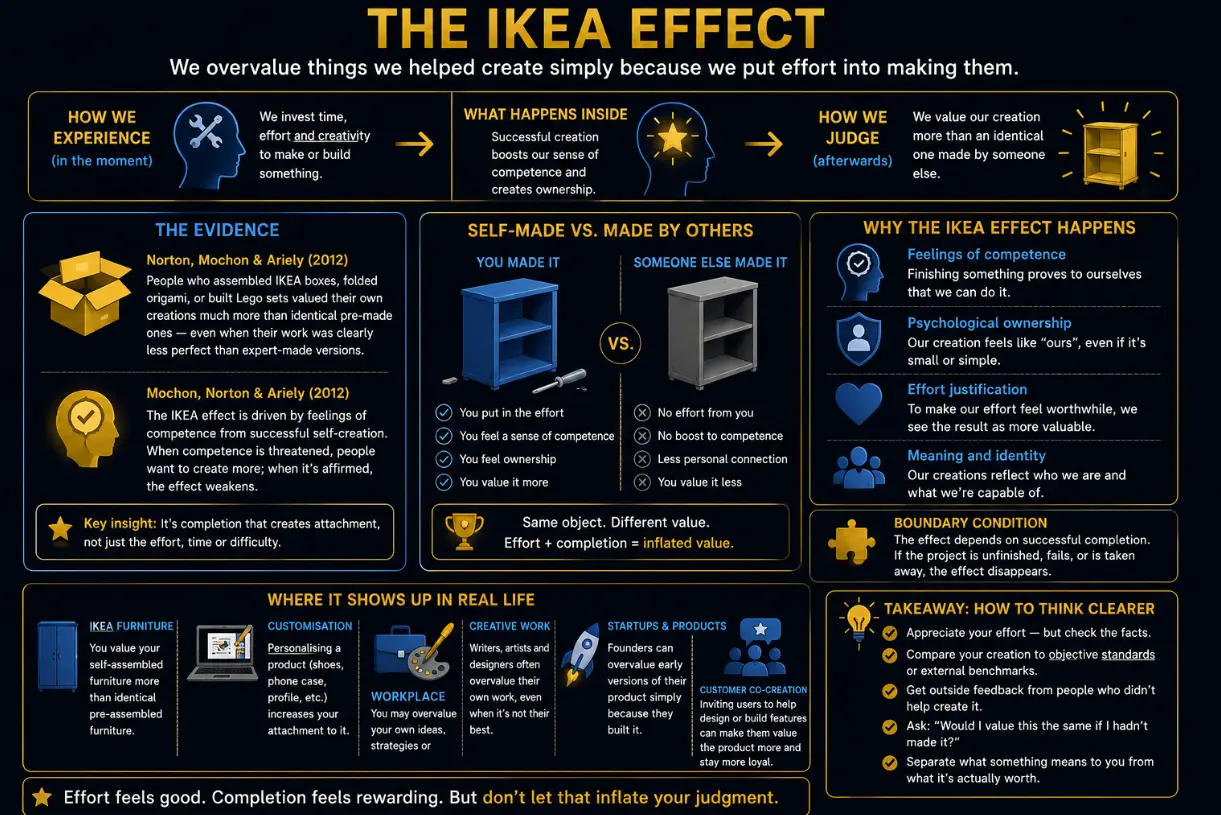
The IKEA effect: effort plus successful completion inflates perceived value. The same object is valued more when you built it yourself — driven by feelings of competence, psychological ownership, and effort justification. The effect disappears if the task is unfinished or taken away.
IKEA Effect in Real Life — Examples
In product design and retail, the IKEA effect explains why participating in the creation or customisation of a product increases attachment to it and willingness to pay. Consumers who configure their own product — choosing colours, features, and options — value the result more highly than consumers who receive an identical product pre-configured. This is why configuration tools are common across product categories from cars to clothing to software: the participation effect increases perceived value at little or no additional cost to the producer.Partial assembly also reduces return rates, because the effort invested in putting something together creates a sense of ownership before the purchase is even finalised — an interaction with the endowment effect that makes giving the item back feel like a loss.
In the workplace, the IKEA effect produces systematic overvaluation of one's own ideas, strategies, and plans relative to those proposed by others. A manager who develops a strategy feels more confident in it, defends it more vigorously, and abandons it less readily than the evidence warrants — not because the strategy is objectively superior, but because the effort invested in developing it has inflated its perceived quality. This is a significant source of organisational inertia: teams and leaders persist with self-developed approaches long past the point where external evaluation would suggest revision or replacement.
In creative work — writing, design, software development, research — the IKEA effect produces the well-known difficulty of evaluating one's own work objectively. The investment of effort, attention, and identity in a creative project makes it hard to see its flaws with the same clarity that an outside reader or reviewer brings. This is not merely vanity; it is a systematic cognitive process in which the effort invested in creation inflates the perceived quality of the result. The standard advice to leave time between writing and editing — to allow the author to read their own work as a reader would — is a practical correction for the IKEA effect in creative contexts.
IKEA Effect in Business and Product Development
In startup and product development contexts, the IKEA effect contributes to a common pattern sometimes called the build trap — the tendency for founders and product teams to become so attached to what they have built that they persist with it despite market signals suggesting a different direction. In plain terms: the team worked hard to create something, so they value it more than their customers do, and that valuation gap makes it psychologically difficult to cut, change, or replace — even when the evidence clearly supports doing so.
Customer co-creation — involving customers in the design, development, or customisation of products — is a recognised commercial application of the IKEA effect. Customers who contribute ideas, vote on features, or participate in beta testing develop attachment to the resulting product that exceeds what they would feel toward an identical product they had no role in creating. This attachment increases loyalty, makes customers less likely to leave or stop using the product, and increases willingness to pay — outcomes that flow directly from the same psychological mechanism that makes flat-pack furniture feel more precious than it is.
How to Overcome the IKEA Effect
Seek external evaluation before acting on your valuation
The most direct counter to the IKEA effect in professional and creative contexts is to actively seek external evaluation before making decisions based on your own assessment of self-created work. The bias operates by inflating perceived quality relative to what a disinterested evaluator would assign; external feedback provides the disinterested perspective that your own assessment lacks. The more effortful or personally significant the creation, the more important external evaluation becomes — and the more strongly the IKEA effect will resist the corrective information it provides.
Apply the same evaluative criteria to self-made and externally made options
When comparing a self-developed option with an externally proposed one, explicitly check whether you are applying the same evaluative criteria to both. The IKEA effect produces asymmetric scrutiny: self-made options receive charitable evaluation while external options are held to a higher standard. Listing the criteria explicitly and applying them identically to both reduces the asymmetry. This connects to the corrective for confirmation bias — the same selective attention that supports confirmation bias also supports the IKEA effect's inflation of self-made options.
Recognise completion as the trigger, not effort alone
Because the IKEA effect requires successful completion, awareness of the mechanism suggests a practical point of intervention: the attachment to a self-made product or plan intensifies at the moment of completion. Decisions about whether to proceed with, revise, or abandon a self-developed approach are therefore better made before completion than after — when the competence signal and ownership attachment are still forming rather than fully established. This is one reason why getting external feedback early and often — before a project reaches its final form — is more resistant to the IKEA effect than waiting until something is fully finished before showing it to anyone. Once the sense of completion is established, the attachment is too.
The Deeper Point
The IKEA effect reveals that the value we assign to things is not determined solely by their intrinsic properties — it is also shaped by the history of our relationship to them, including the effort we invested in bringing them into existence. Labour creates love. This is not irrational in all contexts: genuine investment in creating something often does produce learning, skill, and an understanding of the object that a passive recipient lacks. The problem is that the valuation inflation produced by effort exceeds the actual improvement in quality that the effort generates — people rate their origami figures as comparable to expert work, which they are not.
Understanding the IKEA effect does not mean dismissing the value of effort or the satisfaction of creation. It means developing the habit of checking whether your assessment of self-made work is calibrated against external standards or inflated by the effort invested in making it — and seeking the external perspective that your own assessment systematically underweights.
Related biases worth exploring alongside this one: endowment effect, which similarly inflates the value of what one possesses through the mechanism of ownership; sunk cost fallacy, which makes past investment in a project a reason to continue with it regardless of its future prospects; and overconfidence effect, which produces inflated assessment of one's own abilities and judgments — the broader pattern of which the IKEA effect's inflation of self-made products is one specific instance.
The Cognitive Bias Spotter Test below puts that understanding to work — see if you can identify the IKEA effect and the other nine biases when they appear in realistic scenarios.